

State Council Endorses Private Healthcare and Health Tourism While Vowing to Crack Down on Malpractices
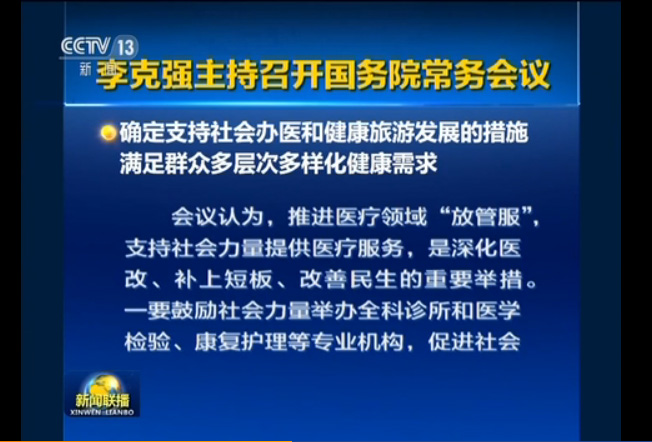
On May 3, Premier Li Keqiang presided over an executive meeting of the State Council, at which measures were proposed to support privately run medical institutions and health tourism, so as to meet the public’s multi-level and diversified health needs.
Encourage Specific Deployments for Socially-Run Medical Institutions
The meeting held that addressing the multi-level and diversified health needs of the public, advancing administrative streamlining, delegating powers, strengthening regulation, and optimizing services in the medical sector, as well as vigorously supporting social forces in providing medical services, are important measures to deepen healthcare reform, address shortcomings, and improve people’s livelihoods. The meeting decided on the following: First, encourage social forces to establish general practice clinics and independently set up specialized institutions such as medical laboratories and rehabilitation and nursing facilities; promote cross-provincial and cross-municipal chain operations by capable privately run traditional Chinese medicine (TCM) clinics and outpatient departments; and attract foreign investors to engage in joint ventures and cooperation to establish high-quality medical institutions.
Second, implement a one-stop acceptance system, parallel approval, and online approval for private medical institutions. Chain medical institutions may have their industrial and commercial registration handled uniformly by the headquarters. Private medical institutions that meet planning conditions and access qualifications shall not be restricted under any pretext, and the establishment of individual clinics shall not be subject to planning layout restrictions. Implement regional registration for physicians to promote orderly mobility and multi-site practice.
Relevant officials from the National Health and Family Planning Commission stated that promoting privately operated medical institutions is one of the key tasks in the current round of healthcare system reform. Advancing such initiatives helps provide multi-tiered and diversified healthcare services, fosters a competitive and mutually beneficial landscape for medical practice, further optimizes the structure of healthcare supply, and meets the growing health needs of the public.
In recent years, privately run healthcare in China has shown an accelerated development trend. According to statistics, by 2015, the number of private hospitals nationwide had reached 12,500, an increase of 5,478 from 2010. The number of outpatient and inpatient visits at non-public medical institutions reached 1.68 billion, accounting for 22% of the total national visits.
While the number of private medical institutions in China is growing rapidly, they face challenges such as low diagnosis and treatment ratios and weak medical service capabilities. The entry of social capital into the healthcare sector is hindered by shortcomings including lagging detailed standards for relevant policies and regulations, talent shortages, and financing difficulties. Industry insiders believe that the disciplinary and age structures of medical staff in private medical institutions are currently unreasonable, resulting in insufficient development momentum and market competitiveness.
Zhao Kun, a researcher at the Health Development Research Center of the National Health and Family Planning Commission, believes that the relevant policies introduced by the State Council’s executive meeting have provided a “prescription” for addressing specific issues related to privately funded medical institutions. Implementing supportive measures—such as one-stop acceptance and parallel approval processes for establishing private medical facilities, as well as regional registration and multi-site practice arrangements for physicians—will help foster the sound development of privately funded healthcare and continuously optimize the operating environment for private medical institutions. “Going forward, China should further coordinate reforms in supporting mechanisms, including performance evaluation and career development pathways for medical personnel, to effectively ‘provide a safety net’ that encourages healthcare professionals to move into private medical institutions,” said Zhao Kun.
Standardizing Private Medical Practice Requires Cracking Down on Illegal and Non-compliant Activities
In recent years, privately operated healthcare institutions in China have developed rapidly, yet certain irregular medical practices have emerged. It is essential to focus on improving the quality of services provided by these institutions and to explore inclusive and effective prudential regulatory approaches. To further standardize the operations of privately operated healthcare providers, this meeting has made specific arrangements, calling for stringent crackdowns on illegal and non-compliant activities such as renting or lending practice licenses to operate, contracting out clinical departments, disseminating false advertising, and engaging in unlicensed medical practice.
Promoting the Health Tourism Market
In recent years, the health tourism market has experienced rapid development in first- and second-tier cities. This conference proposed promoting the deep integration of health, tourism, and elderly care, guiding social capital investment, and encouraging the development of high-end medical services, traditional Chinese medicine (TCM) healthcare, rehabilitation and convalescence, and leisure wellness products, so as to accelerate the cultivation and growth of the health tourism market.
Tourism is more than just sightseeing. In the face of a series of problems brought about by modern urban life, such as environmental pollution, high stress, and sub-optimal health, people are increasingly pursuing healthy lifestyles. Tourism has now become an important way for people to relax and unwind, with more individuals seeking closer connections to nature, finding solace in landscapes, and cultivating their mental well-being. The deep integration of health, tourism, and elderly care is closely related to people's quality of life and can meet the growing multi-level and diversified health needs of the public.