

Smart Healthcare: The Inevitable Trend to Address Imbalanced Medical Resource Allocation
By Wei Qiang
Since the dawn of humanity, health has remained an eternal pursuit. In our quest for well-being and our struggle against disease, we have accumulated extensive experience, endured numerous lessons, and developed an increasingly sophisticated social healthcare system. Of course, this notion of “increasingly sophisticated” is relative to the past; in reality, significant challenges persist. Healthcare serves as a vital social safeguard for individual health. Its protective role essentially encompasses two aspects: preventive care (treating potential diseases before they manifest) and therapeutic care (treating established diseases).
Everyone wishes to stay promptly informed about their health status, hoping to address ailments before they manifest. However, the reality is often that diseases are already advanced by the time they are detected, making them difficult or even impossible to treat. Since healthcare reform was placed on the agenda in the early days of China’s Reform and Opening-up, through the 1984 initial healthcare reform guidance report characterized by “policy support without financial funding,” to the market-oriented healthcare reforms of 1992, and further to the explicit government-led efforts since 2008 to improve the medical insurance system, the difficulties and high costs of accessing medical care have become the primary impression of China’s healthcare landscape.
In early 2017, the issuance of the “National 17 Articles on Pharmaceutical Industry,” which stipulated measures such as the two-invoice system for drug procurement and distribution and the prohibition of medical representatives from engaging in sales activities, together with the recently announced policy mandating the complete elimination of drug markups in all public hospitals, have become focal points of public attention. With sustained economic development, reforms of the healthcare system have never ceased, and the demand for a favorable medical environment has become increasingly urgent.
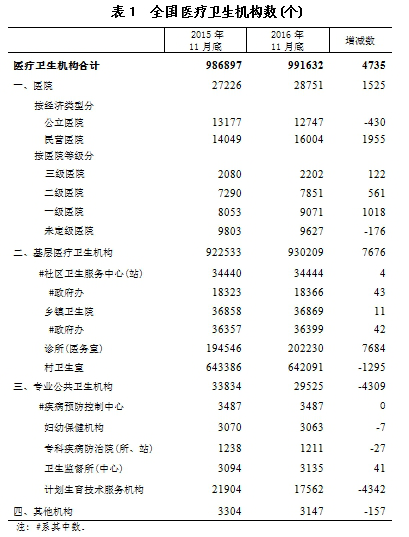
According to data reports from the Statistical Center of the National Health and Family Planning Commission,As of the end of November 2016, the number of medical and health institutions in China reached 992,000, including: 29,000 hospitals, 930,000 primary medical and health institutions, 30,000 specialized public health institutions, and 3,000 other institutions. Compared with the end of November 2015, the total number of medical institutions in China increased by 4,735.。
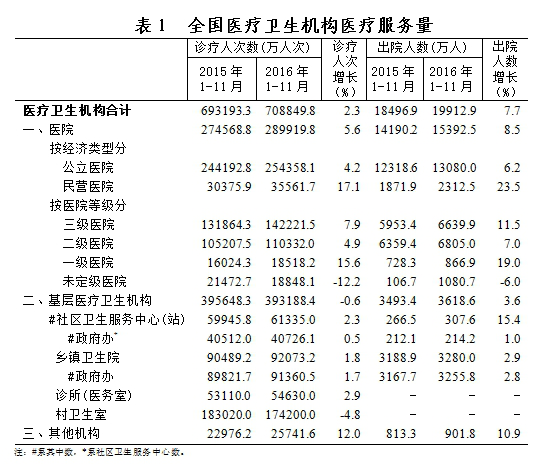
From January to November 2016, the number of medical consultations in China reached7.09 billion visits, a year-on-year increase of 2.3%. From January to November 2016, the number of discharges from medical institutions across ChinaNearly 200 million people, a year-on-year increase of 7.7%. According to data from the Ministry of Finance, China's national fiscal expenditure on healthcare in 2016 was1.32 trillion yuan, representing a 10% year-on-year increase and accounting for approximately 7% of total fiscal expenditure, while the share of out-of-pocket health spending in total health expenditure remained below 30%.
These data reflect the progress of China’s healthcare system. However, compared with the persistent challenges of difficult and costly access to medical care, such progress remains clearly insufficient. Currently, China’s healthcare sector continues to face a shortage of medical resources and their uneven distribution.
What is the reason?
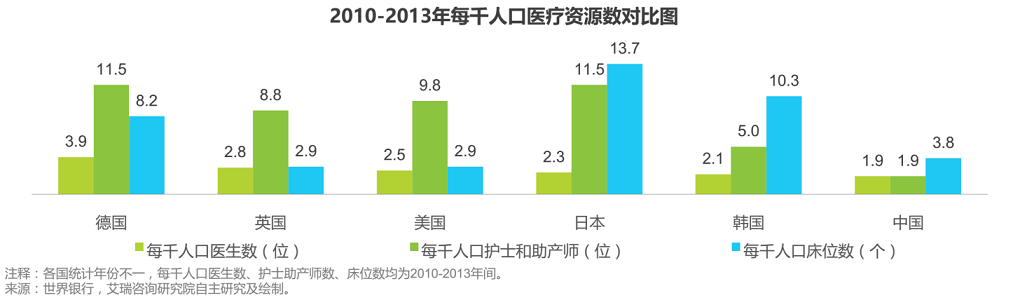
According to iResearch statistics, from 2010 to 2013, China had 1.9 physicians and 1.9 nurses per 1,000 people, resulting in a physician-to-nurse ratio of 1:1, along with 3.8 hospital beds per 1,000 people. Compared with other major countries worldwide during the same period, the number of physicians and hospital beds per 1,000 people was similar, whereas there was a substantial disparity in the number of nurses per 1,000 people, indicating a severe shortage of nurses in China.
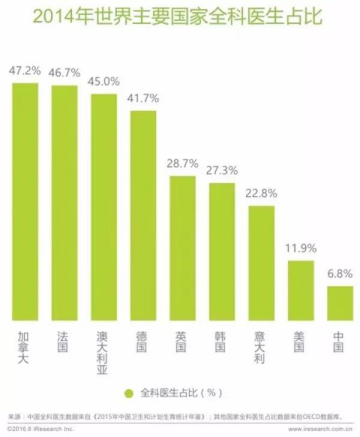
Furthermore, the distribution of physicians across different departments in China is uneven, with a severe shortage of licensed practitioners in certain specialties. According to the 2015 China Health Statistics, the most urgently needed in primary healthcare areGeneral practitioners accounted for 6.8% of the total number of physicians, representing a substantial gap compared to major countries worldwide during the same period.. Furthermore, physicians in departments such as pediatrics and emergency medicine are also in short supply, resulting in a heavy clinical workload for doctors.
In addition to the uneven distribution of physicians across specialties, a shortage of nurses, and a severely imbalanced doctor-to-patient ratio, resource allocation among medical institutions of different tiers in China is also highly unequal. Large hospitals continue to expand, while primary healthcare resources remain underutilized.
According to the 2016 China Health Statistics data on medical services, large hospitals, which are fewer in number, account for the largest proportion of patient visits, while primary healthcare institutions, which are more numerous, account for a smaller proportion. Regardless of the severity of their conditions, patients flock exclusively to large hospitals, exacerbating the already strained ratio of medical resources to patients. The direct consequence of this trend is the difficulty in accessing medical care.
Since the marketization of healthcare, although state funding has increased year by year, the survival and development of hospitals and physicians have primarily relied on their own efforts. Consequently, economic performance has become the primary metric for evaluating hospitals, departments, and physicians. The main avenues for generating such economic benefits for hospitals and physicians are through medical examinations and pharmaceutical sales.
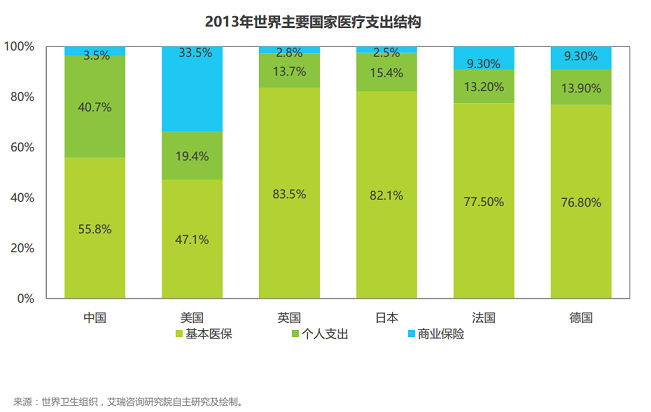
One adverse consequence is medical overutilization, characterized by excessive diagnostic testing and overprescription of medications, which ultimately drives up healthcare costs. Although health insurance coverage continues to expand, data from the World Health Organization in 2013 indicate that among major countries worldwide, China had a remarkably high proportion of out-of-pocket healthcare expenditures (which has since decreased to below 30%). This remains one of the primary factors contributing to the high cost of medical care.
System Exploration
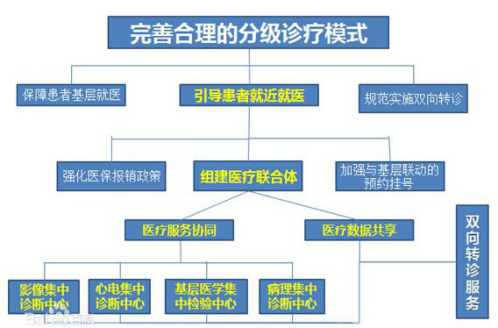
To address the difficulty of accessing medical care, the state has made significant institutional efforts, such as implementing a tiered diagnosis and treatment system. Under this system, diseases are classified based on their severity, urgency, and complexity of treatment. Medical institutions at different tiers assume responsibility for diagnosing and treating different conditions or stages of disease, thereby achieving initial consultations at primary care facilities and enabling two-way referrals between higher- and lower-level medical institutions.
Currently, the implementation of this system has been suboptimal. The primary reason is the severe imbalance in the allocation of medical resources across healthcare institutions at all levels. A shortage of professional primary care personnel, such as general practitioners, coupled with the low quality of primary healthcare services, has led to a lack of patient trust in primary care institutions.Therefore, enhancing the service capacity of primary healthcare institutions is key to alleviating this issue.
To address the issue of high medical costs, the state has introduced numerous policies and regulations. Examples include the elimination of drug markups, the two-invoice system for drug procurement and distribution, the prohibition of pharmaceutical representatives from engaging in sales activities, and universal health insurance coverage.
These systems have made efforts in areas such as pharmaceutical processes and subsidies for medical expenses, but so far, they have not fundamentally alleviated this contradiction. Failure to address the economic support issues for the survival and development of hospitals and healthcare practitioners will force them to seek solutions outside the system, such as excessive medical services including unnecessary examinations, overprescribing, and providing services beyond the scope of medical insurance coverage.
Therefore,Increase the regular income of medical practitioners, steer them away from generating revenue through equipment consumables and drug sales, and enable physicians to return to the essence of providing services based on their medical expertise., is the key to alleviating this issue.
Technological Practice
In response to these challenges, various sectors of society have undertaken extensive exploratory practices, with telemedicine emerging as a particularly prominent model in recent years. Notable emerging telemedicine platforms include Chunyu Yisheng (Spring Rain Doctor), Haodafu (Good Doctor), DXY (Dingxiang Yuan), Lanjing Yisheng (Blue Whale Doctor), and Guahaowang (Registration Network).
These telemedicine models primarily serve functions such as medical information inquiry, online appointment registration, and providing a platform for online doctor-patient communication. From certain perspectives, this type of medical service model offers users benefits including convenient preliminary consultations, efficient access to high-quality medical services, and streamlined communication between doctors and patients during the diagnosis and treatment process.
However, fundamentally, it has not resolved the issues of unequal distribution of medical resources, the weakening function of primary healthcare institutions, and the long-term sustainability and development benefits for medical institutions and physicians.From a global perspective, such models have even exacerbated the imbalance in healthcare resources, placing a greater medical burden on institutions and individuals with high-quality healthcare resources, while further weakening primary healthcare institutions and individuals with insufficient resource capacity.。
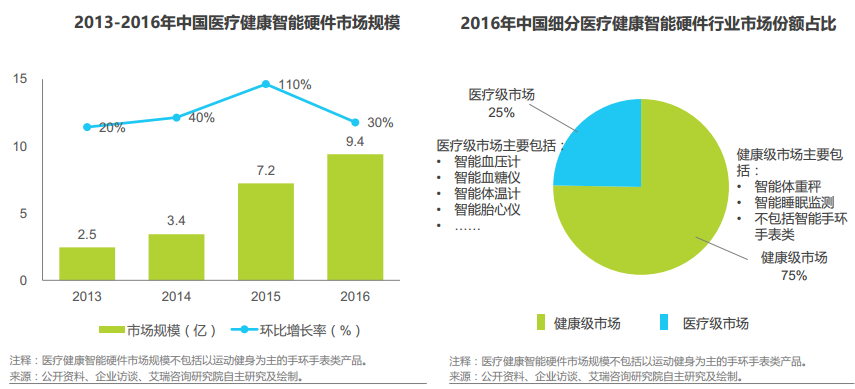
Furthermore, according to data from iResearch’s 2016 Report on China’s Intelligent Healthcare Hardware Industry, the market for health- and medical-related intelligent hardware has grown rapidly in recent years, including products such as smart scales, smart blood pressure monitors, and smart thermometers.
Most smart hardware devices in this category are developing independently, lacking a unified data system and a clear user value framework. Even when data is stored in the cloud, it is often merely presented in a basic format, with information across different systems remaining largely fragmented into isolated silos. This makes it difficult to establish a comprehensive data modeling system that covers diverse age groups and physiological indicators.From the overarching perspective of the entire healthcare system, data that is not subject to unified governance struggles to provide sustained, effective, and deeper value support.
The Arrival of Smart Healthcare
Telemedicine represents an advanced model, and the pace of exploration will not cease; existing telemedicine models will continue to be tested and iterated. With advancements in technologies such as smart wearables, artificial intelligence, and personal data services, we are now witnessing another telemedicine model transition from concept to reality—perhaps more aptly termed “smart healthcare.”
Smart healthcare will fully leverage the advantages of tiered diagnosis and treatment, effectively alleviating doctor-patient conflicts.In the smart healthcare system, individuals will be able to promptly understand trends in their health status, while healthcare institutions—from primary care facilities to Grade A tertiary hospitals—will each play their most suitable roles in health maintenance. All efforts center on delivering personal health services, with the core being the Personal Medical Behavior and Health Data Service System (PMPD System), which comprises three major components: intelligent hardware terminals, human-computer interaction interfaces, and cloud-based data services.
Comprising three major components, the system operates as a self-contained entity under regulatory constraints, with each component maintaining open service interfaces. Provided that regulatory standards are met and user value is aligned, any terminal capable of effective health data collection can be integrated into the system; any platform capable of effective human-computer interaction can be integrated into the system; and any cloud-based data service capable of delivering professional health data analysis and feedback can be integrated into the system.
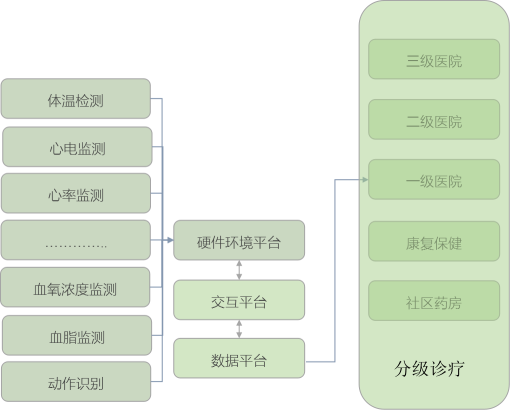
With the rapid development of Internet of Things (IoT) technology, the upgrading of existing medical devices and the network connectivity of future new types of medical devices will become commonplace, with these devices functioning as smart hardware terminals. Within the entire system, raw personal health data is collected by the smart hardware terminals, then uploaded to a human-computer interaction platform, and subsequently transmitted to specialized data analysis servers.
The data analysis results are presented via a human-computer interaction platform, helping users understand their health status or trends. Based on different health conditions or trends, health advice is provided according to priority and urgency, and integrated with healthcare institutions at various levels.
The system provides disease prevention recommendations for individuals in a sub-health state, as well as pathways to connect with preventive care institutions;
Provide care advice for individuals with minor illnesses and injuries, along with pathways to connect with primary care and treatment facilities;
Provide diagnostic and treatment recommendations for patients with acute, specialized conditions, along with referral pathways to specialized care institutions;
Provide diagnostic and treatment recommendations for patients with complex major diseases, along with referral pathways to general hospitals;
Ultimately achieving a tiered diagnosis and treatment system, enabling medical resources at different levels to fully leverage their respective advantages and value, thereby alleviating doctor-patient conflicts caused by the uneven distribution of medical resources.
In this holistic healthcare model, diagnosis and medication use operate relatively independently. Medical professionals demonstrate their value through technical expertise and service quality, allowing all institutions and personnel to return to their core responsibilities.
Still Needs Effort
The foundation for smart healthcare to deliver value is trust, which stems from the reliability of data in assessing health status and trends, as well as the rationality of resource allocation.Driven by the shared user value derived from personal behavior and health data services, the development of smart hardware terminals, human-computer interaction platforms, and cloud-based data service platforms will advance the evolution, maturation, and refinement of the smart healthcare model.
Technological advancement in related fields has become an irresistible trend, with new forms of smart healthcare on the horizon. The pace of their maturation will be influenced by government policies, capital investment, and the willingness of various stakeholders to collaborate in sharing medical resources.
Smart healthcare is an inevitable trend; all parties must continue to strive.
Note: This article was submitted by a reader and does not represent the views of VCBeat.