

Yihu To Home Launches First Offline Health Hub, Creating an Online-Offline Integrated Service Loop
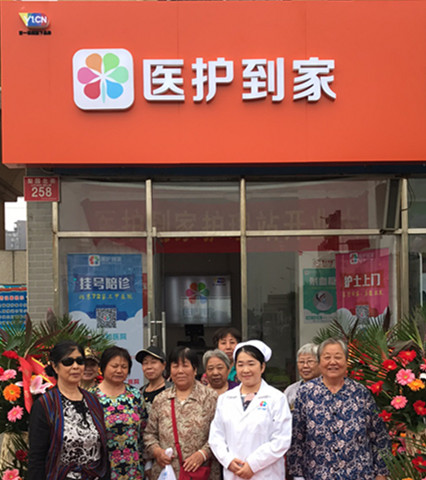
Event Site
On May 4, Huzhi Daojia informed VCBeat (WeChat ID: vcbeat) that its Health Hut on Liyuan North Street in Tongzhou District, Beijing, had officially launched. This is the first Health Hut established by Huzhi Daojia in China, enabling elderly residents in the vicinity to access professional health management services, such as in-home nursing care, right at their doorstep.
"Yihu Daojia" is China's first pilot project for internet-based medical and elderly care services, and a startup under First Video focused on in-home nursing services. Since its inception, it has operated exclusively online, adopting an asset-light business model that allows users to book nearby nurses for basic nursing care on demand, much like using "Didi."
In just over a year, “Nurse to Home” has certified more than 30,000 licensed nurses, with its services covering 280 cities including Beijing, Shanghai, Guangzhou, Nanjing, and Hangzhou.
What is the strategic significance of establishing offline health kiosks for the "Medical Professionals to Home" initiative? What are the functions of these health kiosks?
At present, there remains strong demand for appointment registration and medical accompaniment services, home-visit nursing, and health management, particularly chronic disease management. After one year of online operations, Huayi Daojia has identified significant limitations in its online service offerings. Consequently, nearly 100 experienced nurses on the platform have expressed interest in joining to establish “Health Huts.” The launch of China’s first Health Hut by Huayi Daojia provides these nurses with a platform for innovation and entrepreneurship.
“Given the size of the local elderly population, this health kiosk in Tongzhou is relatively well-equipped. Yihu Daojia will regularly provide members with basic health check-ups and guidance services, including complimentary blood pressure and blood glucose monitoring packages,” said a representative from Yihu Daojia.
It is understood that, in addition to offering all 17 online services—including nurse home visits for injections, intravenous infusions, catheterization, nasogastric feeding, dressing changes, and blood sampling—the Health Hut also provides By-Health dietary supplements, Heyici elderly care products, and smart home hardware from Kangfu Zhijia (Rehabilitation Home), such as blood pressure monitors, blood glucose meters, and nebulizers.
“The facilities are comprehensive, and the nurses here all come from formal medical institutions such as Grade 3A hospitals, possessing extensive experience. In the future, we can frequent this place to enjoy the convenience brought by home-visit nursing services.” Many elderly individuals who experienced the Health Hut told reporters that the Health Hut also guides people to proactively and spontaneously engage in health and fitness activities, paying attention to their own health indicators such as blood pressure and blood glucose, which is highly meaningful.
“The establishment of ‘Health Huts’ has filled a market gap, enabling online services to be effectively implemented on the ground and allowing high-quality medical resources to reach the grassroots level. These facilities address the health and nursing needs of elderly individuals with partial or total disability in surrounding communities, thereby enhancing trust and brand awareness for in-home medical and nursing care services. Results from the trial operation period also demonstrate a significant boost in platform transaction volume,” said the person in charge. “By serving as a physical conduit for online services, Health Huts provide a tangible entry point that encourages older adults to prioritize their health and enjoy the conveniences offered by modern technological advancements in healthcare.”
“A user’s elderly family member required urinary catheterization, a procedure that typically takes only 10 minutes when performed by a professional nurse. However, the family was unable to secure a home visit from a community hospital nurse and ultimately had to call emergency services (120) to transport the elderly patient to the hospital for catheterization before bringing them back home.” This is a real-life case encountered by “Nurses at Home” during its market research.
It is reported that the number of disabled and semi-disabled elderly people in China has exceeded 40 million, with the population aged 60 and above reaching 230 million. However, due to the limited provision of home visit services by nurses in community hospitals, there has been a persistent shortage of medical and nursing resources in the market. Therefore, home-based medical and nursing care will become an essential need, indicating significant growth potential for the future market.
Although the online services offered by "Nurse to Home" are comprehensive, covering 17 types of services such as home visits by nurses for injections and infusions, health management, and blood pressure and blood glucose monitoring, as well as providing health supplements and medical equipment, they still present inconveniences for users.
For example, for disabled elderly individuals, licensed nurses provide home-based services such as injections, intravenous infusions, catheterization, nasogastric feeding, dressing changes, sputum suction, pressure ulcer care, and stoma care during their spare time. Since these services may require nurses to visit the patient’s home multiple times a day, requiring users to place an order via an app for each visit would consume excessive user time.
Nowadays, after placing their first order, users can directly request nurses from the Health Hut to provide home-based services for any subsequent needs.
In the future, Huayi Daojia will collaborate with nurses possessing extensive clinical nursing experience and regional managers on its platform to implement Health Hut partnerships across China.