

2017 Community Chain Clinic White Paper: A Panoramic Scan of Domestic Clinics Under the New Policy Allowing Cross-provincial Operation with a Single License
On May 4, the State Council announced that social capital-funded medical institutions meeting planning requirements and access qualifications shall not be restricted under any pretext! Furthermore, a one-stop acceptance, parallel approval, and online approval system will be implemented for such institutions. Chain medical institutions may have their business registration handled centrally by their headquarters—the era of requiring only a single license has finally arrived!
On April 26, VCBeat reported“National Health and Family Planning Commission Implements Electronic Registration for Medical Institutions, Physicians, and Nurses: Four Core Points Demand Attention”, providing a detailed explanation of the policies outlined in the “Guiding Opinions of the State Council on Accelerating the Promotion of ‘Internet + Government Services’” (hereinafter referred to as the “Opinions”), jointly issued by the National Health and Family Planning Commission and the State Administration of Traditional Chinese Medicine. The aim is to accelerate the formation of a diversified landscape for medical service provision, continuously increase the supply of medical resources, and unlock their potential.
The opinion stated that by June 2018, all provinces should establish local electronic registration systems interconnected with the national electronic registration system to achieve electronic management of the registration of medical institutions, physicians, and nurses.
By 2020, fully implement electronic registration management, basically complete the issuance and use of electronic licenses, achieve the goals of convenient and efficient administrative approval services, dynamic and timely interim and ex-post supervision, and universal access to medical resource information services.
On May 3, Premier Li Keqiang of the State Council presided over an executive meeting of the State Council to determine measures supporting the development of privately-run medical institutions and health tourism, thereby meeting the public’s multi-level and diversified health needs. This is also part of the intensive policy rollouts in recent yearsThe highest-level policy among those encouraging social capital to invest in healthcare.
The meeting held that targeting the multi-level and diverse health needs of the public, advancing streamlining of administration, delegating power, strengthening regulation, and optimizing services in the medical field, and vigorously supporting social forces in providing medical services are important measures to deepen healthcare reform, address shortcomings, and improve people’s livelihoods.
At the meeting, three measures were proposed to rapidly advance privately-run healthcare:
The meeting confirmed,First, encourage non-governmental entities to establish general practice clinics and independently operated specialized institutions such as medical laboratories and rehabilitation and nursing care facilities. Promote cross-provincial and cross-municipal chain operations by capable privately run traditional Chinese medicine (TCM) clinics and outpatient departments. Attract foreign investors to engage in joint ventures and cooperation to establish high-level medical institutions.
Second, implement a one-stop acceptance system, parallel approval, and online approval for private medical institutions.Chain-operated medical institutions may have their industrial and commercial registration handled centrally by the headquarters.No restrictions shall be imposed on privately-run medical institutions that meet planning conditions and access qualifications, under any pretext.Individual clinics are not subject to planning and layout restrictions.Implement regional registration for physicians to facilitate orderly mobility and multi-site practice.
Third, efforts should focus on improving the quality of services provided by private medical institutions by exploring inclusive and effective approaches to prudential regulation.Crack down severely on illegal and non-compliant activities such as opening practices by renting or lending professional licenses, contracting out hospital departments, publishing false advertisements, and practicing medicine without a license.
The meeting proposed promoting the deep integration of health, tourism, and elderly care, guiding social capital investment, encouraging the development of products such as high-end medical services, traditional Chinese medicine (TCM) healthcare, rehabilitation and convalescence, and leisure wellness, and accelerating the cultivation and development of the health tourism market.
At the same time, it clarified“General practice clinics and independently established specialized institutions such as medical laboratories and rehabilitation nursing care” are key areas for private capital investment, and proposed "promoting cross-provincial and cross-municipal chain operations for capable privately-run TCM clinics and outpatient departments."
Notably, the meeting proposed that, while relaxing market access requirements to improve the service quality of privately operated medical institutions, “exploratory, inclusive, and effective prudential regulatory approaches” should be adopted to address long-standing issues such as opening practices by renting practice licenses, contracting out departments, false advertising, and illegal medical practice. It further reaffirmed the implementation of one-stop acceptance, parallel approval, and online approval for privately operated medical institutions.
Since January 2017, high-end medical facilities, chain clinics, and general practice clinics have continued to emerge. These developments include real estate developers transitioning into the healthcare sector, listed companies acquiring hospitals, and collaborations between capital investors and enterprises.
On April 6, VCBeat reported that“Wanda’s Investment in High-End Healthcare in Chengdu Alone Has Exceeded RMB 85 Billion: What Is the Business Logic Behind Wang Jianlin?”,Wanda Group and the Chengdu Municipal People's Government have officially signed a strategic cooperation memorandum, under which both parties agree to invest RMB 70 billion.Build a world-class medical industry hub.
The medical industry center will be planned into two zones: Zone A, the General Hospital Zone, where Wanda Group will be responsible for introducing two world-class general hospitals and eight internationally renowned specialized hospitals; and Zone B, the Medical Industry Park, which will attract 30 healthcare-related enterprises.
On the other hand, according to publicly available data,From 2006 to 2015, the number of private hospitals in China increased from 4,150 to 14,518, representing a growth of 10,368 hospitals over the decade. The compound annual growth rate (CAGR) was 13.3%, and the total number of private hospitals has surpassed that of public hospitals, accounting for 52.7% of all hospitals nationwide.
So, how do entrepreneurs view the release of this policy? What are its impacts? And what strategic plans lie ahead for the future?
Lü Fengping, founder of Chengdu’s first chain of general practice clinics, believes that“This is an exceptionally favorable policy that provides advantageous conditions for our clinic expansion. Over the next three years, Dr. Lü Chain Clinic plans to open 200 clinics across China.”
Meanwhile, Dr. Martin, founder and CEO of Xingren Doctor, believes that:These three measures represent highly favorable news for Xingren Doctor. The new healthcare reform policies have enabled the mobility of physicians, who constitute the core resource in the medical sector. This shift inevitably necessitates greater support from market-oriented healthcare platforms and provides policy assurance for Xingren Clinic’s nationwide expansion.
Currently, Almond Doctor has accumulated 420,000 verified physician users on its online platform and is about to launch an internet hospital. Offline, it has independently established multi-site practice studios to help physicians seamlessly extend their clinical services into a new model that integrates online and offline care. Following the opening of its wholly owned WeWork Shenyang Clinic (Version 1.0 for multi-site practice) last July, Almond Doctor’s pioneering Version 2.0 upgraded shared partnership clinics will open in Shanghai, Chengdu, Shenzhen, and Guangzhou in early 2017. In the future, Almond Doctor plans to open additional clinics.
For Johnson Medical, which has just secured RMB 100 million in financing and is expanding its presence across China, this policy could not have come at a better time. Its CEO, He Haiyang, told VCBeat,“As a chain enterprise, we encountered two problems during our expansion. Firstly, in the past, general practitioner family doctor responsibility chain clinics could not be applied for; now with the concept of 'general practitioners,' it is compliant and legal. Secondly, previously, headquarters could not uniformly handle business registration approvals, requiring each clinic to independently complete its own business procedures, which caused significant difficulties in financial audits, tax reporting, and management. Now, group-wide unified applications for business registration can be made, greatly facilitating operations and reducing obstacles caused by cross-management.””
However, Duan Minyi, Chairman of Chengdu Zhengguangxing Family Doctor Group, believes that “"The national policy encourages private capital to invest in healthcare, but lacks clear supportive conditions, making it akin to hearing spring thunder without receiving spring rain."”
In his view, private healthcare delivery encompasses various business formats, but can be broadly categorized into three types: general hospitals, specialized hospitals, and primary care institutions. These three categories face distinctly different opportunities and exhibit significant variations in risk. Meanwhile, each business format must clearly define its own profit model; there are substantial differences between an egalitarian, public-welfare-oriented model and a diversified model that serves as a supplement to public healthcare.
More importantly, primary care institutions need to clarify their profitability models. The current model, which relies primarily on consultation and treatment fees, will be significantly impacted in the near future by stringent regulations imposed on third-party clinical laboratories and pharmaceutical operations.
Despite numerous challenges, Luo Lin, founder of Linjia Haoyi, believes that the conference’s emphasis on improving the quality of services provided by private medical institutions highlights chain-based, standardized management and operations as one of the core solutions to this issue.
Linjia Haoyi has consistently kept pace with healthcare reform trends, committing to the development of differentiated, standardized, and regulated primary care services to significantly enhance service quality and meet diverse market demands. Guided and supported by these policies, Linjia Haoyi is more confident and resolute in its mission to empower primary healthcare. Over the next three to five years, it plans to establish over 2,000 primary care institutions across China through various models.
“I believe that the further implementation of these policies will enable enterprises like Linjia Haoyi, which are dedicated to developing chains of high-quality primary care institutions, to establish medical facilities more conveniently and in a more standardized manner, thereby truly driving an overall improvement in the quality of healthcare services across society.”
So, what are the implications for specialized chain clinics?
“In 2015, I began preparing to establish an offline pediatric clinic.This time, the state encourages social investment in healthcare, which is beneficial for us and even the entire industry.This is all highly positive news, and private healthcare will usher in significant development opportunities."Mommy Knows" CEO Liang Liang said.
As consumption upgrades, the demand for high-quality medical services continues to rise. Private and non-public healthcare providers are better positioned to meet the diversified and multi-tiered needs of patients, serving as an important complement to the current healthcare system.
Mami Zhidao launched its first Yixin Pediatrics clinic in Shenzhen in February 2017, with clinics in Shanghai and Guangzhou scheduled to open successively this year.“We also hope that the relevant policies and regulations encouraging private investment in healthcare will be implemented more swiftly, that the approval process for clinic qualifications will become more efficient, and that physician mobility will be enhanced. This will enable us to better provide warmer, higher-quality medical services to the public.”
For Zhao Qiang, CEO of Zhibei Pediatrics, who is currently applying to open a second clinic, things have been somewhat troubling lately.. He had previously opened a pediatric clinic at Aoyuan City World in Zhongcun Street, Panyu District, Guangzhou. Opening another new clinic locally would require reapplying for licenses and resubmitting physicians’ practice qualification certificates, making the approval process overly complex. Without unified management during the application process, efficiency is significantly reduced.
“With the policy now in place, I hope local governments will implement it soon to streamline numerous procedures. Once centralized processing by headquarters is established, the efficiency of clinic approval will improve significantly.”
Dr. Wang Yu, Who Aspires to Build a Hilton-Style Management Model for Pediatrics, has opened five pediatric clinics in Chongqing. She believes that“This policy represents a significant benefit to the industry. We hope it will be implemented in Chongqing at an early date, and we remain committed to upholding the Yuboshi Pediatric Chain model, with plans to open more clinics in the future.”
For hospital chains, the new policies introduced by the State Council to promote private healthcare may be more favorable.VCBeat interviewed Dong Xiaoling, Director of the Medical Management Department at Hemei Medical Group, a publicly listed company. “We warmly welcome the introduction of such policies by the state.”
In the future, leveraging its substantial capital and brand advantages, Hemei Medical will continue to open new chain hospitals across various regions. The introduction of new policies will significantly accelerate the approval process for these new hospitals, thereby facilitating greater convenience for the company’s development.
On one hand, the new policy proposes attracting foreign investors to establish joint-venture, high-level medical institutions. Director Dong Xiaoling believes that since Harmony Medical Care listed on the Main Board of the Hong Kong Stock Exchange in 2015, its major investors have been overseas institutional investors. Therefore, Harmony Medical Care maintains frequent communications with overseas institutional investors and holds significant potential for exchanges and cooperation with high-level overseas medical institutions. In the future, Harmony Medical Care will actively explore possibilities for joint ventures and collaborative healthcare provision with overseas institutions in accordance with the new policy.
On the other hand, the new policy also proposes exploring inclusive and effective prudential regulatory measures.Director Dong Xiaoling believes that effective industry regulation by government authorities is, in fact, more conducive to the standardized development of the sector, enabling smoother and more vibrant growth. As a publicly listed company, Hemei Medical has always prioritized customer reputation, adhered to compliant operations, and implemented strict oversight of internal medical quality and service management.Currently, two hospitals under Hemei Medical have obtained Joint Commission International (JCI) accreditation, adopting the most advanced international medical management standards. In the future, more hospitals under Hemei will apply for JCI accreditation.
As an increasing number of enterprises enter the community-based chain clinic sector, and guided by policies such as tiered diagnosis and treatment, the industry has attracted significant attention from capital markets and industrial players. Community-based chain clinics, serving as one of the entry points for primary care, are highly regarded for their attributes of scalability, branding, and standardization. They are viewed as a promising solution for transforming the previously unregulated and fragmented landscape of grassroots clinics, making them a coveted target in the market.
To this end, VCBeat's VBInsight has released the "2017 White Paper on Community Chain Clinics》, this report provides a panoramic overview of domestic community-based chain clinics. It aims to review the entire industry chain by analyzing and discussing the development trajectory of these clinics, offering fresh insights for professionals in primary care-related industries.
The core discussion of the report will revolve around“Development Path of Community Chain Clinics”, analyzes and discusses the current status and development trends of community-based chain clinics. The content will be mainly divided into seven parts:The Boom of Community Chain Clinics; Maturity Assessment of Community Chain Clinics; Behind the Hype of Community Chain Clinics; The Evolutionary Path of Community Chain Clinics; The Industry Chain of Community Chain Clinics; Development Trends in the Community Chain Clinic Industry; <Appendix> Two Typical Overseas Benchmarking Cases.
According to public searches, as of February 2017, there were 47 community-based chain clinics across China (mainland only). The earliest founding year of these clinics dates back to 1955, with the most recent established in February 2017. It is anticipated that more community-based chain clinics will open by the end of 2017.
Geographic distribution spans 24 provinces and municipalities across China, with concentrations in Beijing, Guangdong, Zhejiang, Shanghai, and Sichuan. In Beijing, 20 companies are operating community-based chain clinics. Current presence also extends to Chongqing, Guizhou, Hunan, Gansu, Ningxia, and other regions.
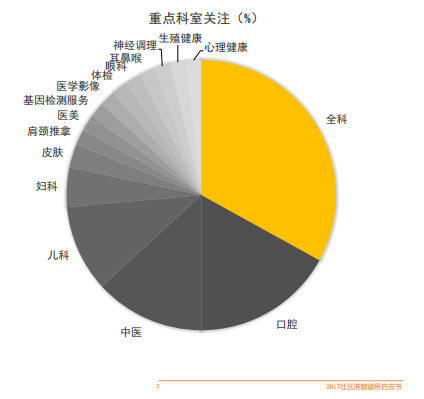
Clinic positioning is divided into 16 categories, with the top five being general practice, dentistry, traditional Chinese medicine (TCM), pediatrics, and gynecology, accounting for a combined attention share of 83%.
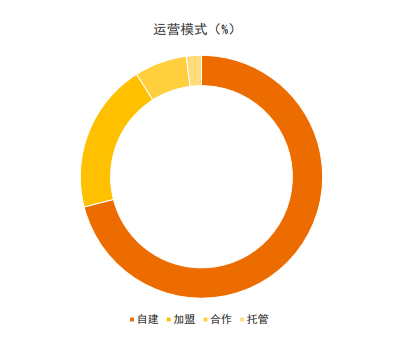
In the operational model of community chain clinics, 71% of the entities involved in construction engage in self-built and self-operated models, while entrusted management is the lowest, at only 2%. The reason for this is that during the period lacking legal basis, the entrusted management model was still in a state of uncertainty, with no successful experience to draw upon.
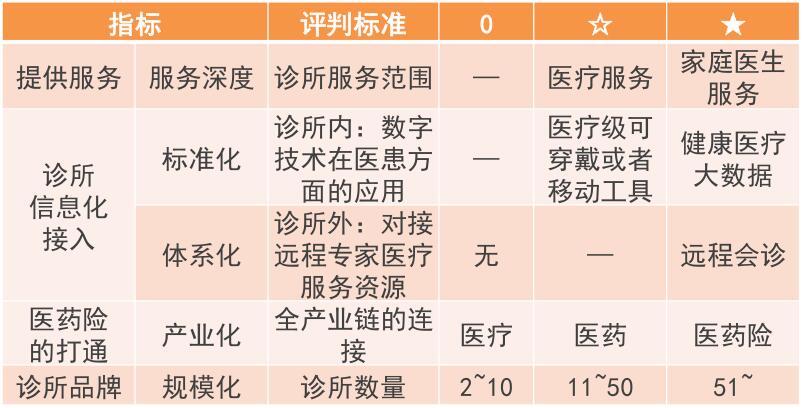
Furthermore, based on the practical experience of community-based chain clinics in China,Extract five key patterns as maturity indicators to preliminarily categorize the operating entities of 47 community chain clinics. Based on service depth, standardization, systematization, industrialization, and scalability, assign ratings of “sparse,” “half-star,” or “one-star” according to maturity levels, and evaluate the maturity of business models by total score.
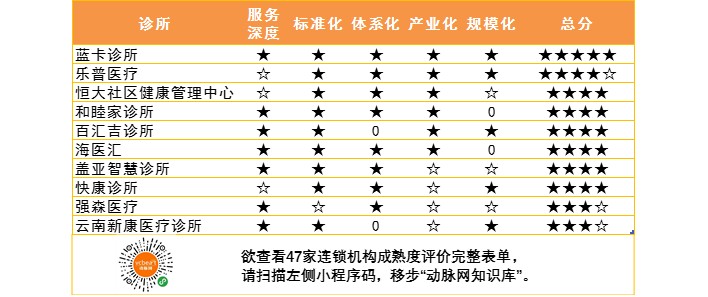
Based on the rankings derived from five key evaluation indicators, entities with ratings of four stars or higher include Blue Card Clinic, Lepu Medical, Evergrande Community Health Management Center, United Family Healthcare Clinics, and others.
From this, three future models for clinics can be inferred, aiming to reverse the industry’s predicament of “universal acclaim yet widespread skepticism.” Compared with other sectors, there is more wait-and-see observation and less hands-on practice. Under the influence of policy guidance, industry upgrading, and market demand, how much profit have these pioneers actually made? How much practical experience have they accumulated? And where will future development lead? For detailed report information and case studies, please click “Members' Exclusive Circle"Read after purchase. Entrepreneurs, investors, and industry professionals are welcome to contact us for discussion and exchange."