

Kuaifang Secures $60M Strategic Investment from Buchang Pharmaceuticals to Expand into Shanghai, Shenzhen, and Beyond
Last November, KuaiFang was preparing for a new round of financing, with BuChang Pharmaceutical—a leading domestic enterprise in Chinese proprietary medicines—engaging in discussions. At that time, nearly a year had passed since KuaiFang’s previous funding round, placing the company squarely within the window for its next financing cycle. Following talks with BuChang, both parties quickly reached a consensus on the investment framework, signaling that the new round of financing was already underway.
Six months later, Buchang announced a strategic investment in Kuaifang Medicine Delivery, totaling RMB 60 million for an 11% equity stake.
During the interval between two rounds of financing, Kuai Fang experienced many developments. In the summer of 2016, news that “Yao Gei Li” had suspended its operations cast a shadow over the entire pharmaceutical O2O market. In response, Kuai Fang rapidly scaled back its business footprint, refocusing on Beijing and adhering to a self-operated model. Subsequently, announcements such as its partnership with JD Daojia and daily order volumes exceeding 10,000 positioned Kuai Fang as a benchmark case in the pharmaceutical O2O sector, sparking extensive discussion for a considerable period.
It is easy to focus solely on the financing event itself, while overlooking the underlying industry directions and trends. For KuaiFang, Buchang Pharmaceutical is undoubtedly a high-quality strategic investor; for Buchang, KuaiFang holds value as a pioneering project in the pharmaceutical retail trend. This bet, sooner or later, will inevitably be placed.
Several Key Issues
Following the announcement of Buchang Pharmaceutical’s investment in KuaiFang, VCBeat promptly contacted KuaiFang CEO Gao Yue to relay several questions of public interest.
1. Under what circumstances did Buchang Pharmaceuticals and Kuai Fang initiate discussions? What aspects of Kuai Fang attracted Buchang Pharmaceuticals’ interest? Beyond the investment relationship, will the two parties engage in business cooperation?
2. After KuaiFang secured financing from Buchang Pharmaceuticals, the market landscape shows that Dingdang Kuaiyao is backed by Renhe Pharmaceutical, HaoYaoshi is backed by Jointown Pharmaceutical Group, and KuaiFang is backed by Buchang Pharmaceuticals. How do you view this competitive landscape, and what will KuaiFang’s strategy be?
3. A series of policies beneficial to pharmaceutical retail have been recently introduced, including the elimination of B and C license reviews for pharmaceutical e-commerce and the encouragement of O2O drug services under "Document No. 13." With an increasing number of market entrants such as Ali Health, JD.com, and Meituan, how will the landscape of pharmaceutical retail evolve in the future?
In response to the above questions, Gao Yue provided detailed answers. He stated that after receiving investment from Tiantu Capital in October 2015, KuaiFang had sufficient funds, so it paid little attention to capital and did not notice the so-called "capital winter."
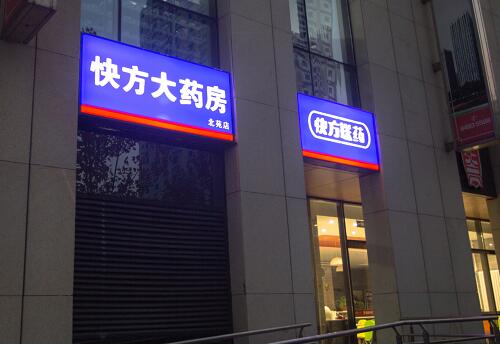
The funds raised in previous financing rounds were primarily used to expand the pharmacy network and upgrade existing stores. “It is a physical transformation,” according to data provided by KuaiFang, which now operates 18 stores in Beijing, with over 10,000 daily orders and an average transaction value of more than RMB 35. These figures essentially reflect KuaiFang’s achievements in the previous phase and explain the use of the financing proceeds.
The initial contact between KuaiFang and Buchang Pharmaceuticals took place last November, constituting a relatively routine communication with investors.
“Buchang has extensive reach in the pharmaceutical sector and shows considerable interest in self-operated O2O models. After our initial engagement, we exchanged views on the industry as a whole and found substantial alignment on the future direction of pharmaceutical retail,” Gao Yue told VCBeat, noting that the collaboration with Buchang stems from shared values and a common perspective on the development of pharmaceutical distribution.
In fact, Buchang has been highly active in both upstream and downstream segments of the pharmaceutical industry chain in recent years. It acquired a stake in the pharmaceutical e-commerce platform Qilekang, launched its “Pharmaceutical E-commerce Authorization” program, and established partnerships with dozens of pharmaceutical e-commerce companies. In the same announcement disclosing its investment in Kuai Fang Song Yao (Quick Prescription Delivery), Buchang also revealed an investment in another biotechnology development company. It can be inferred that while relying on exclusive proprietary Chinese patent medicines such as Danhong Injection and Wenxin Granules, Buchang is also focusing on the upstream and downstream segments of the pharmaceutical industry chain, aiming to build a coordinated layout spanning from traditional Chinese medicinal herbs to pharmaceutical distribution. For Buchang, Kuai Fang Song Yao is undoubtedly a “high-quality target.”
Regarding the prospects for cooperation between KuaiFang and Buchang Pharmaceuticals, Gao Yue responded, “There are currently no plans for collaboration at the business level; however, the pharmaceutical industry is undergoing rapid transformation, and anything could happen in the future.” This statement also hints at potential modes of collaboration between the two parties in the future.
Where Does Kuaifang's Competitiveness Lie?
From the collapse of Yaogeli to KuaiFang, which has secured multiple rounds of financing, why have these two early entrants in the pharmaceutical O2O sector experienced such divergent trajectories? Furthermore, what constitutes KuaiFang’s core competitiveness—is it brand strength, supply chain management, cost control, or financial backing?
From an industry perspective, it is necessary to analyze that pharmaceutical O2O (Online-to-Offline) services are generally considered a specialized form of “online pharmacies” rooted in offline operations. In fact, KuaiFang holds the Class C Internet Drug Transaction Qualification Certificate. The pharmaceutical O2O business faces numerous unfavorable factors, such as low barriers to entry—as any brick-and-mortar pharmacy can establish such services—high operational costs due to additional delivery expenses, low frequency of consumer demand since purchasing medication during illness is a relatively rare event, and restrictions on prescription drugs stemming from the lack of access to prescription sources.
Gao Yue responded that Kuai Fang has introduced a new model for pharmaceutical sales, which aligns with the development trends of the mobile internet. Furthermore, demand for pharmaceutical products themselves is stable and constitutes a rigid necessity.
Through optimization of the entire operational process, KuaiFang has established a stable business system. He stated that KuaiFang prioritizes three key metrics: inventory accuracy, customer satisfaction rate, and on-time delivery rate. By adopting an in-house operational model to control the entire process, KuaiFang has not only reduced costs but also provided consumers with the optimal purchasing experience.
Viewed across the entire market, there are models bearing the “self-operated” label, such as Kuai Fang Song Yao and Ding Dang Kuai Yao; models based on chain pharmacies, like Hao Yao Shi; Alibaba Health’s “Pharmaceutical Pioneer Alliance”; and JD Daojia’s model of partnering with pharmacies and leveraging Dada for delivery. More recently, news has emerged that fresh-food O2O delivery platforms such as Meituan and Baidu Waimai have launched pharmaceutical delivery services. The market can be described as a scene where “each of the Eight Immortals crosses the sea in their own way,” showcasing diverse strategies. Gao Yue offers his own interpretation of this landscape.
“Kuaifang is not in competition with them; the market is large enough. The pharmaceutical retail market is valued at RMB 300 billion, and with the separation of prescribing from dispensing, the segment of home medication delivery alone can sufficiently support the existing players in the market,” said Gao Yue. He emphasized the need for diverse O2O models to cultivate a more “human-centric” market, guide consumers, and gradually expand the market size.
VCBeat asked Gao Yue whether the increasing number of competitors would lead to price wars, similar to those seen in the pharmaceutical e-commerce sector. Gao Yue responded that on-demand medicine delivery via O2O platforms primarily addresses the need for immediacy, making subsidy wars unlikely.
So, how will KuaiFang enhance its competitiveness after securing the new round of financing? Gao Yue stated that KuaiFang had previously focused on offline operations, expanding pharmacy coverage and implementing physical renovations. With the investment from Buchang Pharmaceuticals, KuaiFang will strengthen its online presence and improve users’ online experience, such as enabling customers to quickly locate medications.
Gao Yue also stated that the Kuai Fang model has been validated in Beijing and will now be gradually expanded to cities such as Shanghai and Shenzhen.