

PwC and Almond Doctor Release 2017 Digital Health Report: Global Market Exceeds $9.59 Trillion

Press Conference Venue
On May 9, at W17, 3rd Floor, Infinitus Hub, No. 168 Hubin Road, Huangpu District, Shanghai,Martin, founder of Xingren Doctor, participated in the press conference for the report “2017 Consumer and Physician Survey: New Entrants and the New Healthcare Economy,” which primarily aimed to explore how today’s healthcare consumers, service providers, and new market entrants are reshaping China’s healthcare ecosystem.
This report presents the findings of a nationwide survey conducted among physicians in China from late 2016 to early this year, jointly carried out by PwC and Xingren Doctor, focusing on new market entrants and the new medical economy. The survey primarily consists of two parts: consumer behavior patterns, and the changes and characteristics of physicians and medical services. In collaboration with Xingren Doctor, the survey mainly focuses on the physician segment, offering a unique perspective on the healthcare ecosystem and the new medical economy.
What guidance is available for entrepreneurs? How is the digital health market in China faring? What are the perspectives of physicians? VCBeat has published an in-depth report on these issues.
Although the policy allowing physicians to practice at multiple sites was first issued in 2009, it has failed to promote physician mobility due to various reasons. To address this, the report thoroughly examines the current status of physicians within medical institutions, the challenges they face regarding multi-site practice, and the estimated time required to overcome these barriers. To this end,Xingren Doctor completed 1,317 physician surveys in just two days.
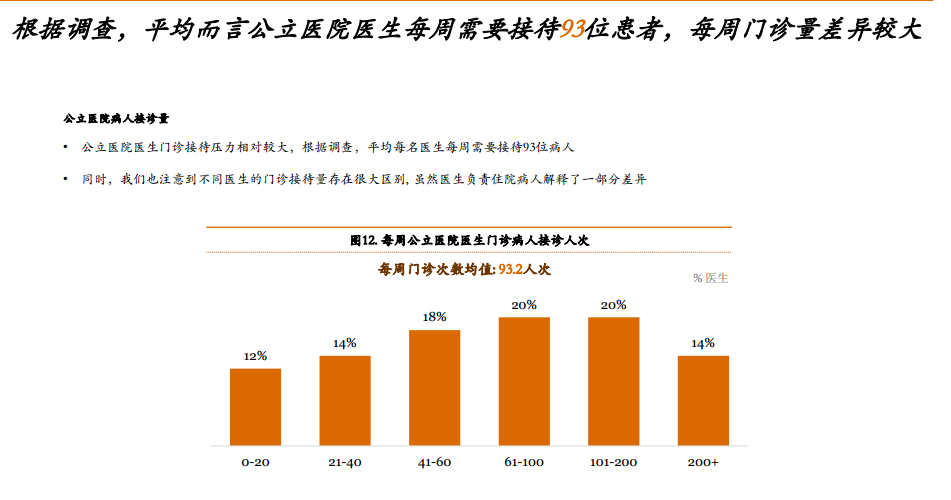
During the investigation,Almond Doctor Finds: For physicians in public hospitals, the average number of patients seen per doctor per week is 93, with significant variation in weekly outpatient volumes.Meanwhile, there is significant variation in outpatient volume among physicians, although the responsibility for managing inpatients accounts for part of this disparity.
Currently, for most physicians, the advantages of working in public medical institutions constitute the primary barrier to their engaging in multi-site practice. These advantages mainly include job stability, abundant clinical experience gained from a larger patient volume, and a strong professional reputation.
On the other hand, physicians who remain in public healthcare institutions for extended periods have come to recognize certain inherent disadvantages. These include cumbersome and protracted administrative procedures, uncompetitive compensation packages, high work-related stress, and a rigid hierarchical structure within hospitals.
Physicians consider relatively higher income to be the greatest advantage of working in private medical institutions, while their primary concern is that such positions may not support their scientific research or enhance their academic standing. Indeed, private medical institutions offer higher salaries and better reflect the quality and value of medical services.
Meanwhile, the “three long waits and one short consultation” phenomenon in public hospitals has driven an increasing number of consumers to seek care at private medical institutions. According to consumer surveys conducted over the past year, more than 40% of respondents reported having previously utilized private healthcare services. Those who have tried private medical services tend to be younger, highly educated, high-income earners, and covered by health insurance. Relatively speaking, although the difference between men and women is not particularly significant, male consumers are more willing to try private healthcare.
Among consumers who have tried private medical services, nearly 70% had a monthly disposable income of more than RMB 5,000, and 62% held personal medical insurance paid out-of-pocket.
In the future, consumers are increasingly likely to accept minor examinations and procedures at private clinics, but acceptance of major examinations and surgeries remains low.
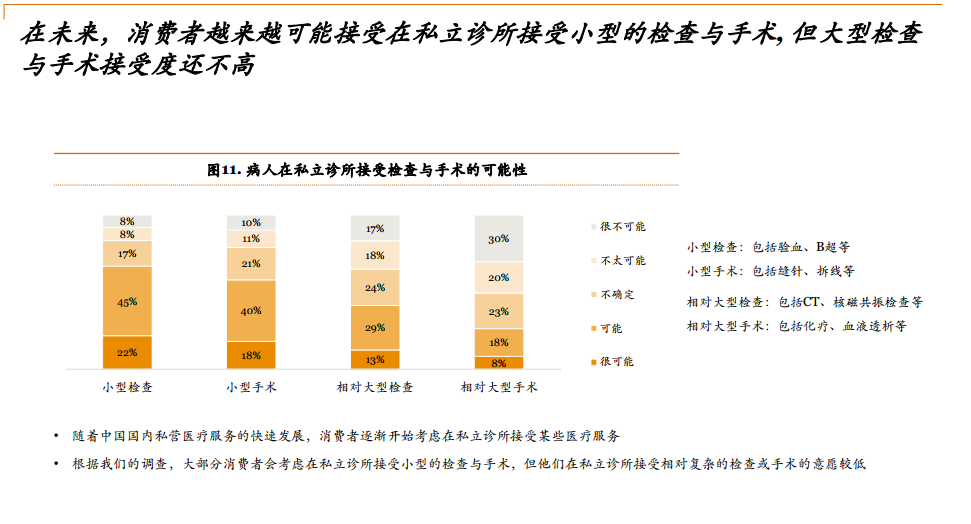
With the rapid development of private healthcare services in China, consumers are increasingly considering receiving certain medical services at private clinics. According to survey statistics, while most consumers are open to undergoing minor examinations and procedures at private clinics, they exhibit a lower willingness to receive relatively complex diagnostic tests or surgeries in such settings.
Therefore, during the survey process, 48% of physicians demonstrated considerable interest in multi-site practice and expressed willingness to engage in it. As shown in the figure:
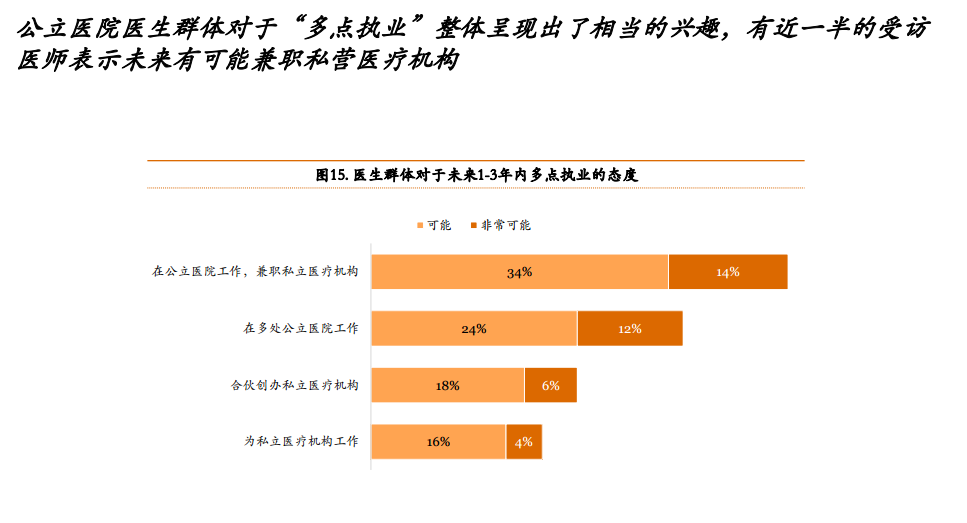
Dr. Martin also believes, “I strongly agree with the views that “within the next 1–3 years, one-third of physicians may take on part-time roles at private medical institutions” and that “digital healthcare can not only enhance physicians’ personal brands and facilitate patient follow-up, but also help patients save time and manage chronic diseases.”
How Can Multi-Site Practice Be Effectively Implemented? In China, nearly every physician faces an overwhelming workload. The number of patients they see in a single day can equal what foreign physicians see in an entire week. Beyond the natural factor of China’s large population, the monolithic and standardized nature of the healthcare system has prolonged unresolved issues such as difficulties in accessing medical care and strained doctor–patient relationships.
To this end, Dr. Martin is determined to bring about change in this field and assist physicians in their practice. This led to the development of a professional and efficient tool for managing doctor-patient communication, named "Xingren Doctor." Through Xingren Doctor, physicians can establish deeper and closer connections with their patients. The platform offers specialized features for follow-up care, tracking, communication, and information retrieval, serving as an essential clinical support tool that enables doctors to provide a diverse range of distinctive services to their patient populations.
Meanwhile, patients can establish long-term, stable relationships with trusted physicians through Xingren Doctor, allowing ample time and opportunities for communication and directly addressing the communication shortcomings inherent in traditional outpatient care.
Since September 2014, Xingren Doctor has focused its efforts on the physician-facing side.By the end of 2016, the number of physicians with real-name registration and practice certification had exceeded 420,000, covering more than 20,000 medical institutions across China.
According to Martin, following the launch of the wholly-owned WeWork Shenyang Clinic 1.0 with multi-site practice capabilities last July, Almond Doctor initiated a nationwide campaign two months later to recruit partners for Almond Clinics in core cities across China. The campaign established a co-construction fund for clinic development, creating multi-site practice studios. This initiative represents Almond’s pioneering upgraded 2.0 shared partnership clinic model, which will also be launched in Shanghai, Chengdu, Shenzhen, and Guangzhou.
“Doctors can contribute capital to the co-construction fund, and in the month of the campaign, outpatient co-construction funds exceeded 40 million yuan. Doctors actively supported the development of Xingren Clinic and showed great interest in the innovative model of clinic partnership.”Formal recruitment was launched in March 2017. Within just 30 days, 243 physicians signed on as outpatient clinic partners, breaking away from the conventional employer-employee relationship between doctors and clinics.
In addition, Xingren Doctor is about to launch an internet hospital, helping physicians seamlessly extend their clinical services into a new model of care that integrates online and offline consultations.
“Xingren Doctor’s multi-site practice solution for physicians not only enables them to enhance their skills while employed at public hospitals, but also addresses the obstacles associated with practicing at multiple locations. ‘2017 may well prove to be a turning point for China’s healthcare sector and Xingren Doctor; teams that are innovative and strategically positioned will reap the rewards,’ said Martin.”
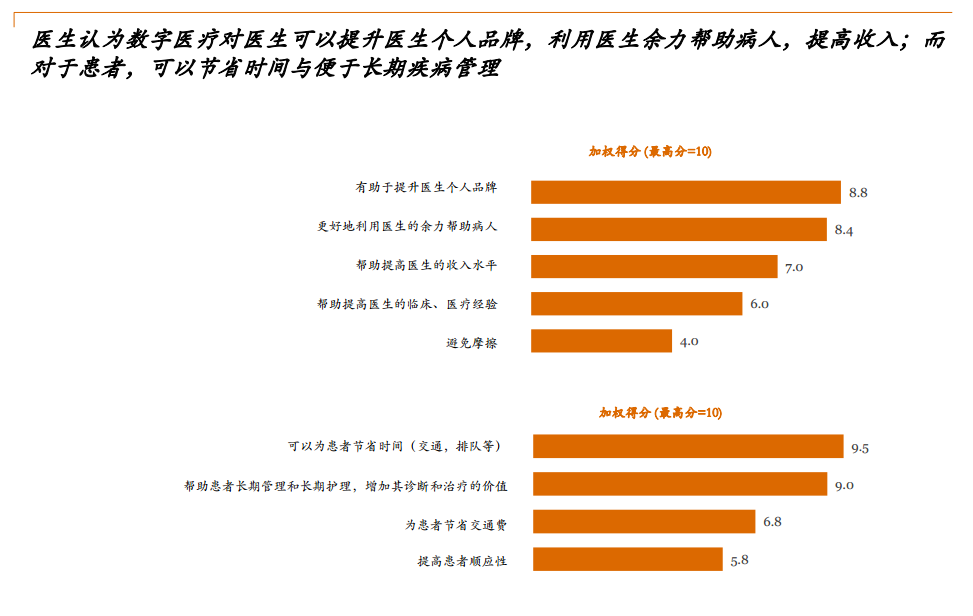
Similarly, physicians believe that digital healthcare can enhance their personal brand, leverage their spare capacity to assist patients, and increase their income. For patients, it saves time and facilitates long-term disease management, as shown in the figure below:
In fact, there are numerous entrepreneurs like Xingren Doctor in the mobile health industry. It is precisely because of this group of innovators who dare to pioneer, strive, and persevere that China’s healthcare sector can initiate innovative transformations within the global healthcare market, which exceeds $9.59 trillion in size. These efforts are reshaping existing healthcare service processes to support or replace traditional face-to-face clinical communications, thereby adapting to consumers’ emerging needs.
On April 20, at the 2017 China “Internet+” Digital Economy Summit held in Hangzhou, to which VCBeat was invited, Tencent Research Institute released the *China Internet+ Digital Economy Index (2017)* report (hereinafter referred to as the “Internet+ Index Report”). Compiled by Tencent in collaboration with companies such as Didi Chuxing, Meituan-Dianping, JD.com, and Ctrip through shared big data, this index report is currently the only digital report in China that applies “Internet+” to public utilities and economic activities, presenting the current state of Internet+ development from coastal to inland regions across the country.Among the sub-sectors, healthcare, transportation and logistics, and education recorded the highest growth rates, reaching 397.61%, 307.77%, and 304.88%, respectively.
Chinese consumers have become highly receptive to obtaining digital health management information, with 73% of them using websites or mobile health management apps to access health-related information. However, online video consultations remain in an early exploratory stage.Only 11% of respondents have tried using online video consultations. According to survey statistics, 51% of medical institutions already offer online appointment registration, with another 20% in the planning stages. Additionally, 37% of medical institutions have enabled electronic payment channels (such as WeChat Pay and Alipay), while 28% are still in preparation.
It is evident that digital healthcare cannot replace traditional healthcare, as it serves a distinct target population. It is more suitable for patients with mild conditions, those with chronic diseases, individuals who have already been diagnosed, patients requiring follow-up care, and younger patients. Accordingly, PwC has provided recommendations and insights for new market entrants, entrepreneurs, investors, and regulators, as outlined below:
For New Entrants
When large conglomerates attempt to transform and enter the healthcare sector by building novel, disruptive business models, they should remain confident and patient, as the overall market environment and favorable policies will continue to drive consumption upgrades in health and medical care.
New entrants should focus on consumers’ unmet or underserved needs. When entering narrow niche segments or cultivating entirely new markets, it is important to consider the costs associated with consumer education.
Relatively young and high-income consumer groups are the key target customers for new entrants' market positioning.
However, due to low switching costs, they may be more likely to switch to superior products and services offered by other new entrants. For the relatively older population, new entrants should focus on using new technologies to cultivate user habits and ensure a smooth adaptation process.
For new entrants in the digital health sector, consumer willingness to pay remains low; therefore, an advertising/e-commerce model combined with free services offers greater sustainability. Operational costs should be controlled as much as possible.
Invest more in protecting data privacy and security, as this influences consumer purchasing behavior and their willingness to share personal data.
For Current Business Operators
Traditional healthcare providers, such as hospitals, should continue to invest in digitalization to address the evolving habits of patients. Digitalization, broadly defined, encompasses the application of the Internet of Things (IoT) and artificial intelligence (AI). By leveraging digitalization as a point of differentiation, hospitals can provide greater convenience and practical effectiveness for patients, medical staff, and hospital administrators.
In the new healthcare economy, physicians remain the most critical strategic asset. As more doctors express interest in working outside public hospitals, healthcare organizations should strive to retain talent by innovating not only in financial compensation but also in reducing administrative burdens and improving work-life balance.
Pharmaceutical companies and medical device manufacturers should continue to make strategic investments in digital initiatives, correctly position the role of “digitalization,” and align it with other operational and commercial activities;
For Investors
Target companies should have a clear value proposition to cater to "pioneer" consumers—patients who naturally adapt to digital health and are willing to try new healthcare models;
To attract medical talent to join its newly invested businesses, the target company needs to foster a sense of employee belonging and connectivity, offer competitive compensation, provide greater recognition of value, and demonstrate operational efficiency along with streamlined administrative processes;
Investors should focus not only on the size of the target company’s user base, but also on its quality and demographic characteristics;
The leading companies in each therapeutic area are clearly highly attractive investment targets, and consumers face relatively higher switching costs for their services.
For Regulators
Regulatory Requirements for Enhancing the Security and Privacy of Patient Health Data;
Develop a guideline for evaluating the effectiveness of digital health solutions to provide a pathway for validating their efficacy;
Encourage physicians to make further use of their fragmented time and engage in multi-site practice, enabling them to realize their professional value in the market.