

Kaiser Permanente Reemerges as Innovation Pioneer: CEO Named Among World's Most Influential, $950M Invested in Tech R&D and Future Care Centers

Kaiser Group’s Current CEO, Bernard J. Tyson
Bernard J. Tyson, CEO of Kaiser Permanente, was named one of Time magazine’s 100 Most Influential People in the World for 2017 in late April this year, primarily due to his unique vision for the future of healthcare.
In recent years, the U.S.-based Kaiser Permanente Group has gained significant prominence in China. As one of the most renowned healthcare organizations in the United States and the pioneer of the Health Maintenance Organization (HMO) model, its distinctive healthcare management approach was repeatedly cited by former President Barack Obama in his speeches.
Kaiser Permanente is a highly integrated healthcare system that combines health insurance with medical services, thereby aligning the interests of healthcare providers and insurers. Surplus funds generated after service delivery can be redistributed within the group, addressing the lack of financial incentive for cost containment inherent in the fee-for-service payment model.
Such integrated healthcare can provide members with comprehensive, one-stop health services, ensuring attentive care from medical professionals throughout the entire continuum—from disease prevention and diagnosis to post-illness rehabilitation.
Tracing the Developmental Trajectory of Kaiser: This Healthcare Empire Originated from a Single Physician and NurseIn 1933, in Southern California, a burgeoning city undergoing extensive construction required the development of a massive water conveyance system. Due to the absence of local medical facilities, injured workers faced a three-day journey to reach medical care in Southern California. Consequently, the workers hired a physician named Garfield and a nurse to establish an on-site medical team.
But later, the doctor realized that he had no income when no one was injured, and sometimes he could not afford to treat an injured person. The clever doctor negotiated a solution with the workers: each worker would pay the doctor one dollar per month, and in return, the doctor would provide free medical treatment whenever a worker was injured. This way, the doctor secured a stable monthly income.
Because fees are fixed, physicians’ overall revenue is essentially capped; under such a model, doctors’ income rises only when employees fall ill less often, receive early treatment, and healthcare expenditures are minimized. This incentivizes physicians to place greater emphasis on workers’ occupational safety and routine health maintenance, forming the prototype of Kaiser Permanente’s business model.
By 1938, Henry J. Kaiser, the entrepreneur constructing the Grand Coulee Dam, entered into an agreement with Dr. Garfield to establish a hospital and hire physicians to provide medical services to his company’s workers and their families.
Its operational model is as follows:Employers collaborated with labor unions, whereby companies prepaid $1.50 per worker each month for workers’ compensation medical insurance, while simultaneously deducting five cents from each worker’s wages to remit to Dr. Garfield’s clinic for non-occupational medical expenses. This constituted an early model of prepaid healthcare services.
In 1945, Kaiser Permanente was officially established and opened to the public.
The advantages of integrated healthcare lie in coordinating the work among primary care physicians, specialists, hospitals, pharmacies, and laboratories; strengthening communication and collaboration among care providers to improve care quality and offer greater convenience to members; reducing costs while maintaining or enhancing service quality due to the effectiveness of preventive care; and fostering innovation.
To date,Kaiser Permanente has 11.3 million members across the United States, with a total workforce of over 200,000, including 54,072 nurses and 21,275 physicians. It operates 706 hospitals and medical facilities. According to the company’s annual report, its operating revenue reached $60.7 billion in 2015.。
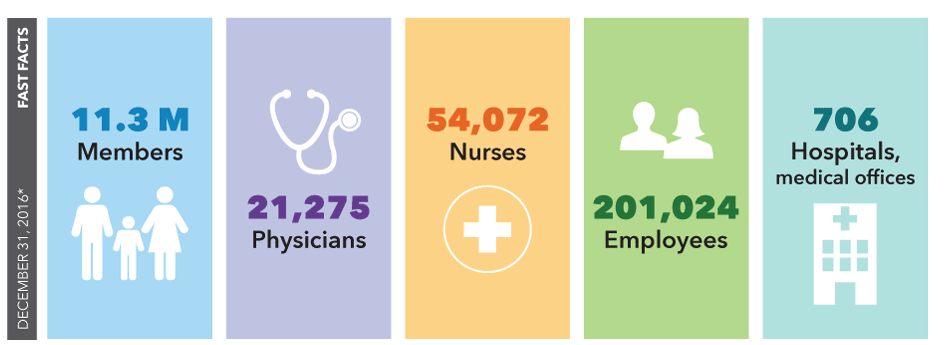 Current Scale and Data of the Kaiser Group
As generations succeed one another,The traditional HMO model has also declined from its peak. For instance, in the 1990s, many emerging HMO companies disrupted the entire market by attracting customers with low membership fees while rarely providing medical services, leading to vicious competition that severely impacted Kaiser.。
However, new healthcare models have also emerged.The Home Is Gradually Becoming the Primary Frontline for Medical Care. During the tenure of Halvorson, the former CEO of the Group,Kaiser Permanente has gradually established its own telemedicine system, providing medical services to patients at home through electronic consultations, electronic connectivity, electronic monitoring, and mobile applications.。
Bernard J. Tyson, the current head of Kaiser Permanente, has a unique vision for the future of healthcare. Since assuming leadership, he has undertaken several major initiatives, includingAcquired the Seattle-based healthcare system Group Health earlier this year。
However, it is clear that Bernard is not content with the status quo; he is taking active steps to realize his vision for the future of healthcare at Kaiser.
“In my view, in terms of patient experience, the optimal setting for future hospital care is undoubtedly the home,” Bernard pointed out while attending a meeting of the Nashville Healthcare Council. He believes that future hospitals will evolve into high-tech hubs, integrating abundant medical resources and personnel to meet the healthcare needs of their communities.
Let’s take a look at the major moves by Bernard and Caesar.
ContinueSetupOnline Healthcare Ecosystem
As early as 2012, during the tenure of former CEO George Halvorson, Kaiser Permanente had already begun taking action in telemedicine.They launched Android and iOS clients at the time, integrating their world’s largest privately owned electronic health record (EHR) system, which had been fully operational since 2010, into mobile platforms.。
Through this initiative, Kaiser Permanente members can access their personal health records around the clock via their mobile devices.In addition, it offers a full suite of features, including emailing physicians, scheduling consultations, refilling prescriptions, and locating Kaiser Permanente medical facilities, marking a revolutionary innovation in telemedicine.。
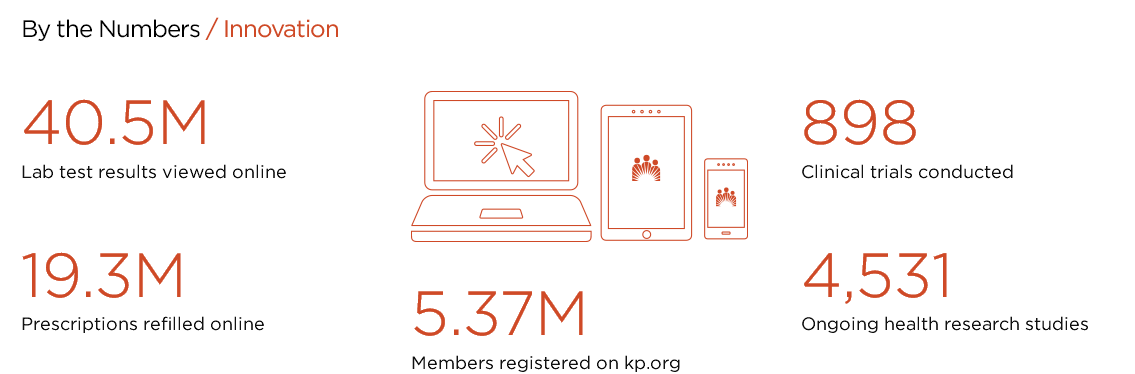
Half of Kaiser Permanente members have registered for the kp.org online portal
Currently, more than half of Kaiser Permanente members have registered for the kp.org online portal.According to internal research at Kaiser Permanente, members who are willing to access their health information online are also more likely to engage in disease prevention and screening. For instance, online tools can flag the date of a patient’s last colorectal cancer screening and provide the recommended date for the next one. Furthermore, these tools facilitate the management of specific health conditions, such as smoking cessation programs and weight management.
Ensuring that patients undergo testing and screening at appropriate times is a critical component of high-quality healthcare. The personalized healthcare services provided through Kaiser’s online portal have effectively enhanced member engagement and participation.。In 2016, Kaiser Permanente physicians conducted over 100 million primary care visits, 52% of which were online consultations.。
In fact, its IT architecture has played an indispensable role in the transformation of the Kaiser Permanente care model.Kaiser Permanente’s IT department employs more than 7,000 staff members and is responsible for building and maintaining the IT infrastructure, data, and applications of the Kaiser Permanente online portal, including its electronic health record (EHR) system.。
They leverage IT technologies to support a wide range of healthcare activities, encompassing not only member-facing medical services and health programs but also the company’s laboratories and pharmacies. In the 2016 “Best Places to Work in IT” list published by Computerworld magazine in the United States, Kaiser Permanente’s IT department ranked seventh among the 50 selected companies, making it hard to imagine that it is actually part of a healthcare group.
Kaiser allocated 25% of its $3.8 billion annual capital expenditure ($950 million) to new technology development last year, underscoring the group’s strong commitment to this area. In addition to its online portal, it continues to roll out other ITC products to enhance its future healthcare ecosystem.Launched in 2015, the “My Pregnancy” app leverages Comcast X1 technology to transform home televisions into interactive medical resources for expectant mothers. Bernard, CEO of Kaiser Permanente, remarked, “My doctor is always in my pocket.”
Kaiser's New Model: Future Community Diagnosis and Treatment Centers
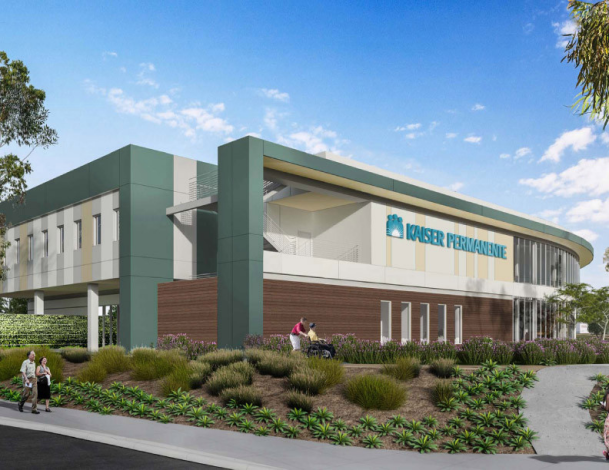
Caesar Group’s Future Community Diagnostic and Treatment Center
Bernard’s vision for the future of healthcare certainly does not stop at online medical services. In addition to investments in IT, Kaiser has also spent heavily to build high-tech diagnosis and treatment centers.If online portals serve as the virtual landing points for Kaiser’s model transformation, then care centers act as the physical landing points, aiming to shift medical services from hospitals to communities and members’ homes.The center’s first innovative pilot is located in Manhattan Beach, California.
A patient’s positive experience begins in the waiting room of the diagnostic and treatment center. Located in Manhattan Beach, with its pleasant climate, the center is decorated in a distinctive West Coast modernist style. Lush greenery and soft lighting create an especially soothing atmosphere. Near the front entrance stands a self-service kiosk resembling an ATM; patients who prefer not to wait for a receptionist can look up information on their own. When the physician is ready for the consultation, patients receive an automated notification.
Upon entering the examination room, the first thing that catches your eye is a spacious leather examination chair, rather than the seats that typically cause patients embarrassment and discomfort. The physician seated opposite the patient can perform various tasks using an iPad or a wall-mounted touchscreen, such as sending prescriptions to the pharmacy and reviewing X-rays and laboratory results. The patient simply sits comfortably in the center of the room, with all care and attention revolving around them.
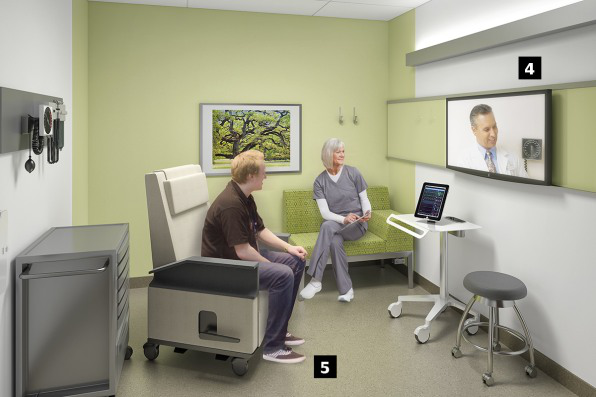
Internal Environment of the Diagnosis and Treatment Center
“How can we, as a healthcare organization, demonstrate care and respect for our patients, provide them with comprehensive diagnostic and treatment information, and create a seamless patient experience?” Bernard stated that this very question drove them to redesign the examination rooms. Kaiser Permanente advocates for a human-centered, design-led healthcare experience, and the renovation of its examination rooms is merely the tip of the iceberg in its vision for the future of healthcare.
The Manhattan pilot site features 12 examination rooms with a total area of 8,000 square feet, making it the smallest among all pilot locations. In June 2017, they will open their largest pilot site in the Baldwin Hills–Crenshaw neighborhood of Los Angeles. Including activity spaces and a garden with a two-mile walking path, the total area will reach 100,000 square feet.。
In such large-scale centers, the patient experience is significantly enriched. The reception area is designed to resemble a public plaza, allowing patients to take leisurely walks during long waiting periods or obtain free information on exercise and nutrition at an information counter called the “Thrive Bar.” Furthermore, members can participate in yoga classes, attend cooking demonstrations, and engage in various other indoor and outdoor activities offered by Kaiser.
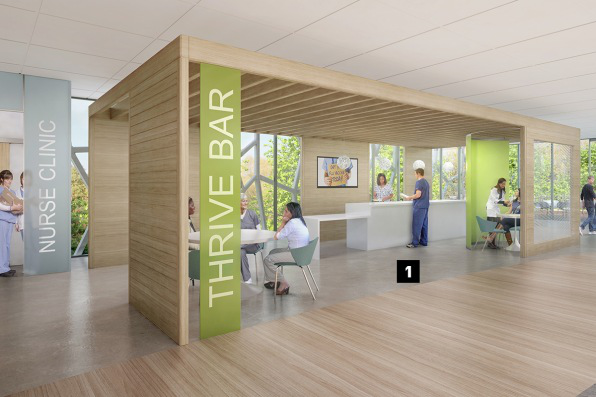
Thrive Bar’s information desk offers free access to fitness and nutrition information.
Kaiser’s innovative concepts have upended the traditional image of hospitals. Drawing inspiration from service industries such as Starbucks, these new care centers resemble community coffee shops, where members can stroll and exercise along garden paths and access health education in waiting areas, rather than simply seeking medical treatment. Bernard views these pilot projects as experiments in workflow and construction standards, with the ambition to reshape all of Kaiser’s healthcare facilities across China in this manner.
“The traditional culture in the healthcare industry is to welcome patients into the hospital, complete the diagnosis and treatment, and then see them off. However, we want our members to be willing to stay a bit longer; this is not just about doctor consultations but also concerns the overall health status of our members.” Great emphasis is placed on patient education and disease prevention, which is particularly important for the unique model of Kaiser Permanente.
In fact, the construction of new diagnostic and treatment centers is closely tied to cost reduction, as they can deliver medical services to members more efficiently. Kaiser Permanente projects that in-person consultation rates at the first ten pilot diagnostic suites will increase by 20%–40%, while medical costs will be reduced by 10% thanks to redesigned workflows and multi-faceted technology investments.。
The Transformation of Industry Giants Is Imperative
Although Kaiser Permanente has long been regarded as a giant in the healthcare market, service demand continues to expand amid competition from other large companies and startups.New healthcare centers represent a comprehensive transformation of the patient experience, with every aspect—from the design and décor of registration and waiting areas to interactions with medical staff—being completely revitalized.。
At the Healthcare Information and Management Systems Society (HIMSS) conference, Richard Daniels, Chief Information Officer of Kaiser Permanente, stated that in 2015, the coverage rate of U.S. government-funded healthcare programs would increase from 40% in 2013 to 60%. The greater government investment and financial burden mean that higher demands will be placed on the healthcare services industry.
“We have to consider adopting better technologies and implementing more effective business models,” said Richard. In fact, Kaiser Permanente did not rely on any unique, cutting-edge “black box” technologies; rather, it was more willing to invest billions of dollars and leverage a diverse array of technologies.
In addition to the innovative transformations mentioned above,Kaiser also announced that it would open its own medical school in Pasadena, California, in 2019, signaling that physician training and education have become a key component of its new model.。
Faced with increasingly fierce competition, Kaiser Group CEO Bernard remains undaunted: “In the healthcare industry, many still struggle to view patients as consumers, but Kaiser is pioneering this shift in mindset.”
Kaiser, the established industry titan, has already become the most innovative pioneer in the healthcare sector.
References:
https://share.kaiserpermanente.org/article/future-care-delivery/
https://www.fastcompany.com/3057404/kaiser-permanente-designed-a-health-center-that-puts-patients-first
http://medcitynews.com/2017/02/kaiser-permanente-cio-business-models/?rf=1