

Tasly Invests €20 Million in French Biotech Firm Pharnext and Establishes RMB 142.86 Million Joint Venture for Neurological Drug Development
VCBeat learned from Tasly’s early morning announcement today that Tasly plans to invest €20 million in Pharnext, a French new drug development company, through its wholly-owned subsidiary Hong Kong Tasly, acquiring a 12.59% stake in the company.
Meanwhile, Tasly and Pharnext will jointly establish a joint venture in Tianjin, China. Tasly will contribute RMB 100 million in cash, while Pharnext will contribute RMB 42.85 million in cash. The company will provide services including drug research and development, technological innovation, technical consulting, and advisory services, leveraging the technological strengths of both Tasly and Pharnext.
Total cost reached 250 million
The two transactions combined will cost RMB 250 million, which is no small sum even for a company of Tasly’s scale. So what exactly is the allure of this French new-drug R&D company called Pharnext?
According to announcements retrieved from VCBeat, Pharnext (full name: Pharnext S.A.) was founded by Daniel Cohen in 2007 and listed on the Euronext Paris exchange in July 2016.
Pharnext is dedicated to the development of synergistic combination therapies, focusing on orphan drugs and mainstream medications for neurological disorders, including Charcot-Marie-Tooth disease, Alzheimer’s disease, Parkinson’s disease, and amyotrophic lateral sclerosis.
The company’s core technology is its proprietary biological network pharmacology platform, which conducts virtual screening of marketed drugs to develop combination therapies with independent intellectual property rights and ultra-low-dose formulations for the treatment of other diseases. Pharnext currently has two combination drugs in clinical development: PXT3003 for the treatment of Charcot-Marie-Tooth disease type 1A (CMT1A), and PXT864 for the treatment of Alzheimer’s disease.
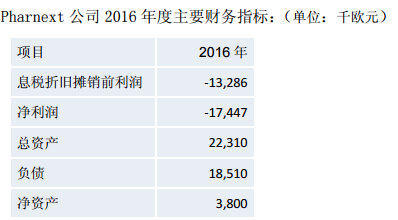
According to the announcement disclosed by Tasly, Pharnext’s total assets at the end of 2016 were €22.31 million (approximately RMB 167 million), with liabilities of €18.51 million and net assets of €3.8 million.
In terms of the specific investment structure, Tasly will invest a total of €20 million in Pharnext through its wholly-owned subsidiary, Tasly (Hong Kong) Pharmaceutical Co., Ltd. (hereinafter referred to as “Tasly Hong Kong”). This investment will be executed by subscribing to newly issued ordinary shares of Pharnext for €5 million (hereinafter referred to as the “Equity Investment,” corresponding to a post-investment shareholding of 3.57%) and subscribing to convertible bonds worth €15 million (hereinafter referred to as the “Convertible Bond Investment”; upon successful conversion, this investment would yield 1.1538 million shares, corresponding to a post-investment shareholding of 9.02%). The combined post-investment shareholding in Pharnext will amount to 12.59%.
A joint venture with a registered capital of RMB 200 million will be established.
In addition to direct investment, Tasly and Pharnext will establish a joint venture in Tianjin, China, with a registered capital of RMB 200 million, to facilitate the localization of Pharnext’s technologies and products in the Chinese market.
Among them, Tasly contributed RMB 100 million in cash, while Pharnext contributed technology valued at RMB 42.857 million in accordance with the provisions of its "Terms and Conditions for Proprietary Technology License." Its founder, Daniel COHEN, received equity shares in return for providing technical support. The difference between the total investment amount and the registered capital shall be resolved through loans as determined by the Board of Directors.
The joint venture’s business focus is on product research and development (R&D) and product management, including drug research, development, and regulatory filing, as well as technology licensing and transfer related to developed products; import and export of goods and technologies; and the provision of consulting and advisory services related to drug R&D technologies to enterprises and R&D institutions.
The initial focus of the collaboration lies on PXT3003, a novel drug under development by Pharnext, as previously mentioned. PXT3003 is an exclusive patented combination therapy for the treatment of Charcot-Marie-Tooth disease type 1A (CMT1A). Charcot-Marie-Tooth disease, also known as Hereditary Motor and Sensory Neuropathy (HMSN), exhibits significant genetic heterogeneity. The incidence in Europe and the United States ranges from 1:3,300 to 1:2,500, with CMT1A accounting for 37%–57% of all CMT cases. Epidemiological data in China remain scarce.
Currently, there are no medications with proven efficacy for the treatment of Charcot-Marie-Tooth disease (CMT) worldwide. PXT3003 has demonstrated promising therapeutic effects for CMT1A in Phase II clinical trials conducted in Europe and the United States. Developed simultaneously in these regions, it has been granted orphan drug status by both the U.S. Food and Drug Administration (FDA) and the European Medicines Agency (EMA).
VCBeat has learned that PXT3003 has completed a Phase II clinical trial involving 80 patients across six centers and is currently conducting synchronized global Phase III clinical development. The international Phase III clinical study, encompassing 27 clinical centers in Europe and the United States, was launched in the fourth quarter of 2015 and has completed enrollment screening for 300 patients with mild-to-moderate Charcot-Marie-Tooth disease type 1A (CMT1A). Pharnext is actively working to secure early market access authorization for the drug in Europe as soon as possible, enabling its commercial sale in the European market.
Tasly stated that, following the drug’s introduction into China, it will promptly initiate the new drug application process, coordinate with relevant regulatory authorities to identify efficient approval pathways, and accelerate the review and approval procedure.