

Airdoc DR, AI-Powered Diabetic Retinopathy Screening System, Debuts at Microsoft Build 2017 and Files IPO Prospectus
VCBeat has learned that on May 10, Airdoc’s DR system was unveiled at the Microsoft Build 2017 Developer Conference. DR is an auxiliary analysis system for diabetic retinopathy, designed to identify and screen for diabetic retinal lesions. Airdoc’s AI-assisted analysis solution has been widely adopted in numerous hospitals, including Shanghai Changzheng Hospital, becoming a valuable tool for physicians to rapidly and accurately analyze diseases.
Airdoc, with its AI-assisted analytical applications in the medical field,Becoming the First Chinese Startup to Appear in the Build Conference Keynote, and is also a key case selected by Microsoft after rigorous screening from among AI companies in more than 140 countries worldwide.
The Build Developer Conference is Microsoft’s annual flagship event, consistently drawing tens of millions of developers worldwide who follow it closely through various channels. On-site tickets, priced at over $2,000, are notoriously difficult to secure. Making an appearance this year is Airdoc, a typically low-profile artificial intelligence company specializing in the healthcare sector.
According to VCBeat, Airdoc has long established in-depth collaborations with dozens of leading medical institutions in China and the United States, and it is the first artificial intelligence enterprise in the medical field in China to secure multiple rounds of investment from renowned institutions.
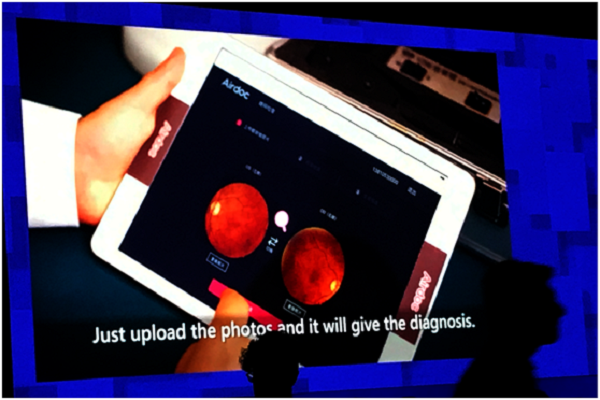
(Figure: Airdoc at Microsoft Build 2017)
Diabetic Retinopathy Fundus Image Recognition and Lesion Area Detection
Diabetic Retinopathy (DR) is one of the most common complications of diabetes. The number of diabetic patients in China has been increasing year by year, exceeding 100 million, with DR patients accounting for 25%–38% of all diabetic cases. According to predictions by the World Health Organization, the global number of DR patients will rise to 366 million by 2030.
Diabetic retinopathy is an irreversible, blinding eye disease. Patients in the early stages of diabetic retinopathy are typically asymptomatic; symptoms usually manifest only when the disease has progressed to a more severe stage. Early diagnosis and treatment of diabetic retinopathy can effectively prevent visual impairment and blindness.
Based on extensive fundus image datasets annotated by numerous expert physicians, Airdoc leverages deep learning technologies and designs specialized deep neural network architectures to achieve recognition of diabetic retinopathy in fundus images and detection of diabetic retinopathy lesion regions.
Professor Wei Ruili of Shanghai Changzheng Hospital commented on Airdoc as follows: “With the Airdoc DR system, we can extend the expertise of our specialist physicians and our diagnostic capabilities across China. In other words, images captured by mobile phones or professional medical devices from any location can be transmitted to the cloud for auxiliary analysis to obtain accurate recommendations, enabling patients to receive early prevention guidance and analytical support at any time.”
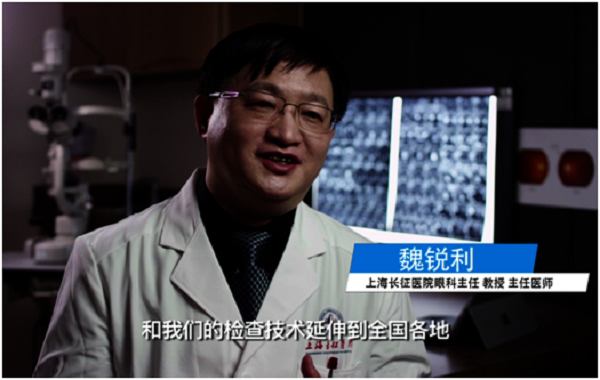
Professor Wei Ruili, Shanghai Changzheng Hospital, Second Military Medical University
Dr. Huang Xiao from Shanghai Changzheng Hospital expressed strong approval for the simplicity and ease of use of the Airdoc AI-assisted analysis system in an interview, stating, “Airdoc DR is highly useful and very easy to operate. We can access it directly from the cloud within the hospital. After logging into the system, entering some medical history information, and uploading images, the system automatically provides auxiliary reference opinions.”
Airdoc’s Origins with AI
Artificial intelligence has undergone 60 years of development. Since 2016, numerous industries have begun to embrace AI. For instance, autonomous driving, facial recognition, and smart healthcare have all become hotspots. Countless companies, large and small, are dedicated to leveraging artificial intelligence to solve problems, with “AI+” now standing at the forefront of technological innovation.
Against the backdrop of scarce medical resources becoming a global issue, artificial intelligence is considered the most effective way to increase the total supply of medical resources. Zhang Dalei introduced to VCBeat that Airdoc’s image-assisted analysis system has been practically applied in doctors’ work in various countries over the past two or three years and has received positive feedback.
Airdoc was founded by core technical experts from leading companies and their research institutes, including Microsoft, Samsung, Yahoo, and Google. Airdoc’s solutions have been widely adopted worldwide in fields such as radiology, pathology, cardiology, neurology, dermatology, and ophthalmology, assisting physicians with the auxiliary analysis of a broad range of conditions. Unlike laboratory-stage products, Airdoc has long been deployed in real-world clinical settings, addressing many practical challenges encountered by physicians in their daily work.
As Airdoc specializes in medical image recognition, the majority of the medical images involved are high-resolution, which drives up computational costs and necessitates solutions for large-scale computing. For sensitive data and model training, Airdoc has established its own high-security data centers; for non-sensitive model training, Airdoc was among the earliest users of AWS China’s GPU services and one of the earliest commercial partners of the Microsoft Cognitive Toolkit.。
AI Empowers the Decentralization of Medical Resources
The “13th Five-Year Plan for National Informatization,” under the “Healthy China Information Services Initiative,” explicitly states that it will promote the application of artificial intelligence in disease prevention, assisted diagnosis, public health emergencies, healthcare, and daily nursing care.
The healthcare market is vast. Research predicts that global health big data storage volume was 500 PB in 2012 and will reach 25,000 PB by 2020, a 50-fold increase. The entire industry offers numerous opportunities, such as clinical decision support, medical image recognition, drug development, and health management.
In China, Airdoc has amassed extensive expertise in the healthcare sector. Zhang Dalei has also been invited to serve in various academic and industry organizations overseen by the National Health and Family Planning Commission and the China Association for Science and Technology, and has frequently participated as an expert judge at national conferences on public health.
In the foreseeable future, the Airdoc Medical Assistance Analysis System will continue to extend the technical capabilities of top-tier medical institutions across China, providing real-time analytical support to primary healthcare facilities. This initiative will facilitate the continuous decentralization of high-quality medical services and offer robust support for family doctor contract services.