

Guardant Health Secures $360 Million Series E Funding to Accelerate Cancer Early Detection Through Liquid Biopsy
On the morning of May 12, U.S. biotechnology company Guardant Health announced a major development: the company has secured up to $360 million in Series E financing and plans to sequence tumor DNA for more than one million cancer patients within five years.
Guardant Health, founded in 2013, is a California-based liquid biopsy company focused on cancer diagnosis and management, aiming to identify the optimal real-time treatment regimen for patients based on their specific tumor cells. In 2014, the company launched its first commercial blood-based cancer screening product, Guardant360, which enables non-invasive cancer screening using only two small vials of blood.
Grail, the Silicon Valley company previously covered by VCBeat, is Guardant Health’s biggest competitor. Spun out of Illumina, Grail holds certain advantages in resources and platform capabilities. In March this year, Grail announced a massive $900 million financing round, with pharmaceutical giants such as Bristol-Myers Squibb and Johnson & Johnson among its investors. Last month, Grail further announced that it would recruit 120,000 women to launch the large-scale STRIVE trial.
As competitors launched aggressive moves, Guardant Health was quietly preparing a major strategic initiative. The company had previously conducted tests on 40,000 individuals. This round of financing will expand Project LUNAR, Guardant Health’s early cancer detection program announced in 2016.
Project LUNAR is a highly ambitious initiative by Guardant Health to apply its Guardant360 technology for detecting minimal residual disease in cancer survivors and for early detection in high-risk populations. The company aims to leverage its technological platform for early detection, recurrence monitoring, and assessment of minimal residual disease.
The initial LUNAR product will seek evidence of residual disease in patients who have undergone surgery, radiation therapy, or other treatments aimed at curing cancer. Guardant Health then plans to introduce the test in high-risk patients who have not yet been diagnosed, to detect early signs of cancer.
Guardant Health emphasizes that the purpose of the test is not to promote the product, but rather to collect more data.
“We can liken Guardant to a security antivirus software, with cancer being the malicious program within cells. The earlier we detect them, the sooner we can eliminate them,” said Helmy Eltoukhy, Co-founder and CEO of Guardant Health. “This is the significance of liquid biopsy in cancer screening.”
Eltoukhy revealed that Guardant hopes to help people detect traces of cancer in their bodies at an early stage through simple blood tests, identifying the disease when it is still curable. Liquid biopsy captures minute fragments of tumor DNA in patients’ blood using DNA sequencing technology. However, Eltoukhy noted that although this technology has demonstrated remarkable potential in cancer detection, extensive trials are still required for validation: “We will adopt a phased strategy to gradually advance cancer detection toward early-stage screening.”
The first step is to address the limitations of clinical tissue biopsies. For some patients undergoing physical examinations, the invasiveness of tissue biopsy is not tolerable. Currently, Guardant has partnered with the M.D. Anderson Cancer Center to employ liquid biopsy technology in these patients.
Scott Kopetz, an Associate Professor at MD Anderson Cancer Center, believes that although tissue biopsy is more commonly used in clinical practice, liquid biopsy will hold greater value in the future: “Liquid biopsy can provide higher resolution than previous technologies.”
In the earliest stages, cancer was treated through surgery. Later, specific drugs began to be used for treatment. However, in Kopetz’s view, early detection is key to gaining the upper hand: “This technology has the potential to be a game-changer in the field of oncology,” said Kopetz.
Eltoukhy believes that one of the core challenges in conquering cancer is big data, as researchers have long suffered from a scarcity of data. The company’s launch of the world’s first commercially available comprehensive liquid biopsy has sparked a surge in cancer data collection, with every physician and patient using its products and services contributing to data research. Guardant will accelerate this progress over the next five years, providing the industry with much-needed data inputs.
Yet Guardant must confront a critical question: Is a trial involving one million individuals truly the right path to achieving early cancer screening? In contrast to Grail’s more aggressive approach, not all of Guardant’s data from this million-person cohort are derived from clinical trials. Instead, a larger proportion comes from commercial testing. Of course, this includes structured studies conducted at institutions such as the M.D. Anderson Cancer Center and other medical facilities, but the majority of the data will stem from patients’ continuous use of the product. Eltoukhy also acknowledged, “Pan-cancer detection will pose a major challenge for the company.”
“I believe it is very difficult to interpret these data,” said Luis Diaz, founder of the Center for Personalized Genomic Diagnostics at Memorial Sloan Kettering Cancer Center. “But if they can access individual-level data, there will be an opportunity to generate more information and bring new breakthroughs to this field.”
Guardant Health will apply its breakthrough technologies based on machine learning and genomics to cancer care. Guardant’s approach is built on intelligent science and smart business models, so the system’s capabilities grow with every use by physicians.
In this round, SoftBank is the largest investor. Masayoshi Son, Chairman and CEO of SoftBank Group, issued a statement saying, “We aim to help us become the industry leader and the Rosetta Stone in the field of cancer.”
In addition, other funds and investment institutions such as T. Rowe Price Associates, Inc. and Temasek have also participated. Existing investors, including Sequoia Capital, Khosla Ventures, Lightspeed Venture Partners, OrbiMed, and 8VC, continue to provide strong support.
According to VCBeat, Guardant Health secured $100 million in Series D financing in January 2016. To date, the company has raised a total of $550 million, though it has not disclosed its specific valuation.
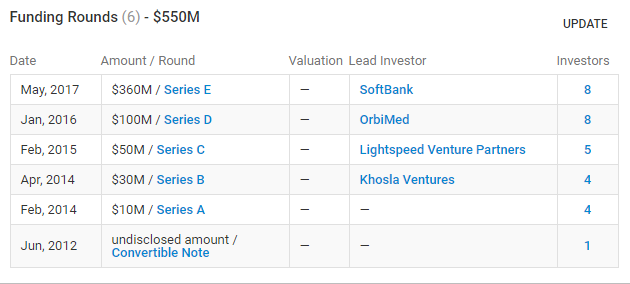
Guardant Health Historical Financing Data
In addition to funding news, Guardant and SoftBank also revealed plans to establish a new joint venture aimed at commercializing Guardant Health’s existing liquid biopsy technology in Asia, the Middle East, and Africa. “These regions see more than 7.8 million new cancer diagnoses annually, making it essential to promote Guardant’s technology there,” said Eltoukhy.