

How Alipay Won Over Healthcare Professionals in Just Three Years
Unbeknownst to many, Alipay’s “Future Hospital” initiative has already entered its third year. From the launch of cloud hospitals and the integration of medical insurance payments to gradually securing a dominant position in the mobile healthcare sector, the journey has been smooth sailing, as ifIt,Skillfully circumvented external resistance. While many internet healthcare companies repeatedly hit walls, Alipay quietly and gradually penetrated every aspect of the healthcare sector...
Data, generally speaking, does not lie.
As of May 2017, there have been more than1,500 Public HospitalsJoin Alipay’s “Future Hospital,” coveringChina's 30 Provinces, Autonomous Regions, and Municipalities, recent200 Cities, cumulatively providing over [number] convenient services via Alipay, including real-name registration, mobile payment, and report inquiries.300 million visits, pharmacies that support Alipay have alsoOver 80,000. At the strategic cooperation meeting with Hangsheng Yuntai, Alipay once again announced its impressive achievements to the industry.
In fact, internet companies inevitably face exclusion from traditional enterprises. Much like newcomers setting up a street stall, they are perceived as threatening the livelihoods of locals. Even after having their business disrupted, they must put on a smile and mutter in acquiescence, “Well done!”
Is it because it was too aggressive? No.
As a leader in mobile consumption and finance, Alipay seems to possess a natural affinity, enabling all industry services related to “money” to be provided on the Alipay platform.Initially, many mocked its ingratitude, but it then shifted its stance and told the outside world: “We’re not vying for power or profit; we’re here to serve everyone. That shouldn’t be a problem, right?”"In this way, even the brick that the other party had just grabbed in their hand would likely have to be put back."
Clearly, such industry positioning allowed Alipay to reap significant benefits in its later development.
Alipay has always adhered to the philosophy of consolidating all industry chains involved in healthcare onto a single platform with the fewest possible steps. Internally, they refer to this driving force as “Techfin”, with its core strategy being to open up infrastructure to all ecosystem partners and customers, leveraging data as the foundation and technology as the means to enhance industry efficiency and reduce costs.
As a450 million usersAs a lifestyle services platform, Alipay has a sufficiently large user base to naturally become the core gateway for traffic distribution; secondly, it also possesses, includingReal-name Authentication, Financial Services, Ant Credit, Data Processingsuch capabilities, starting from “money,” firmly tether users to the entire consumption chain.
So, we cannot help but ask: What exactly has Alipay brought to the healthcare industry?
Back in 2014, it was still known as Alipay Wallet. Under the “Future Hospital Initiative,” Alipay’s medical development roadmap was divided into three phases:
Phase I: Assisting Hospitals in Establishing Mobile Healthcare Services
By leveraging Alibaba’s open mobile platform capabilities, payment and financial solution capabilities, and data capabilities, and by partnering with various Independent Software Vendors (ISVs), we collaborate with hospitals to build patient-centric smart healthcare platforms. This enables hospitals to deliver end-to-end mobile healthcare services—covering appointment registration, waiting, in-hospital navigation, payment, report retrieval, and doctor-patient interaction—thereby enhancing the patient healthcare experience.
Phase 2: Activating the Full Healthcare Ecosystem Services
In conjunction with the advancement of healthcare reform, all processes—including electronic prescribing via online platforms, localized medication delivery, patient referrals, real-time medical insurance reimbursement, and instant commercial insurance claims—are completed through internet-based services, thereby revitalizing the entire societal healthcare ecosystem.
Phase III: Co-building a Big Data-Based Health Management Platform to Transition from Treatment to Prevention
Open up big data platforms, leverage cloud computing capabilities, and collaborate with wearable device manufacturers, healthcare institutions, government health departments, and other stakeholders to jointly build a big data-based health management platform, facilitating the transition from treatment to prevention.
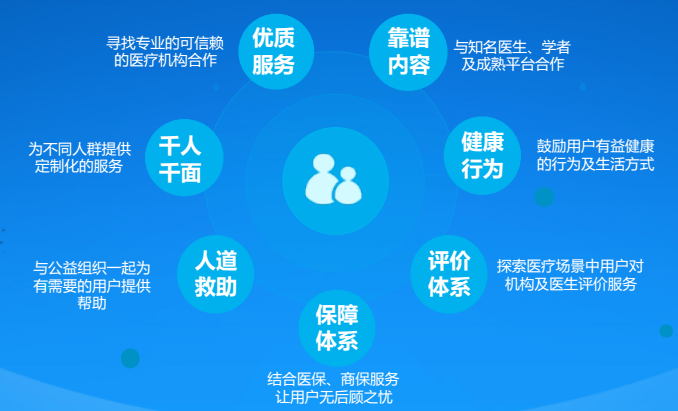
Ant Financial’s Open Healthcare Platform serves as the “soil, water, and air” that enables hospitals, medical insurance providers, pharmacies, and healthcare service companies to center their operations around user health management, thereby forming a comprehensive healthcare ecosystem.
At first glance, it may seem overly idealistic, but who would have thought that, leveraging their unparalleled execution capabilities in China, they actually managed to achieve it? Three years later, Alipay has not only successfully navigated the first two phases but is also making significant strides toward the third phase—big data.
Outside perceptions of Alipay seem to have gradually shifted from viewing it as a stereotypical second-generation rich kid who only talks big and makes empty boasts, to seeing it as a harmonious and amiable “Family Members”. Compared with the complacency of consumer industry giants, adopting a humble stance and starting from the grassroots level is clearly a wiser, albeit seemingly naive, approach.
Not long ago, at the strategic cooperation conference between Alipay and Hengsheng Yuntai, VCBeat had an exchange with Wang Bo, General Manager of Innovation and Intelligent Services Department at Ant Financial. One statement left a deep impression:
“China’s broader healthcare market must embrace a flourishing diversity, with an increasing number of responsible internet companies enhancing their service capabilities to provide the public with diversified choices. Ultimately, it is the entire ecosystem that will thrive.”
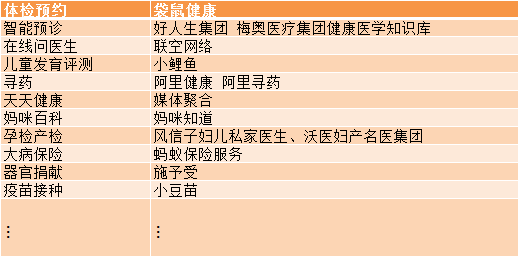
Nowadays, by opening Alipay and accessing its medical services, users can find the “Health Platform That Understands You Better,” jointly built with Hundsun Yuntai, which has successively launched services including health consultations, health information, maternal and child care services, and health finance.15 Health Management Services. It is foreseeable that more similar services will emerge, relying on this platform to continuously branch out and penetrate into various niche sectors of healthcare.
Artificial Intelligence and Cloud Computing
When it comes to deeper integration in the healthcare sector, it is impossible not to mention Alipay’s other partner—Alibaba Cloud.
As early as April 2015, Alibaba Cloud entered into a strategic cooperation agreement with Xi’an International Medical Center and Donghua Software to jointly build China’s first physical smart “Cloud Hospital”—the Xi’an International Medical Center. This institution is also the first physical healthcare organization in China to leverage data-driven precision medicine and health management.
Subsequently, Alibaba Cloud formed strategic partnerships with Hisida Technology, Xinyi International, and Jingyi Medical Cloud.
In April this year, “Tech Picks” released a revenue ranking of China’s professional cloud computing vendors. According to the list, Alibaba Cloud topped the chart in 2016 with revenues of RMB 5.56 billion—three times that of Microsoft Azure, which ranked second.
Meanwhile, Alibaba Cloud’s more ambitious plans gradually came to light. In March 2017, at the Apsara Conference Shenzhen Summit, Alibaba Cloud officially launched “ET Medical Brain.”
“ET Medical Brain” leverages deep learning technology to enhance its “clinical expertise” by analyzing vast amounts of case data, serving as a physician’s assistant in areas such as virtual patient assistance, medical imaging, precision medicine, drug efficacy mining, new drug development, and health management.
Of course, the emergence and application of this technology must be based on cloud computing. In retrospect, Alibaba’s early move was remarkably prescient.
Cloud computing has brought about two fundamental transformations to artificial intelligence:
First, as data computing shifts from local systems to the cloud, data that once resided in isolation across disparate systems in factories and hospitals has become online and interconnected, thereby laying the foundational conditions for the emergence of machine intelligence.
Second, the profound technological transformation brought by cloud computing to the IT industry has made access to computing power sufficiently simple and efficient.
On this point, Hu Xiaoming, Vice President of Alibaba Group, once stated: “As doctors integrate more of their clinical experience into this platform, Alibaba Cloud and our partners will increasingly deliver greater computational power to the market as a service. We are also integrating more deep learning capabilities into the platform, making it increasingly powerful. This will provide significant assistance in disease diagnosis and new drug development.”
Turning our attention back to the third phase of Alipay’s “Future Hospital” initiative, the core objective is to collaborate with ecosystem partners to jointly build a big data-based health management platform, thereby facilitating a shift from treatment to prevention.
Upon reflection, following the prevailing “playbook” of our time, the introduction of artificial intelligence in the wake of big data is a logical next step.
Therefore, it is highly likely that Alibaba Cloud and Alipay will truly join forces in the third phase. It is at that point that the industry barriers established by Alibaba within the healthcare system will truly demonstrate their value.
"Only when there is no enemy in your heart can you be invincible in the world."
Jack Ma seems to possess an innate contrarian mindset in business; while others follow one path, he deliberately chooses another, navigating it with greater ease and success.
“"If you treat your rivals as enemies, you lose before the first move is made. I believe the reason I have prevailed in competition with other enterprises is that I have never regarded them as competitors."”
Does Alipay Have Competitors? It May in the Minds of Others, but Perhaps Not in Jack Ma’s. One thing is certain: every path he has taken has evolved into a vast market, with the true beneficiaries often being the broader population. The healthcare industry appears to follow a similar pattern...