

Spok Reports Doubling of U.S. Hospital Mobility Strategy Adoption Over Five Years, Reaching 65% by 2017
In recent years, the rapid development of mobile internet has profoundly impacted every aspect of people’s lives.Meanwhile, the healthcare sector is leveraging various mobile solutions to enhance operational efficiency and deliver a “smart healthcare” experience for patients.According to statistics from Spok, the adoption rate of mobility strategies in U.S. hospitals has increased year by year. In just five years from 2012 to 2017, the adoption rate of hospital Mobility Strategy nearly doubled.
Spok, Inc. is a global leader in healthcare communications, headquartered in Springfield, Virginia, USA. The company is dedicated to providing care teams with the clinical information they need to improve patient outcomes. Its Spok Care Connect® platform has been adopted by numerous top-tier hospitals, supporting administrative compliance, enhancing clinicians’ workflows, and delivering a better patient experience.
Since 2011, Spok has been advocating for healthcare professionals to pay attention to the development of mobile health strategies. In this year’s report, “The Evolution of Mobility Strategies in the Healthcare Industry,”Spok focused its investigation on the timing of hospital mobile solution deployment, the oversight and execution of these solutions, the components of hospital strategic objectives related to mobile strategies, and more.VCBeat (WeChat: vcbeat) has compiled the key highlights of the report to provide insights into the current status, challenges, and future directions of mobile health adoption in U.S. hospitals.
The data in the Spok report, sourced from February 2017, is based on responses from more than 300 healthcare professionals in the United States. Among them, 22% were physicians, 13% were nursing staff, 10% were IT personnel, and 7% were executive-level leaders; the remaining 35% comprised other hospital staff, including risk managers, mobile engineers, infection prevention specialists, and directors of quality, risk, and compliance.
Definition of Mobile Strategy
Before formulating a mobile strategy, we must first understand what it entails. Based on the collected survey responses, there is currently no unified definition among relevant practitioners in the United States; different organizations have varying interpretations of “what constitutes a mobile strategy,” with some even unable to provide any explanation at all.
So, what exactly is a mobile strategy, and why do hospitals need to establish their own?Spok believes that a mobility strategy can help hospitals align mobile objectives with organizational goals and provide a framework for all mobility-related initiatives. In short, a mobility strategy integrates elements such as security, technology, and communication into a comprehensive plan to improve employee productivity and enhance patient care.
The Prevalence of Mobile Strategies Across the United States
Surveys over the years show that the adoption rate of mobile strategies in hospitals was 34% in 2012, rose to 44% in 2014, and is projected to surge to 65% by 2017. An increasing number of hospitals are dedicating valuable time and resources to developing formal mobile initiatives.
For organizations that have already implemented a mobile strategy, the survey inquired about the duration of its implementation. Approximately one-fifth of respondents indicated that they had formally adopted a mobile strategy for less than one year; 40% reported having done so for 1–3 years; and 39% stated that their strategy had been in place for more than three years. Establishing a formal mobile strategy is a critical first step in hospital mobilization; however, simple adoption rates do not reflect the details and comprehensiveness of such strategies. The report provides a more detailed analysis below.
Development of Mobile Strategy
In addition to assessing whether a formal mobility strategy has been established, Spok also investigated the measures healthcare organizations are taking to keep pace with evolving technologies and end-user needs. Accordingly, for respondents whose mobility strategies had been implemented for more than one year, the survey asked whether their mobility strategy had been updated since its initial implementation.
23% of respondents were uncertain, and 7% indicated that their mobile strategies had not been updated. Regarding the reasons for updating mobile strategies, the vast majority of respondents cited changes in end-user needs (44%) and advancements in technology and mobile devices (35%). Other reasons included new features from EHR vendors (26%), adjustments to align with changes in overall strategic objectives (23%), difficulties in implementing the original strategy (21%), and changes in hospital leadership (16%).
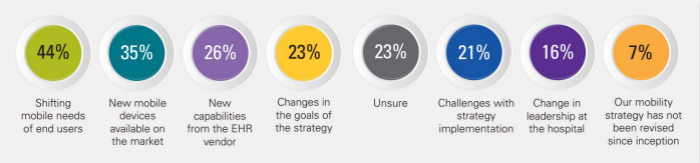
It is evident that mobile strategies are highly dynamic, with hospitals making adjustments based on diverse needs. Looking ahead, we anticipate a continued rise in the number of hospitals adopting mobile strategies.Currently, hospitals are facing numerous challenges, such as the increasing severity and frequency of security vulnerabilities year by year, and the constantly changing needs of end-users. Meanwhile, new mobile devices and solutions aimed at addressing clinical and operational issues continue to emerge.。
All of this means that hospitals that have not yet refined their mobile strategies and plans will face increasing inconveniences and pressures across all fronts. Even organizations that introduced their mobile strategies just two years ago have already begun updating and revising their guidelines.
This is because a mobile strategy must continuously evolve to remain relevant in a rapidly changing environment if it is to succeed. We also anticipate that more hospitals will establish dedicated cross-functional teams focused on mobile support, tasked with overseeing the development of mobile strategies and ensuring that these strategies and objectives are kept up to date at all times.
Consistency of Strategy
One of the primary functions of a mobile strategy is to align mobile initiatives with hospital objectives and serve as the framework for designing all mobile-related projects.To examine the relationship between mobile strategies and hospital strategic objectives, we asked respondents in our survey whether these two elements were closely aligned within their institutions. Based on the responses received, the majority of respondents indicated that their hospitals’ mobile strategies rarely incorporate institutional strategic objectives.
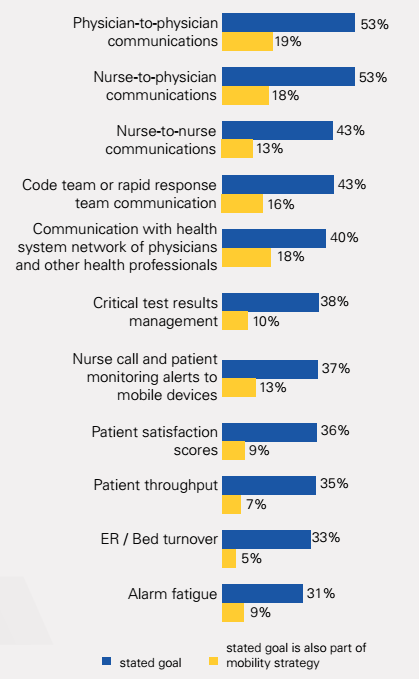
53% of respondents stated that improving physician-to-physician and nurse-to-physician communication is a goal for their hospitals, while 43% cited improving nurse-to-nurse communication. Correspondingly, 19% of respondents indicated that improving physician-to-physician communication is also included in their hospital’s mobility strategy, with 18% for nurse-to-physician and 13% for nurse-to-nurse communication.
Additionally, nine other options, ranging from improving code team communication to fatigue warning lights, showed similar trends, with the inclusion of hospital goals in formal mobility strategies ranging between 5% and 18%. This result indicates that some teams responsible for planning mobility strategies have seized the opportunity to focus on more impactful operations aligned with the strategic goals of hospitals.
Furthermore, it reveals that there is still significant room for growth in mobile strategies, which should be more closely integrated into the hospital’s overall objectives within their mobile planning. If hospitals adopt a mobile strategy without considering how to leverage mobile solutions to enhance clinical workflows and achieve strategic goals, they will miss the opportunity to maximize the return on their mobile investments.
Participants in the Mobile Strategy
Over the past few years, we have continuously surveyed hospital personnel involved in formulating mobile strategies.This year’s results show that the IT department remains the most frequent initiator of mobility initiatives, at 82%, a decline of only 4 percentage points from 2014. Participation by the communications department (34%) and senior management (14%) has also decreased to some extent over the past three years. However, engagement among clinical staff and external experts has increased significantly.。
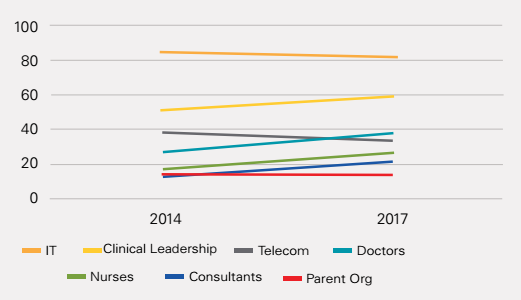
Clinical leadership engagement rose from 51% in 2014 to 60%, with physician and nurse engagement increasing by 9% and 10%, respectively.The trend of including clinical staff in mobile strategy planning teams is becoming increasingly evident, indicating that hospitals are gradually recognizing the importance of clinical perspectives in the formulation of mobile strategies.。
Clinical staff are typically both the end users of mobile devices and employees required to comply with mobile policy guidelines. Their involvement helps ensure that strategies account for clinical concerns and practical barriers, thereby grounding the design of mobile strategy processes in real-world clinical workflows.
For example, merely identifying “secure text messages” as a mobile security initiative is far from sufficient; it is essential to consider how clinicians use these secure texts from a communication perspective.
If a resident physician needs to consult the on-call cardiologist regarding a patient’s issue, how would they identify the correct recipient for a text message? Would they manually enter the phone number, or locate the appropriate contact within a secure messaging application before sending the message? Overlooking this critical detail by failing to include physician and nurse information in the design specifications could hinder the hospital’s two key objectives: improving communication between physicians and between nurses and physicians.
Furthermore, clinical staff joining the planning team can also propose practical solutions.Compared with solutions developed solely by IT or telecommunications departments, input from peer clinicians is more effective in driving the adoption of mobile health strategies. In short, while the involvement of physicians and nurses in mobile strategy planning continues to rise, their participation rate remains below 40%, leaving substantial room for improvement in the future.。
Certainly, the involvement of external mobile communications experts is also crucial in strategic planning. They can provide professional advice to help hospitals select mobile technology equipment, guide them through solution deployment, define success metrics, and assist with various aspects ranging from infrastructure requirements and change management understanding to the development of implementation plans and end-user adoption.
Furthermore, they can help enhance the competence and skills of hospital IT staff and provide best practice knowledge tailored to the healthcare industry. Since 2014, the involvement of technology vendors or external consultants in formulating mobile strategies has also increased, rising from 14% to 22%.
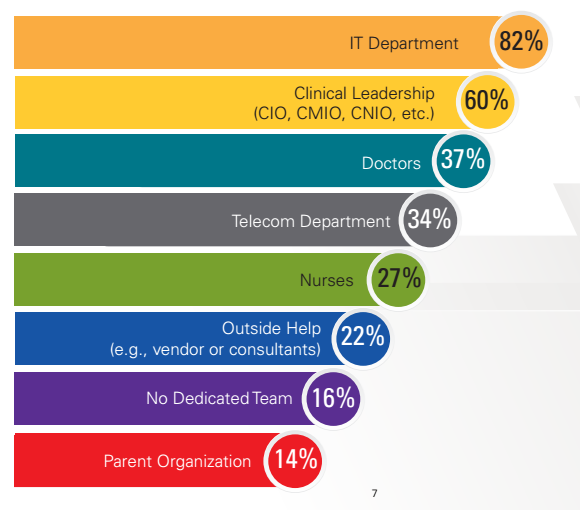
We anticipate that as the alignment between hospital objectives and mobile strategy goals strengthens, engagement among clinical staff and external experts will continue to rise.
The Ultimate Destination of Mobile Strategy
Currently, the planning of mobile strategies is still led by IT departments, which are typically responsible for formulating these strategies and translating them into tangible technological realities. However, only 25% of respondents consider mobile strategy to be a technical initiative. Twenty-four percent view it as a clinical initiative, while as many as 47% describe mobile strategy as a communications initiative.
Interestingly, as noted above, the involvement of communications in formulating mobile strategies is relatively low (only 34%). The mismatch between strategy design and execution may stem from varying interpretations among respondents; however, this also indicates, to some extent, that hospitals have missed opportunities to build stronger cross-functional teams when establishing mobile initiatives and objectives.
Members of the communications team are experts in communication infrastructure. They understand the storage and accessibility of contact data, such as phone numbers, pager numbers, on-call schedules, and code team member lists. They are also well-versed in existing communication channels and processes. Involving them from the outset of strategy development can help prevent unexpected delays during the implementation of mobile strategies and initiatives.
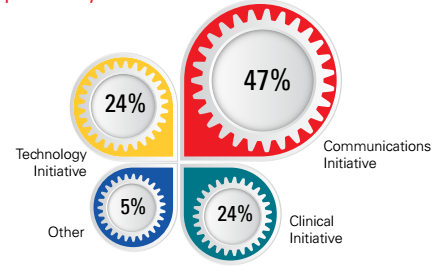
Under “Other,” respondents provided varied subjective responses. Some hospitals view mobile strategies as security initiatives tied to HIPAA compliance. However, we believe that security should be a consideration in formulating mobile strategies, rather than the driving force behind their development.
Many respondents also indicated that mobile strategy is an initiative that overlaps with technology, communications, and clinical aspects.Overall, the answer to this question indicates that mobile health strategies are still evolving, with significant variations in practices among different hospitals and healthcare systems.
Executors of the Mobile Strategy
Formulating policies or rules is far easier than ensuring compliance. In our survey, we asked hospitals what measures they had taken to oversee the implementation of their mobility strategies and how these strategies were enforced. Twenty-five percent of respondents indicated that their mobility strategies were implemented by a security team responsible for overseeing the hospital or healthcare system.
This indicates that in some hospitals, mobile strategies are still regarded as a security measure to manage various approved methods for sharing (or not sharing) patient information via mobile devices. Nineteen percent of respondents reported that their mobile strategies were implemented by communications teams, while only 9% had a dedicated mobile team overseeing and enforcing these strategies. Fourteen percent of respondents indicated that the implementation of mobile strategies was distributed across various departments. Twenty-five percent of participants stated that their institutions lacked any mechanism for implementing mobile strategies.
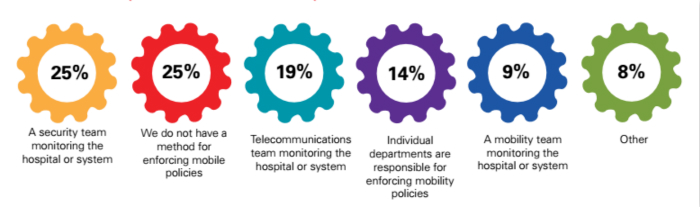
These findings indicate that there is still room for further development in the oversight and execution of mobile health strategies. If documentation regarding mobile health strategies lacks details on the content, frequency, and targets of oversight, implementation will pose a significant challenge. Furthermore, effective oversight requires substantial time and effort. Overall, the success of mobile health strategies hinges on coordination between management and execution levels, which represents a key area for future development.
Standards for a Successful Mobile Strategy
We investigated whether hospitals and healthcare systems measure the effectiveness of their mobility strategies in achieving their objectives. When respondents were asked if their organizations had formal evaluation processes to assess the success of mobile support initiatives, 32% responded affirmatively, while 68% indicated they did not.
Similar to oversight and execution, defining metrics for success is a critical component that may be overlooked during the early planning stages of a mobile health strategy. A robust mobile health strategy should establish quantifiable indicators from the outset to define desired outcomes, such as enhancing communication between physicians and nurses or improving patient satisfaction scores. Clearly defined success criteria help keep the planning team focused on ultimate objectives and align the interests of various stakeholders.
Clearly articulating the ultimate objective is crucial for formulating a mobile strategy, because:
1. Clearly define the final outcomes and metrics.
2. Helps keep the mobile team motivated to overcome obstacles.
3. Aligning all stakeholders and end-users under a shared objective yields clear benefits for hospitals, individual healthcare professionals, and patients.
Adoption of Mobile Strategy
Engaging stakeholders (such as physicians and nurses using mobile devices) or department heads responsible for policy implementation is crucial to driving the adoption of new technologies in organizations resistant to change. Based on our communication experience with clients, approaches vary across organizations: some adopt a laissez-faire stance, while others employ more coercive measures, such as imposing financial penalties on departments or individuals that fail to adopt new applications or devices.
Therefore, in this year’s survey, we asked respondents how their hospitals are driving the adoption of new technologies associated with mobile strategies (such as the use of secure text messaging applications provided by the hospital).
In the survey, we received over 200 open-ended responses, with the most common themes being:
1. Education
2. Encourage the use by key opinion leaders among physicians
3. Provide training and help desk support
4. None
Some respondents capitalized all the letters in “none,” vividly conveying their frustration with the lack of a change-encouraging culture at their institutions. Twenty-five percent of healthcare professionals indicated that their organizations had no mechanisms to monitor or enforce compliance. Meanwhile, 68% lacked formal success review processes, making it impossible to determine whether existing strategies needed refinement or adjustment.
Alternatively, at the outset of designing their mobile strategies, hospitals or healthcare systems may have failed to anticipate the need for future modifications in response to evolving circumstances, nor did they account for the allocation of time, budget, and staff resources required for implementing new technologies.
Some respondents proposed more creative solutions, such as garnering acceptance and support at the grassroots level, offering financial incentives, providing food, and creating Facebook pages.. While food can encourage meeting attendance and financial incentives can stimulate increased participation, perhaps the most powerful tool for driving effective change is demonstrating personal value through new solutions.
One respondent noted that his hospital would have the same individual perform the same task using two different methods, allowing them to personally experience the superiority of the new approach. If the new technology is demonstrably superior to the old one, adoption rates will increase; furthermore, endorsement by key opinion leaders (KOLs) will facilitate its dissemination and encourage broader uptake.
Future Outlook
Mobile strategies are gaining momentum, with increasingly widespread adoption in the healthcare sector and growing maturity through continuous revisions and refinements. Nevertheless, significant room for growth remains, necessitating sustained development. A key focus in advancing mobile strategies is to enhance the engagement of clinical personnel during the strategic planning phase.
Engagement from physicians, nurses, and clinical leaders can provide crucial end-user insights, helping to mitigate risks and enhance adoption rates among clinical staff. Another key focus is integrating the hospital’s strategic initiatives into its mobile health strategy. Hospitals should broaden their perspective: beyond merely adopting new technologies or safeguarding data, they should align their mobile initiatives as closely as possible with annual institutional goals, such as improving patient satisfaction scores and reducing average length of stay.。
Note: The above content is compiled by VCBeat and does not represent the views of VCBeat.