

Current Status and Challenges of Taiwan's Primary Healthcare: Insights from Dr. Ke Shao-Hua of Min-Sheng General Hospital
On May 17, the “2017 China Primary Healthcare Innovation Practice Forum,” co-hosted by VCBeat (WeChat: vcbeat), Eggshell Research Institute, and the China Association for Promotion of Rehabilitation Technology Translation and Development, was held in Chengdu. The conference explored development trends in the primary healthcare industry from the perspectives of industrial policy, technological evolution, business models, and industrial collaboration. It brought together professionals from various sectors of the industry to participate in keynote speeches, roundtable discussions, and other activities.
This article presents a sharing session titled “The Current Status and Dilemmas of Primary Care in Taiwan,” delivered by Dr. Ke Shaohua, Vice President for Quality and Administration at Min Sheng General Hospital in Taiwan. VCBeat has compiled the on-site transcript for our readers’ benefit.
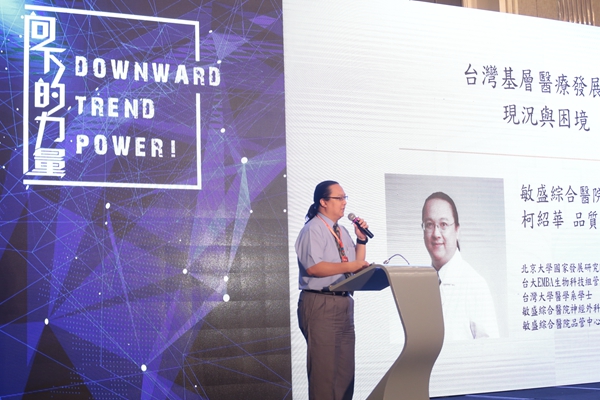
Dr. Shao-Hua Ko, Vice President of Quality and Administration at Taiwan Min-Sheng General Hospital
Ke Shaohua: Thank you all, and thank you to the organizers for the invitation. It is a privilege to have this opportunity to gather with our primary care colleagues from mainland China and share experiences. Taiwan started developing its primary care sector several decades earlier. Along the way, we encountered numerous challenges, which we subsequently resolved. Later, new issues emerged, which in itself isThe Ongoing Process of Confronting and Resolving ProblemsNext, let us take a moment to briefly introduce the historical background of the development of primary healthcare in Taiwan over the past century, and how we have sought solutions to address these challenges.
The modern healthcare system in Taiwan traces its origins to the Japanese colonial period. During this era, political public health and medical modernization were strategic objectives. It was an arduous time for the Taiwanese people, with top students predominantly enrolling in medical programs. Over more than five decades of accumulation, physicians emerged as the elite class. Many engaged in resistance against Japanese rule or navigated life under colonial governance, providing substantial support to grassroots healthcare.
From 1945 to 1975, a defining characteristic of Taiwan’s medical ecosystem was that the majority of large-scale healthcare institutions were publicly owned, with virtually no private hospitals in existence. Continuing the trend from the 50 years of Japanese colonial rule, private primary care providers assumed the responsibility of delivering medical services in remote rural areas. During these three decades, Taiwan’s relatively closed society, compounded by the legacy of the preceding decades under Japanese rule, constrained the development of its healthcare sector.
Until 1975, which marked a watershed moment for healthcare in Taiwan., it is widely known that the private healthcare system was established in 1975. That year marked the beginning of licensing for private hospitals, leading to the proliferation of both basic private medical practices and large-scale corporate medical groups. Of course, the period from 1975 to 1995 also coincided with Taiwan’s rise as one of the “Four Asian Tigers.”
From the perspective of physicians and healthcare supply, we believe this was Taiwan’s golden age. With pricing power in hand, private providers had highly favorable conditions to attract talent originally employed in public hospitals and large medical centers. Over a 20-year period, many professionals flocked to private hospitals and primary care settings, marking a phase of vibrant diversification across the hospital sector. During that period, salaries in the private healthcare sector were approximately ten times those in public hospitals, not to mention the even more lucrative compensation in primary care.From the perspective of public access to medical care, those 20 years were extremely challenging. We often hear about people being unable to afford medical expenses and thus unable to seek treatment.
So inThe Period of Full Implementation of National Health Insurance Since 1995. Since the implementation of universal National Health Insurance in 1995, payment quotas have been gradually introduced, and medical standards as well as insurance claim reviews have become increasingly stringent. Large hospitals have progressively moved toward conglomeratization, oligopolization, and trust-like consolidation. Approximately 80% of private hospitals are corporate-run institutions, with Christian hospitals and others accounting for the vast majority of Taiwan’s private healthcare sector. What, then, is the fate of primary care providers? With shrinking margins for survival, many have gradually transitioned into the aesthetic medicine industry.
Reports indicate that Taiwan’s healthcare standards are quite high. However, does this mean there are no issues in primary care? In fact, many problems persist. First, emergency and critical care services at large hospitals are particularly expensive due to certain factors. Meanwhile, the number of primary care clinics continues to increase, leading large hospitals to compete with these clinics for treating minor ailments. Under the unchanged global budget system for primary care under National Health Insurance, all clinics—whether 5,000 or more—must share the same fixed pool of funds. This situation necessitates the implementation of segmented management within primary care.Therefore, primary healthcare providers are concurrently engaging in the medical aesthetics industry.
This shows the change in the number of hospitals in our region. Although the total number has increased, the number of medium-to-large hospitals has decreased. Therefore, in Taiwan, we have observed this trend in recent years, namelyThe emergency department was forced to shut down., and some hospitals have even shut down outright, choosing to exit the field. Of course, I will not delve into the reasons behind the collapse of Taiwan’s healthcare system; we will only briefly touch upon it. In fact, beneath the surface of Taiwan’s recent developments, many problems persist, some of which are shared with those faced by mainland China.
From 2011 to the present, some issues have been resolved, while others still show no sign of resolution. So, where exactly lies the predicament of primary healthcare in Taiwan? First, district hospitals and county-level hospitals are collapsing. Consequently, patients are flocking to tertiary hospitals. In terms of institutional design, Taiwan is relativelyThere are no restrictions on the public seeking medical care directly at large hospitals.
County-Level Healthcare Lacks a Sustainable Business ModelThe specialization of general practitioners and the generalization of specialists have long been topics of consideration in Taiwan. This situation differs from that in mainland China. In Taiwan, when specialists move away from primary care settings, there is often a gap as they fail to assume the role of general practitioners at the grassroots level. Although Taiwan has attempted to cultivate general practitioners, it has proven difficult to curb physicians’ pursuit of specialization.
In recent years, we have been contemplating the future direction of primary care in Taiwan. Key considerations include leveraging self-media to expand service coverage or target specialized training programs, utilizing cloud-based healthcare and databases, and implementing personalized pricing models for medical services.Provision of a Second Opinion, such as the clinics that gained significant popularity recently but focus solely on providing second-opinion services. The final approach involves integrating supply chain platforms to effectively reduce costs and create value, which is what my hospital has been striving to achieve over the past decade.
In fact, over the years, we have found thatTrust between primary healthcare providers and community residents remains the most critical factor.How to provide capabilities that earn public trust is the key to the success of primary healthcare. In the course of historical development, how has the transition been made from a public system to a private one? Taiwan has invested substantial social costs in cultivating high-quality physician resources, costs that are indeed borne by the entire population. How to maintain the public welfare nature of society amid such transformation costs is an issue worthy of consideration. Based on Taiwan’s painful experience, medical institutions will inevitably become polarized: county-level hospitals continue to move upmarket, while the composition of medical consortia will be gradually restricted under future policies.
Therefore, what lessons can be drawn from Taiwan's experience for everyone.First, profiting from medical practices is unethical; second, the sustainable development of healthcare requires continuous profit support.
Within our own healthcare system, we operate as the largest medical consortium in Taiwan. We are striving toward a framework centered on quality and patient-focused informatics for smart hospitals. Within this integrated care delivery system, we have established structures for both information management and quality management. As mentioned, we have performed exceptionally well in these areas, particularly in information management. However, quality management is an area where our counterparts on the Chinese mainland may need to place greater emphasis in the future. That concludes my brief sharing. Thank you all!