

Standardization and Practice of 'Internet Plus' Community Health Management: Fangzhuang Community Health Service Center's Innovation Model
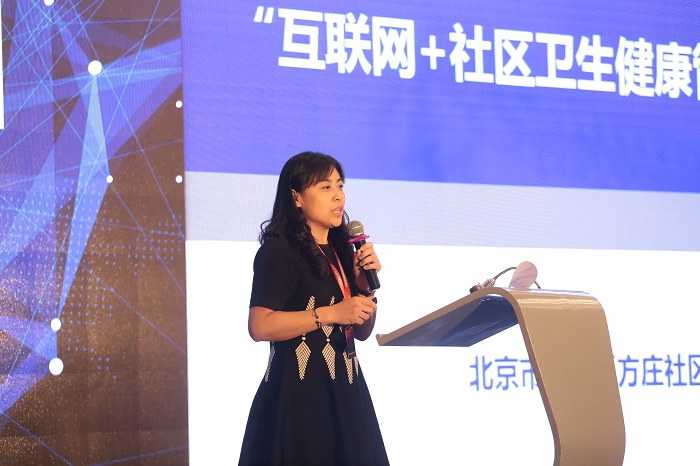
On May 17, VCBeat’s “2017 China Primary Healthcare Innovation Practice Forum” was grandly held in Chengdu. Ms. Liu Xinying, Deputy Director of the Fangzhuang Community Health Service Center in Fengtai District, Beijing, was invited to deliver an insightful speech on the theme of “Exploration and Practice of Standardization in ‘Internet+’ Community Health Management.” The following are the highlights from her presentation:
“Internet + Community Health Management” refers to the application of internet technologies in the provision of basic medical care and essential public health services by community health service institutions. This approach aims to enhance the operational efficiency of community health services while improving residents’ sense of gain in health management. In practice, the Fangzhuang Community Health Service Center has deeply integrated innovative achievements of mobile internet with community healthcare and health management, and has undertaken a series of explorations and practices in standardization.
The Internet application requirements for community health services encompass several aspects:
First, community medical institutions bear a substantial burden of providing basic medical care and national essential public health services, resulting in heavy workloads. However, current human resource staffing at the primary care level is insufficient. Under the existing performance-based salary structure, these positions lack professional appeal to high-caliber talent; many institutions struggle to recruit medical personnel in a timely manner, even when authorized headcount positions are available. Furthermore, the operational model of community health services is cumbersome and involves extensive repetitive tasks. These factors collectively contribute to low service efficiency at the primary care level.
On the other hand, due to China’s vast territory, there are significant disparities in the development of primary healthcare institutions across different regions. Variations in the service capabilities and proficiency levels among healthcare professionals further contribute to a lack of standardization in service delivery.
Furthermore, in the daily operations of community health services, continuous health management is provided to patients, resulting in the accumulation of substantial health management data. However, patients are often unaware of what data has been collected by community health centers or what health management interventions have been performed by primary care providers, thereby preventing them from fully leveraging this information. By utilizing internet-based technologies to extend access to these data into residents’ homes for personal use, significant value in health management can be realized.
The final point is information sharing. Various in-hospital service systems must first achieve resource sharing; however, many primary healthcare institutions currently lack integration among their internal service systems, and information sharing is rarely realized within medical consortiums. Against this backdrop, the Fangzhuang Community Health Center has undertaken practical initiatives and explorations. Taking Fangzhuang as an example, the community serves a total population of 110,000, yet has only 142 staff members. Last year alone, outpatient visits at the community clinic reached 430,000, generating revenue of RMB 137.6 million. The center has signed contracts with 32,600 residents, achieving a contract coverage rate of 65% among key population groups.
In 2013, Fangzhuang established standardized diagnosis and treatment protocols for general practice, enabling refined management of enrolled patients. By first integrating internal hospital systems, then linking central data with hospitals within the medical consortium via a cloud platform, and finally transmitting institutional data to residents’ homes through internet-based solutions, users can access comprehensive health management information via mobile apps and online platforms. This approach has facilitated the development of an efficient internet-based family doctor enrollment service system, allowing family doctors to provide personalized health assessments and guidance to residents.
Based on Fangzhuang’s exploration and practice in applying internet technologies to community health services, the National Health and Family Planning Commission commissioned the Center in July 2016 to conduct a pilot study on the standardization of “Internet+” community health management. The Guidelines for Standardized Development of Internet-Enabled Community Health Management Services were developed based on this research, with the aim of providing reference for more community health service centers in their application of internet-based approaches.
This construction guideline only establishes the overall business architecture for community health service institutions utilizing internet technology to carry out health management work, including four applications: terminal APP, health clinic website, two-way referral system, and intelligent chronic disease management. It defines functional specifications and technical specifications during the implementation process. Additionally, it includes two systems: data standards and information security.
From a demand perspective, community health service institutions must prioritize improving service efficiency and enhancing the homogeneity of care delivered by physicians. Artificial intelligence offers an excellent solution in this regard; therefore, we have integrated guidelines and expert consensus statements related to chronic disease management into the system.
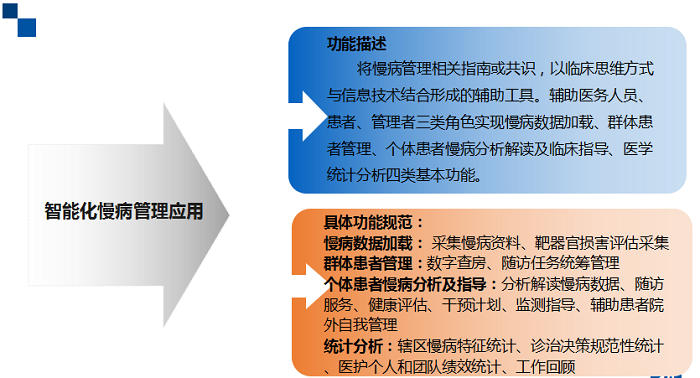
This enables direct data loading during chronic disease management, facilitating personalized assessment and guidance under clinical guideline support.
Prior to using this application, such information had to be handwritten by physicians. Now, once the system is loaded, physician recommendations, assessments, and lifestyle guidance can be automatically generated, requiring only a final review by the physician. Meanwhile, the guidelines analyze patient data in real time, providing early warnings and alerts regarding patients’ health status.
A rough estimate indicates that by leveraging the chronic disease management application, the workload of managing chronic diseases alone can save the equivalent of 4.57 full-time community healthcare workers per 10,000 patients managed. Based on an annual labor cost of RMB 150,000 per person (including housing provident fund, insurance, and other benefits), the approximate cost savings would amount to RMB 686,000.
Based on this functionality, we have outlined the specific functional specifications for intelligent chronic disease management applications, which consist of four components: chronic disease data loading, population-level patient management, individual patient chronic disease analysis and guidance, and statistical analysis.
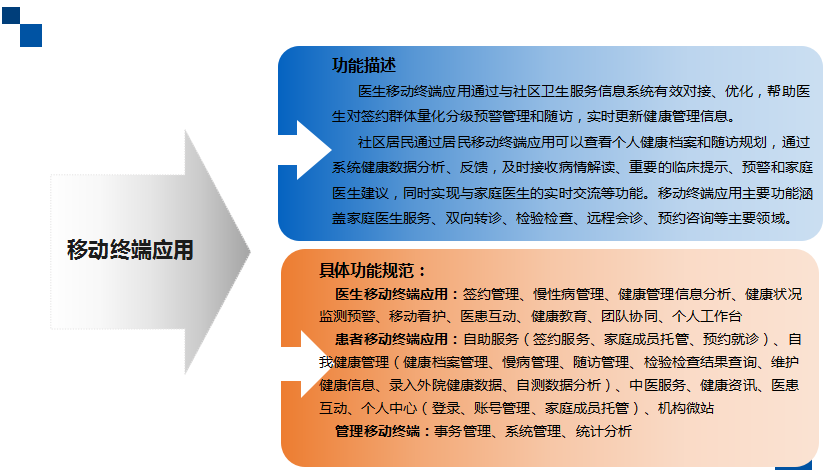
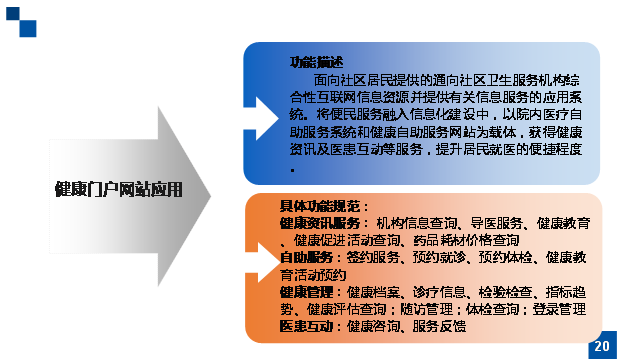
Part II: To ensure that patients can effectively utilize their health management information and actively participate in the process of managing their own health, internet-based technologies are employed to extend in-hospital health management services to out-of-hospital settings. Through mobile applications, residents can real-time access all records of health management services received at community health service institutions, maintain and upload data on changes in personal lifestyle, examination results from external hospitals, and home self-monitoring measurements, as well as interact with their contracted physicians. Physicians can use their smartphones to tag and maintain patient health information labels, send targeted health education notifications based on these tags, and update their outpatient schedules. Each physician can only access the medical records of their own assigned patients via the app, thereby safeguarding patient privacy. An alternative approach is to obtain relevant health management information through a health portal website. This guideline provides a detailed overview and description of the functional specifications for both components.
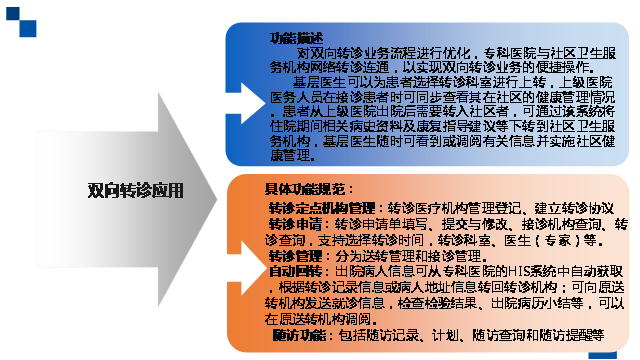
In 2015, the Fangzhuang Community Health Service Center established a cloud-based platform for two-way referrals with Tiantan Hospital. This platform enabled general practitioners and specialists to conduct two-way referrals based on shared information, thereby providing community patients with continuous health management tailored to their individual health needs. This guideline recommends that the functional specifications for two-way referral applications should include the following components: management of designated referral institutions, referral requests, referral management, automatic return referrals, and follow-up services.
During the implementation of the standardization project, the Fangzhuang Community Health Service Center repeatedly solicited feedback from health administrative departments, community health service managers, industry stakeholders, and corporate representatives. The Standardization Construction Guide underwent 21 revisions and was officially published in full in the Chinese Journal of General Practice in April 2017.
The establishment of the “Internet Plus” Community Health Management Standardization Pilot has significantly enhanced the operations of the Fangzhuang Community Health Service Center. From the perspective of medical staff, both the efficiency of public health services and the scientific rigor of health management have been comprehensively improved.
For patients, the use of internet and mobile applications facilitates convenient access to personal health information, enables awareness and participation in self-health management, and provides coordinated care from both general practitioners and specialists, thereby enhancing their sense of gain from community health services.
For institutions, the systematic refinement of technology and functionality has standardized and regulated service processes in community health centers, enabling them to attract and cultivate a large pool of multidisciplinary talents. Meanwhile, the diversification of communication channels between medical staff and patients has further enhanced the level of community health management.