

China's Domestic Medical Imaging Equipment Surpasses Global Giants at CMEF: A Sign of Industry Transformation?
At the 2017 CMEF exhibition, the large-scale medical equipment showcased by Chinese R&D companies not only surpassed the “GPS” (GE, Philips, and Siemens) in quantity and variety; after an in-depth investigation by VCBeat, it was found that the quality of many of these devices is nearly on par with that of the “GPS.” Is this a signal that domestically produced large-scale medical equipment is catching up with the “GPS”?
Let's first take a look at two booth layout maps:
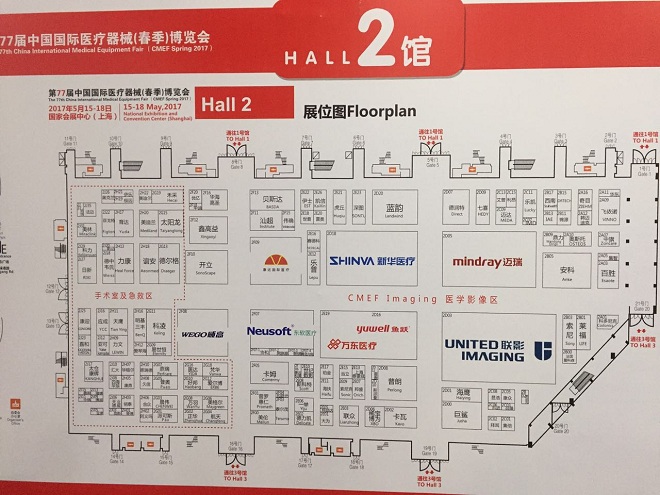
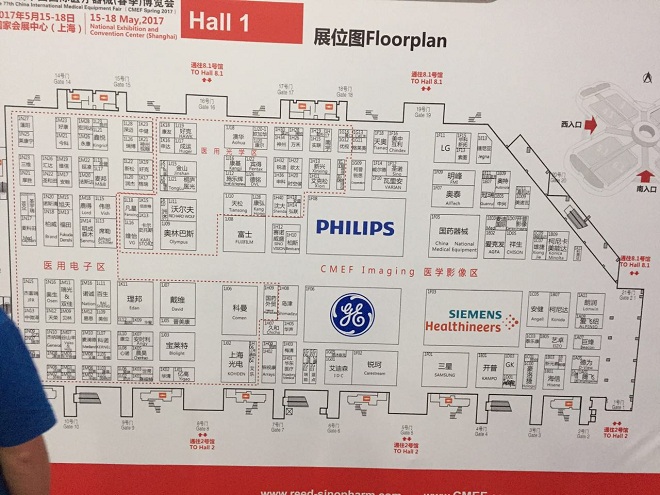
As shown in the figure, the booth spaces of large Chinese medical device manufacturers are significantly larger than those of foreign companies. At their booths, they have also showcased their flagship products. VCBeat has compiled a list of CT, PET-CT, MRI, and other products unveiled by companies such as United Imaging, Neusoft, Raycan, and SinoVision, to explore their respective competitive advantages.
Neusoft: Relatively Successful Marketization
In 2003, Neusoft Medical’s spiral CT scanners were exported to the international market, marking a breakthrough in China’s first-ever export of domestically produced medical equipment. Today, high-end products such as 1.5T superconducting MRI systems, 128-slice CT scanners, and PET/CT systems have once again filled gaps in this field, propelling China into the ranks of global manufacturers of high-end medical devices.Neusoft Medical now covers eight major product lines, including CT, MR, XR, US, IVD, RT, PET/CT, and Imaging Cloud.。
Today, Neusoft Medical’s equipment has been sold to more than 9,000 hospitals in 109 countries worldwide, including the United States and Germany, with presence in over one hundred hospitals in the U.S. alone. It is reported that Neusoft Medical is also expanding rapidly in emerging markets, with its installation base in many South American countries, Russia, and other regions showing a year-on-year upward trend.
At this exhibition, two Neusoft products drew significant attention: the NeuViz Prime ultra-fast spectral CT and the “Lingbo” mobile DR.
NeuViz Prime CT Features Ultra-High Rotation Speed, marking a new breakthrough in coronary artery imaging and low-dose scanning. According to the launch event, the “infinite heat capacity X-ray tube” equipped in the NeuViz Prime CT is designed to address the current challenge of excessive patient volumes in hospitals: the X-ray tube requires no preheating and no waiting time, enabling the NeuViz Prime CT system to operate continuously without interruption, thereby ensuring high throughput for large patient volumes. Enhanced by multiple technologies, the X-ray tube also boasts an extended service life. Meanwhile, the 60 kV imaging technology of the NeuViz Prime CT is also “unique worldwide.”
As demonstrated at the press conference, the highly integrated mobile cart design, equipped with a high-resolution wireless flat-panel detector, featuring a dual-motor power-assist and dual-battery independent power supply design, an airbag-style collision protection system, and a wireless remote exposure hand switch, embodies the “Lingbo” mobile DR’sEasy to Operate, Long Battery Life, Enhanced Safety, Wide Applicationssuch characteristics.
United Imaging: World's First Panoramic Dynamic Scanning PET-CT
At this press conference, United Imaging Healthcare unveiled the world’s first total-body scanning PET-CT system—the uExplorer. The uExplorer enables 4D real-time dynamic whole-body scanning, visualizing the dynamic metabolic processes of all organs. With an industry-leading resolution of 2.8 mm, it precisely captures early tumor lesions and tiny metastases. It achieves whole-body imaging in just 15 seconds, completing a full scan of all organs across the entire body within a single bed position and a single breath-hold cycle. Its sensitivity is increased by 40-fold, while radiation dose is reduced to 1/40th, expanding its applicability to include mothers and infants, adolescents, and children.
At this exhibition, United Imaging Healthcare also unveiled nine new products, including the world’s first “spatiotemporal-integrated” ultra-high-definition TOF PET/MR, the industry’s first 3.0T Optical Shuttle MRI, the world’s first integrated CT-guided linear accelerator, the world’s first 112-ring digital optical-guide PET-CT, the world’s first real-time multi-dimensional holographic imaging mrCT, and the 3.0T Explorer MRI with the world’s most powerful gradient performance...
United Imaging has also performed well in commercialization, with an annual revenue of RMB 2 billion in 2015. According to United Imaging, as of March 2016, the company had installed its equipment at 1,000 customer sites, including more than 100 Grade III Class A hospitals.
Ruishikang: China's First 64-Slice PET/CT
According to the classification by the National Health and Family Planning Commission, PET/CT systems are categorized into three types: 16-slice, 64-slice, and 128-slice. Among these, the domestically produced 16-slice PET/CT was successfully developed by Shanghai United Imaging Healthcare, while no Chinese manufacturers have yet entered the 128-slice PET/CT market.
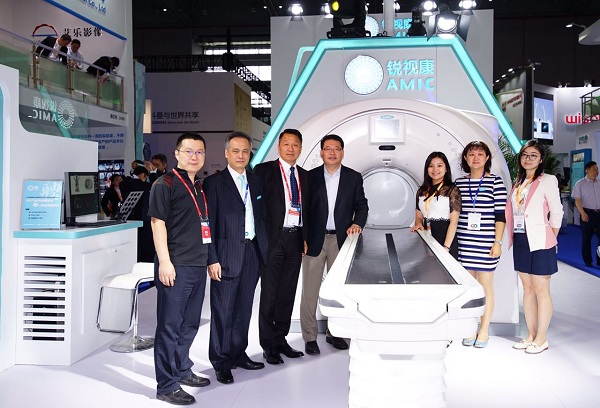
RayScan’s RAY-SCAN 64 is China’s first 64-slice PET/CT system, organically integrating a high-sensitivity 36-ring PET scanner with a high-resolution 64-slice CT scanner.It features high sensitivity, high fusion accuracy, high acquisition speed, and high spatial resolution. The device retains a modular design with independent PET and CT components, supporting the standalone operation of both the PET and CT systems.. Meanwhile, the RAY-SCAN 64 from Ruishikang features a built-in quality control rod source system, eliminating the need for hospital staff to manually handle and position radioactive sources, thereby effectively protecting operators and reducing radiation exposure.
Liu Yajing, Vice President of Rayvision Health, told VCBeat that during its deployment at PLA General Hospital (301 Hospital), the company’s product underwent double-blind clinical controlled trials against the GE Discovery VCT (64-slice CT) at PLA General Hospital and the Philips Gemini TF (16-slice CT) at Beijing Cancer Hospital. Statistical results showed that, under standardized operating conditions, the overall image quality score was equivalent to or superior to that of the control devices.
Fu Zhanli, Associate Chief Physician (Clinical Applications) in the Department of Nuclear Medicine at Peking University First Hospital, stated, “The main technical specifications and performance of this system have fully reached those of international brand equipment and can completely meet our clinical diagnostic needs.”
This system has two key features: First, the CT component can be used independently as a diagnostic CT scanner, which is highly beneficial for the diagnosis and differential diagnosis of pulmonary lesions. Second, the telemedicine system enables remote experts and frontline operators to simultaneously view images and communicate via video from different locations, thereby helping institutions that are new to PET/CT better carry out their clinical work.
Sinovision: Focusing on the Primary Healthcare Market
Sinovision’s “Jing Guangjiao” series of CT scanners are equipped with a high-performance hardware platform and incorporate imaging technologies found in many high-end CT systems. They feature a 76-cm scan bore and achieve an ultra-high resolution of 20 line pairs per centimeter, even within the challenging large-bore configuration. The resulting high-definition images provide a foundation for mutual recognition of scan results across hospitals at all levels.
Meanwhile, Sinovision has also integrated a wide array of pre-installed clinical software packages from its high-end CT systems into the Jing Guangjiao CT, endowing it with comprehensive clinical applications within the industry. This enables full-spectrum clinical scanning—from 2D to 3D imaging, from vascular to oncological assessments, and from emergency and outpatient care to health checkups—thereby effectively enhancing the device’s clinical utility.
In addition to its hardware CT, SinoMicro showcased its tiered diagnosis and treatment solution for imaging systems at the 2017 CMEF exhibition.From equipment and standardized scanning protocols for various conditions to cloud-based diagnostic platforms and training support, this comprehensive solution helps primary care hospitals resolve the critical issue of “non-recognition of imaging results by tertiary hospitals due to lack of standardized examinations,” thereby empowering them to fulfill their responsibilities within the tiered diagnosis and treatment system.。
Anke: One of the Three Major Chinese Enterprises Simultaneously Engaged in R&D and Industrialization of CT, MRI, and Other Products
In late 1989, Shenzhen Anke’s MRI system passed the appraisal conducted by the former State Science and Technology Commission, obtaining approval for market launch. As a result, China became the fourth country in the world (after the United States, Germany, and Japan) capable of producing magnetic resonance imaging (MRI) systems, forcing the prices of imported MRI equipment to drop by more than 40%.
In 1998, Shenzhen Anke launched China’s first single-slice spiral CT scanner, followed by a mobile CT unit, marking the first industrialization of domestically produced CT systems. This achievement made China the world’s fifth-largest manufacturer of complete CT units, after the United States, Japan, Germany, and the Netherlands, and led to an approximately 30% reduction in the average price of imported CT scanners and a nearly 50% decrease in service fees. Anke Medical has made significant efforts to break foreign monopolies.
In recent years, Anke has continuously launched new products. The next-generation precision platform ANATOM 64, introduced in 2016, features dozens of high-end core CT technologies that are independently developed and pioneered by the company. It offers advantages such as rapid scanning speed, low radiation dose, high-quality images, and a user-friendly interface. The release of the ANATOM 128 non-contact slip-ring multi-slice spiral CT marks Anke’s successful entry into the ranks of global high-end CT manufacturers.
Of course, in addition to these companies, Aotai, Wandong, Xinhua, Xingaoyi, Basda, and Mingfeng are also major medical equipment manufacturers.
Domestic Enterprises’ CT Sales Volume Share Exceeded 50% in 2019
On May 16 this year, the China Association of Medical Equipment and Beijing Huatong Ren Commercial Information Co., Ltd. jointly released the “2016 China CT Market Research Report,” which showed that by the end of 2016, CThe installed base of T devices across China has surpassed 20,000 units., representing a 10% increase from 2015; the overall market size for CT equipment approached RMB 10 billion, with 16-slice and 64-slice devices accounting for 74% of the market share, reaching RMB 7.39 billion, while the market size for ultra-high-end CT devices with more than 64 slices was RMB 2.42 billion.
2From 2012 to 2016, the sales share of domestically produced enterprises maintained rapid growth, increasing from 14.7% to 38.4%. It is projected that by 2019, the sales proportion of domestically produced enterprises will exceed 50%.。
Product Mix of Total Installed CT Equipment in China in 2015
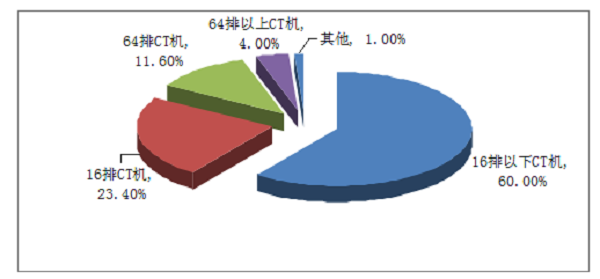
Information sourced from the internet
Product Structure of CT Equipment Sales in China in 2015
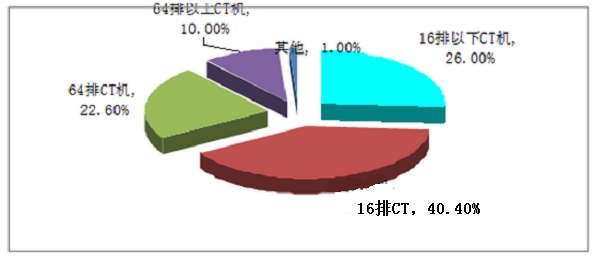
Information sourced from the internet
Among the 12,100 CT units surveyed and collected by the China Association of Medical Equipment, GE, Siemens, and Philips collectively accounted for an 85% market share; domestic manufacturers such as Neusoft, United Imaging, and Anke have also begun to gain momentum.The proportion of imported equipment continues to decline.. Surveys show that secondary medical institutions in China have an average of 1.2 CT scanners, tertiary medical institutions have an average of 2.1, and Grade A tertiary hospitals have an average of 2.4.
VCBeat also learned that, based on an analysis of the installed base data for various types of CT equipment from 2012 to 2016, devices with fewer than 16 slices still held the largest market share, although it had declined from 64% to 46%.and showing a year-on-year downward trend. With the development of primary healthcare institutions and private medical institutions, 16-slice CT scanners are expected to replace single- and dual-slice CT scanners as the mainstream in the market by 2020.。
While the market share of domestically produced large-scale medical equipment is indeed increasing, we still lag behind international giants by several years. Deficiencies remain in core technologies—such as high-end MRI sequences, high-speed CT, and high-energy linear accelerators—as well as in key components including CT X-ray tubes, detectors, high-voltage generators, slip rings, and MRI magnets. Additionally, there is a gap in providing homogeneous service capabilities across Chinese and foreign markets.
The development of domestically produced medical equipment requires joint efforts from both the government and enterprises. First, while WTO restrictions prevent the enactment of specific regulations explicitly banning the import of foreign-made equipment, the state can still promote the localization of medical devices by offering preferential policies in approval processes and taxation. Furthermore, continued encouragement should be given to the development of third-party imaging centers, with appropriate financial subsidies provided as needed.
While enterprises continue to break through technical bottlenecks, should they first consider improving service quality? On one hand, as product profit margins decline, services can be leveraged to boost profitability. On the other hand, establishing regional service platforms would allow overseas customers to enjoy the same level of care available in domestic hospitals, thereby achieving service homogenization. Would this approach not be more conducive to enhancing user satisfaction?