

Yao Xiaofei of Rogrand E-Commerce: Innovating Pharmaceutical Supply Chain Marketing Models to Empower Drug Distribution
Across the pharmaceutical industry, commercial entities serve as a critical distribution link connecting upstream and downstream stakeholders, fulfilling the roles and functions of supply chain management and marketing channels. However, significant pain points persist within these supply chains and marketing channels. Amidst the broader context of regulatory reforms and digital transformation, how can pharmaceutical commercial enterprises identify development opportunities, address upgrade challenges, and uphold their value in distribution?
As one of the earliest pioneers to venture into third-party pharmaceutical B2B e-commerce in China, Yao Xiaofei, Chairman of Rongguan E-commerce, offers her own insights on the matter.
VCBeat (WeChat ID: vcbeat) has learned that at the “2017 China Pharmaceutical Distribution Industry Supply-Side Reform and Innovation Forum,” hosted by the China Pharmaceutical Commerce Association, Yao Xiaofei from Rongguan E-Commerce, as a corporate representative, shared an internet innovation case study titled “Innovating New Models of Pharmaceutical Supply Chain Marketing and Building a New Global Health Ecosystem.” The presentation focused on the transformations facing the pharmaceutical distribution industry under the new circumstances.
She pointed out that “innovating marketing models to empower pharmaceutical distribution” is one of the key initiatives through which third-party comprehensive e-commerce platforms help pharmaceutical distribution companies “adapt to transformation trends and uphold the value of distribution.”
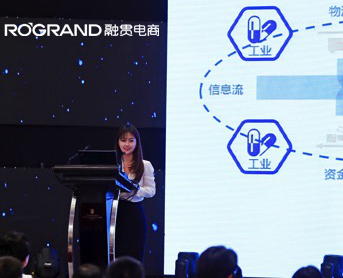
Yao Xiaofei from Rongguan E-commerce Shares Innovative Experiences in Pharmaceutical Supply Chain Marketing
Pharmaceutical Distribution Should Transition Toward Diversified Services
Yao Xiaofei stated, “Under the new circumstances, the distribution industry is facing industrial upgrading, first and foremost in terms of its attributes.”Transitioning from a traditional wholesaler and retailer to an integrated service provider and smart service provider, the comprehensiveness, depth, and intelligence of the services will enable continuous iterative upgrades.”
The pharmaceutical distribution industry is currently undergoing significant transformations, including regulatory upgrades and compliance requirements, medical insurance payment reforms, the coordinated development of healthcare, medical insurance, and pharmaceutical services (“Three-Medical Linkage”) alongside the “Sanming Healthcare Reform,” the replacement of business tax with value-added tax (VAT) and the two-invoice system, as well as mergers, acquisitions, and diversified operations. Concurrently, the rapid integration of internet technologies and cross-industry resources with the traditional pharmaceutical sector is ushering in a new development paradigm for the distribution industry:The application of the Internet and big data has enabled more precise information flows; the influx of socialized logistics has enhanced the efficiency and capabilities of supply chain services; and the penetration of Internet finance has facilitated efficient capital circulation between upstream and downstream partners.
However, within this new distribution model, business operations are not fully automated; a strong relational component exists, namely commercial flow. Commercial flow represents actual business transactions, rather than mere information flow. This is particularly true in the pharmaceutical industry, where products and services possess unique attributes, meaning that information alignment alone cannot be directly converted into business outcomes.Distribution enterprises can achieve core growth only by firmly controlling commercial flows, which means effectively enhancing their marketing and service capabilities.。
Regarding how to empower the marketing capabilities of pharmaceutical distribution enterprises, Yao Xiaofei pointed out: “The essence of marketing is creating, communicating, and delivering value to customers, as well as managing customer relationships. In the marketing process, we emphasize service; the transformation of pharmaceutical distribution enterprises and their upstream and downstream supply chain clients from a trade-based relationship to a service-oriented one is key to achieving long-term mutual integration and symbiosis. The integrated application of the internet is an effective means to empower the marketing and service capabilities of pharmaceutical distribution enterprises and to innovate and create value.”
PharmaceuticalsB2BThird-Party Platforms Hold Greater Advantages
Yao Xiaofei stated that with the gradual advancement of technology, the market'sThe seller-driven economic model is gradually and rapidly transitioning to a buyer-driven economic model.. As with the supply-side structural reform proposed in the economic sector, thereforeMarketing Is Becoming Increasingly Important。
She believes that the core drivers for growth in distribution enterprises are: clearly selecting the target market best suited for their services; understanding, quantifying, and addressing customers’ unmet needs and desires; determining appropriate products and implementation plans to serve the target market; and transitioning from spatial marketing to quality-based marketing to better serve that market.
Therefore, to enhance their marketing and service capabilities, an increasing number of pharmaceutical distributors are venturing into pharmaceutical e-commerce: companies are either building their own platforms or collaborating with various types of third-party B2B platforms, including price-oriented platforms and comprehensive service-oriented platforms.
However,"E-commerce is not e-commerce for the sake of e-commerce.", developed to serve the corporate upgrade strategy. Regardless of the approach taken to develop e-commerce operations, establishing an enterprise-wide e-commerce strategy is fundamental. A precise analysis of current business conditions—including customer structure, product portfolio, business policies, performance evaluation systems, and operational resources—is essential to ensure the selection of an appropriate e-commerce model.
In the era of "Internet Plus," most self-built e-commerce platforms face challenges such as inadequate strategic planning, incomplete e-commerce systems, fragmented business processes, and a lack of platform resources.
Comprehensive service-oriented e-commerce platforms possess robust and advanced e-commerce technologies, underlying infrastructure, data capabilities, and a well-established e-commerce ecosystem. They provide one-stop solutions ranging from the formulation of e-commerce strategies and implementation plans to the execution and rollout of platform campaigns. By ensuring precise positioning for enterprises’ e-commerce development, they offer comprehensive operational services and support, effectively helping commercial circulation enterprises rapidly enhance their marketing capabilities.
In the face of industry transformation, Yao Xiaofei stated, “We must learn to be open and inclusive, proactively embrace new technologies, seek ecosystem collaborations, and guide development in accordance with emerging trends.”
Under new distribution paradigms, the future trend will see commercial enterprises rapidly transforming into service providers, upgrading from space-based marketing to quality-driven marketing, and shifting from traditional upstream-downstream trade relationships to embedded service models. In the era of the Internet and the Internet of Things (IoT), the ability to leverage applied technologies and foster ecosystem-based collaborations will determine the enhancement of marketing capabilities and the establishment of industry value.
Integrating ecological resources based on internet platforms, such asSupply chain finance and greater resource integration within the pharmaceutical manufacturing sector will empower distribution enterprises, enhancing their marketing innovation and operational efficiency.
Yao Xiaofei finally emphasized that, as a pioneer in China’s B2B pharmaceutical e-commerce sector, Rongguan E-commerce will continue to uphold its mission of facilitating the industry’s “Internet Plus” transformation, with the goal of providing platform resources and empowering distribution enterprises.Committed to building a win-win cooperative ecosystem from an independent third-party perspective, collaborating with distribution partners to drive industrial upgrading, making the industry more efficient, giving governments greater confidence, and delivering greater benefits to the public.