

XiuZheng Health Group Plans to Establish 100,000 Community Health Stations Within Three Years to Empower Primary Healthcare
Recently, the “2017 China Primary Healthcare Innovation Practice Forum,” co-hosted by VCBeat (WeChat ID: vcbeat), Eggshell Research Institute, and the China Association for Promotion of Rehabilitation Technology Transformation and Development, was held in Chengdu.
Mr. Zhang Xuehai, Vice President of Xiuzheng Health Group, delivered a keynote speech titled “A Brief Analysis of the Application of ‘Internet +’ Health Management Systems in Medical Institutions.” He revealed that, starting from 2017, Xiuzheng would take the lead in establishing 100,000 health centers across China to support primary healthcare.
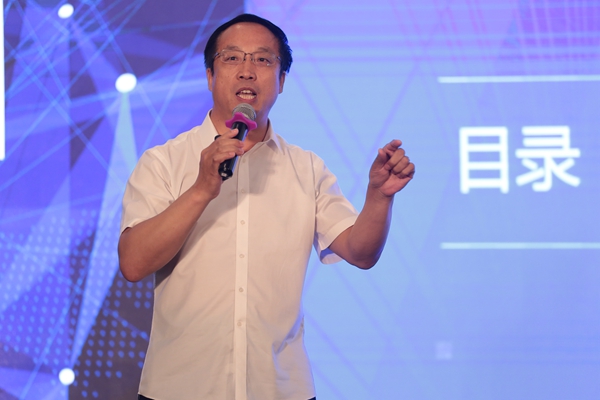
Zhang Xuehai first introduced the achievements made by Xiuzheng Group. He stated that since its establishment in 1995 by Chairman Xiu Laigui, Xiuzheng Group has undergone more than 20 years of development. In 2016, Xiuzheng achieved a total industrial output value of RMB 64.6 billion, sales revenue of RMB 63.6 billion, and profits and taxes of RMB 4.76 billion. Xiuzheng has established bases for medicinal materials, pharmaceuticals, and health products in every province across China. The company’s marketing personnel number nearly 100,000, covering terminals at all levels nationwide.
Prior to 2014, Xiuzheng Group’s business model primarily relied on advertising combined with controlled distribution. Around 2015, Xiuzheng began to implement changes by shifting its controlled distribution strategy for the third terminal to a model leveraging “Internet + primary healthcare” (remote smart health management) to manage the fourth terminal. This approach aimed to channel traffic back to the third terminal, ultimately achieving sustained growth in sales revenue.
Xiuzheng has also maintained its focus on primary healthcare, recently launching the Health Pavilion project. The company plans to establish a number of TCM-based Health Pavilions across China, primarily serving grassroots communities to address the challenges of difficult and costly access to medical care at the primary level.
Xiuzheng Health Hall System
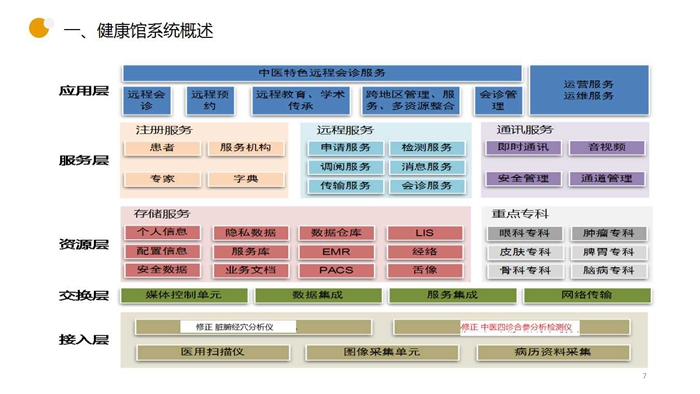
In his presentation, Zhang Xuehai introduced the Health Pavilion System from four aspects. He stated that the Xiuzheng Internet+ Remote Smart Medical Health Pavilion System is a domestically produced, independent, secure, and controllable internet medical health big data platform built upon Traditional Chinese Medicine (TCM) workstations, leveraging the achievements of the National Health Informatization “46312” Project, and based on the national health information standard system and security assurance framework.
The system leverages data integration, application integration, device integration, unified security authentication, and traceability regulatory mechanisms to provide diverse traditional Chinese medicine (TCM) healthcare services tailored to different user groups.
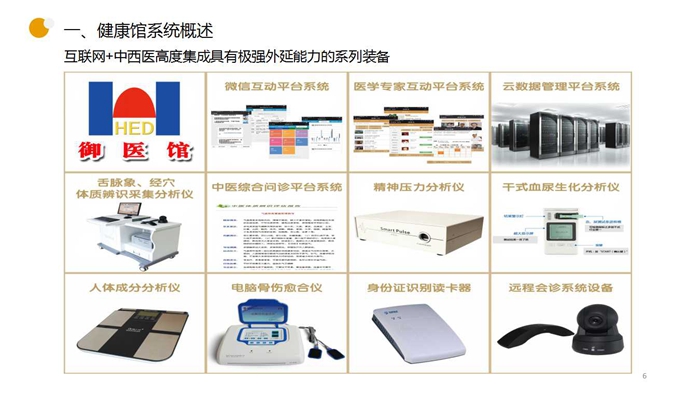
Zhang Xuehai believes that the Health PavilionSystemAligned with the tiered diagnosis and treatment policy,Leverage digital TCM diagnostic and therapeutic devices to accumulate experience in realizing a comprehensive tiered diagnosis and treatment system integrating traditional Chinese and Western medicine, thereby curbing the growth rate of government healthcare insurance expenditures and meeting national policy performance targets. This approach genuinely serves the public by addressing the challenges of difficult and costly access to medical care.
“Current policies are increasingly focusing on primary healthcare, with substantial support being provided, which will create significant opportunities in this sector. Enterprises engaged in primary healthcare should seize this opportunity, particularly in the field of Traditional Chinese Medicine (TCM). Xiuzheng Pharmaceutical will also make strategic efforts in this direction.”
Zhang Xuehai also analyzed the current competitive landscape of internet healthcare and mobile healthcare. He believes that, at present, cloud platform systems at all levels have entered a stage of fierce competition. While Alibaba and Tencent hold an absolute advantage in big data, the data they control is difficult to utilize effectively at the primary care terminal level.
He pointed out that in 2016, the internet healthcare industry entered its market initiation phase, with internet user growth approaching saturation and a gradual shift toward mobile internet. As an innovative sector within the comprehensive development of internet healthcare, mobile healthcare has increasingly become part of everyday life for the general public.
Furthermore, driven by the widespread adoption of 4G mobile networks, mobile health services have become increasingly diversified. Coupled with the entry of numerous medical institutions into the market, a competitive landscape subsequently emerged. Therefore, capitalizing on the favorable conditions presented by the mobile internet, the growing user acceptance of mobile health has directly propelled the overall development of the internet healthcare industry.
Zhang Xuehai believes that internet healthcare differs from traditional healthcare, as doctors and nurses can be dynamically mobilized. For related companies to drive patient traffic, they must reach the grassroots level to realize their value. The adjustment of the Shangma Health Center project aims to leverage this approach to tap into the grassroots healthcare market.
The revised target for the construction of Health Halls is as follows: In 2017, launch operations in 30 provinces, with 100 halls per province, totaling 3,000 halls; in 2018, expand to 330 prefecture-level cities, with 100 halls per city, totaling 33,000 halls; by 2020, cover 2,300 county towns, adding 30 halls per town, for a total increase of 69,000 outlets. This means completing the construction of at least 100,000 Health Halls within three years.
Addressing Primary Healthcare Issues
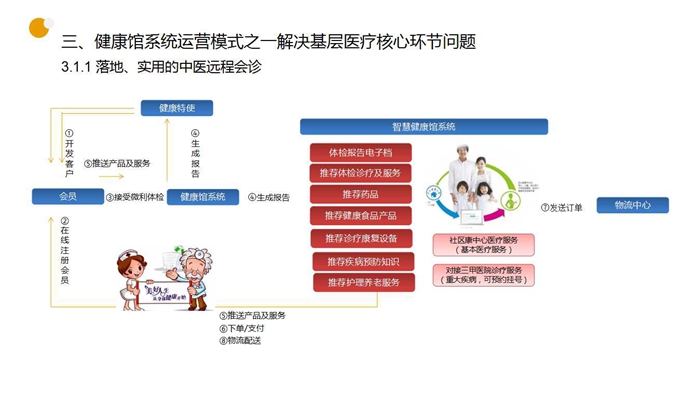
In terms of establishment, the Health Pavilion will be built using a model where a lead investor takes a modified leading role, with suppliers and social capital participating through crowdfunding as co-investors. The cost for each pavilion is 500,000 yuan, guaranteed by primary healthcare institutions.
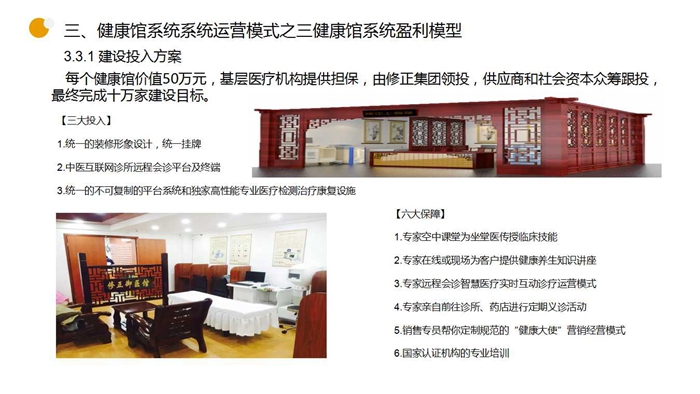
The Health Pavilion will adopt a unified decoration and branding design to establish an internet-based remote consultation terminal and platform for Traditional Chinese Medicine.
In terms of its profit model, the Health Pavilion can generate revenue through services such as clinical diagnosis and treatment, medication guidance, sales of health foods, rehabilitation and physiotherapy, appointment registration and referral, and elderly care nursing.
Why This Correction Is Necessary: Zhang Xuehai Also Introduced the Strategic Significance of Implementing the Health Pavilion Project. The first significance is that it addresses the rigid demands of primary healthcare institutions, optimizes the allocation of expert resources, and mitigates the imbalance in medical resource distribution. It meets the needs of society and patients, alleviates the shortage of general practitioners in primary healthcare institutions, and improves the tiered diagnosis and treatment system.
The Second SignificanceIt meets the rigid demand for universal health. It will assist the government in implementing the policy of “initial diagnosis at the primary care level”Healthcare Reform“Objective. To cultivate among residents the philosophy that prevention is better than cure.”
The third significance is that the “Smart Health Pavilion System,” as a core brand under Xiuzheng Group focusing on the broader health sector, will become a key focal point for Xiuzheng’s grassroots business operations.
Zhang Xuehai also stated that the Health Pavilion will adopt a multi-screen linkage system to gain control over the business district and explore additional revenue models. Meanwhile, offline operations will leverage Xiuzheng Group and other pharmaceutical and health industry enterprises to secure a stable base of end customers and business foundation.
The revised vision is to promote the nationwide construction of the “Xiuzheng Health Hall System,” which can acquire a massive base of customers with essential needs, providing free health screenings, health consultations, and health assistance to at least 900 million people. It can also serve as a source of population-wide health data for government medical institutions.
Zhang Xuehai concluded by stating that health centers represent a key direction for empowering grassroots communities. Xiuzheng hopes to see more enterprises join in this effort to collectively address the scarcity of medical resources at the grassroots level and better serve these communities.
The data in this article was provided and confirmed by the respondents.