

How Vishuo Medical Successfully Exported Its Domestic Genomic Knowledge Base to Top-Tier Hospitals Overseas
Gene databases form the foundation of the data interpretation process. However, establishing a company solely focused on database services is not a favored approach. Competition in the database market is fierce; nearly every gene sequencing company maintains its own genetic disease database, and even upstream reagent suppliers are offering such services. Some suppliers even bundle instruments with their offerings, turning this process into a commercialized business.
It is indeed challenging for companies to operate solely as database providers; therefore, many firms choose to establish dedicated bioinformatics departments to strategically position themselves in the database sector.
However, Weishuo Medical not only treats the database as its core business,The company has been operating continuously from 2011 to the present. In addition to collaborating with domestic medical and research institutions, it has even secured a contract for Thailand’s government NIPT project and established a long-term partnership with Mount Sinai Hospital in the United States, one of the world’s top hospitals.
In the genetic big data market, where many hesitate to go all in, how has this company grown and even sold its domestic databases to top-tier hospitals overseas? VCBeat has decided to conduct a brief analysis of this company.
Forward-Thinking Clinicians
Founder of Shuo Medicine andCEO Hao Zhanping was among the first cohort of graduate students in China to specialize in Gamma Knife therapy (with cranial Gamma Knife procedures falling under the specialty of neurosurgery).Before becoming an entrepreneur, he had spent nearly20 Years as a Surgeon.
Hao Zhanping, Founder and CEO of Shuo Medicine
In 2005, Hao Zhanping, a neurosurgeon with ten years of experience, transitioned to the field of oncology.In the Department of OncologyOver the past six years, he has encountered numerous cancer patients and found that conventional approaches were insufficient to address their conditions. He believes that leveraging genetic testing to guide medication and treatment decisions could potentially improve patient outcomes.
Hao Zhanping revealed that it was during that period that he experiencedThe Value of Basic Science in Guiding Clinical Practice. He began to seek a transition from clinical practice, aiming to bridge basic sciences with clinical medicine for the futureNGS Paves the Way for Clinical Adoption.
In 2011, Hao Zhanping began venturing into the field of basic medical sciences. At this time, he reconnected with his childhood friend, Guo Dongliang. Guo had previously held positions at Eli Lilly and Merck’s Translational Medicine Research Center in the United States and was an expert in bioinformatics and cloud computing. After numerous discussions, the two established the R&D headquarters for Weishuo Medical Big Data in Singapore, while simultaneously setting up a medical testing center in China.
According to data from the VCBeat knowledge base, the establishment timelines for most genetic data companies (including those focused on analysis, interpretation, and databases)All are in2014, 2015. Shuoyixue was an early entrant in this field.
Shortly after the establishment of the testing center, Hao Zhanping encountered a patient he had previously treated in clinical practice—a 35-year-old with lung cancer and widespread bone metastases. In a conventional clinical setting, the only treatment option would have been chemotherapy. After conducting genetic testing on the patient, it was discovered that he was positive for ALK fusion gene. Coincidentally, a hospital in Beijing was conducting a Phase III clinical trial of targeted therapy specifically for this type of genetic mutation. Fortunately, the patient was successfully enrolled in the trial. After one month of medication, his condition returned to normal—PET-CT scans revealed that the lesions had disappeared.
At that time, Hao Zhanping was not engaged in entrepreneurship on a full-time basis. He found methods outside of clinical practice to enhance clinical proficiency, and he admitted that this discovery had a significant impact on him. What is wrong with traditional healthcare? The underlying cause can largely be attributed to the difficulties in clinical translation. Although new technologies exist outside the clinical setting, they are often stalled at the translation stage; unable to penetrate into clinical practice, these innovations result in very slow clinical development.
Two years later, Hao Zhanping resigned from the hospital to devote his full attention to the enterprise, aiming to bridge basic scientific achievements with clinical translation, accelerate clinical development, and drive the growth of the basic medical sciences industry.
The First-Mover Advantage Brought by Forward-Thinking Awareness
Traditional genetic interpretation involves correlating genomic information with disease types. However, this approach is difficult to implement in clinical practice for two reasons: first, not all clinicians possess a genetics background sufficient to fully comprehend genetic interpretation reports; second, not all omics data can be directly mapped to specific clinical phenotypes.
Take a study conducted abroad as an example. In this study, the majority of drug-resistant patients exhibited mutation rates at the genetic level that were lower than5%. From the perspective of bioinformatics analysis, these patients would be directly classified as non-resistant. However, this is inaccurate; in reality, the majority of these patients exhibit clinical drug resistance.
Recognizing these issues, many companies have begun to attempt the integration of clinical and omics data. However, for such databases to develop core competitiveness, data volume is key. This data includes both genomics data and clinical phenotype data.
Enterprises face two major challenges: first, time—data integration is not an overnight task and requires both time and manpower; second, the source of clinical data, as most companies find it difficult to obtain such data.
Shuomed’s solution involves co-establishing precision medicine centers with multiple hospitals to acquire clinical data. Additionally, since its inception, the company has focused on providing data interpretation and annotation services for clinical applications. Its core productiCMDB(individual Clinical Medicine Database)The knowledge base exclusively utilizes proprietary annotations. The data herein is partially sourced from public databases focused on clinical disease integration, and the remainder is derived fromFDA and CFDA guidelines, as well as data on pharmacology, drug molecular structures, and clinical feedback.
Hao Zhanping told VCBeat that the company currently has more than 100 employees and has spent over six years integrating data. This six-year accumulation has become the company’s first-mover advantage.
Product Forms That Meet Clinical Needs
The volume of genetic data is growing, placing increasing pressure on data transmission and computation. Traditional equipment is costly and requires significant space. In response to this challenge, many enterprises have introduced cloud technology to the field. Between 2013 and 2014, in ChinaMany bioinformatics cloud platform service providers have emerged. Shuoyi Medicine is also inIn February 2012, the world’s first database and analytics platform for personalized cancer diagnosis and treatment (iCMDB) was released, providing global cloud-based access.
However, in reality, the cloud-based model is difficult to promote in hospitals; this model is more suitable for enterprises or research institutions. Hospitals’ external network interfaces and transmission speeds may be restricted, and many software components involved in the intermediate processes require registration and approval from regulatory authorities. It is currently impossible to have hospitals upload patient data to public clouds. Hospitals remain more inclined to adopt localized service models.
In May 2015, based on the iCMDB platform, Shuo Medical launched the world’s first all-in-one machine for personalized clinical diagnosis and treatment database analysis. Unlike cloud-based models, this all-in-one system localizes both data analysis and report generation, thereby meeting the testing and analytical needs of clinical hospitals.
Clear Product Positioning
The iCMDB Knowledge Base is a personalized clinical medicine knowledge system that encompasses diseases, biomarkers, variant loci, drugs, and diagnostic and treatment protocols. VCBeat defines this database as a diagnostic and therapeutic tool. In clinical decision-making, a single condition often presents multiple options for medications and treatment regimens. The aim is to leverage the knowledge base to enumerate available treatment options, thereby assisting physicians in making informed clinical decisions.
Different genotypes demonstrate significant variability in guiding treatment decisions. For instance, among patients with hepatitis complicated by cirrhosis, the genotype may determine whether a patient requires surgical resection or transplantation, while others may be better suited for interventional therapy. The knowledge base integrates all relevant genomic data with clinical etiologies and pathogenic mechanisms to form a specialized sub-database.
Such a sub-library thus becomes a query tool for clinicians in disease diagnosis. By inputting disease characteristics, the knowledge base performs computational integration in the background and ultimately presents the consolidated clinical and omics data together.
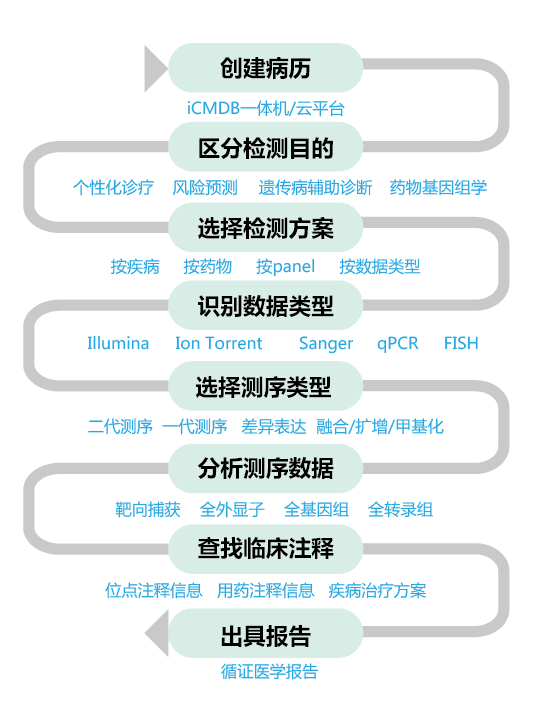
Image from Weishuo Medical website
“This approach does not mean that the knowledge base can make diagnoses. The function of the knowledge base is to provide physicians with all relevant information, allowing them to make their own judgments,” stated Hao Zhanping. If an internist were to keep pace with the most cutting-edge research, they would need to read two to four academic papers per day; however, given the already heavy workload of clinicians, it is impractical for them to review such a volume of literature within a month. Therefore, there is a need for tools that can offer objective and rigorous clinical decision support.
Currently, the knowledge base provides detailed annotations for over 200 diseases, linking them to corresponding biomarkers and their variant types. It also includes therapeutic drugs and multi-level treatment regimens, effectively meeting clinical application needs. Users can subscribe to individual disease modules or the complete package based on their specific requirements. The annual subscription fee for a single disease module ranges from RMB 50,000 to 70,000, while the price for the complete package isAnnuallyRMB 1.5 million.
Not limited to the domestic market
Hao Zhanping also revealed to VCBeat that while testing laboratories in Southeast Asia are relatively fragmented, the willingness to pay is strong. Compared with China, market promotion is easier in Southeast Asia. Therefore, the company has chosen to advance its business jointly in China and Singapore.
Currently, domestic partners include the Chinese People's Liberation Army.The 307th Hospital, Guangzhou Institute of Respiratory Health, and Huayinkang Gene cover the fields of clinical practice, scientific research, and industry.
In overseas markets, in December 2012, Weishuo Medical entered into a partnership with Ramathibodi Hospital. Ramathibodi Hospital is an affiliated hospital of Mahidol University, one of Thailand’s most prestigious medical schools. Weishuo Medical willForRamathibodi Hospital offers testing and prevention and treatment solutions for human immunodeficiency virus (HIV).
In addition, in March 2015, the Shuoyi Medical overseas team successfully signed a contract for the Thai government’s NIPT project.
In the Singapore market, the company focuses more on collaborative research projects, such as its partnership with the Agency for Science, Technology and Research (A*STAR) and joint studies with Tan Tock Seng Hospital in the field of pharmacogenomics.
The company’s iCMDB knowledge base has obtained Class A registration qualification from the Health Sciences Authority (HSA) of Singapore, as well as the healthcare license issued by the HSA. This may pave the way for further expansion into additional clinical projects in Singapore in the future.
In the European and American markets, the company has two major partners: QIAGEN’s Institute for Translational Medicine and the Icahn School of Medicine at Mount Sinai.
Having successively acquired Ingenuity Systems, CLC Bio, and Biobase, QIAGEN has established significant influence in clinical interpretation databases and the broader field of biological data analysis and interpretation, with its databases being adopted by numerous third-party organizations. In this latest collaboration, however, QIAGEN is acting not as a database provider but as the purchaser.
In February 2016, Icahn School of Medicine at Mount Sinai in the United States officially entered into a long-term agreement with the Company, making Shuo Medical the first medical institution in Asia to provide clinical medicine database services to top-tier U.S. hospitals.
In fact, the company began expanding its business into the U.S. market as early as 2013; in addition to Mount Sinai Hospital, it maintains collaborative relationships with five other medical institutions.
It is understood that Shuo Medicine has already partnered withCustomServicesz has established a strategic partnership to build sales channels covering North America and Australia., the company will next focus on these two marketsSustained Efforts.
Implications
Overall, the Shuo Medicine model is actually quite simple: it is not impossible to replicate, yet it is not easy to replicate either.
The core competitiveness of genetic databases lies in the scale of data. In this regard, most domestic genetic testing companies are accumulating data through sequencing services, launching testing initiatives, or collaborating with clinical hospitals.
However, to build a multi-omics integrated database, literature extraction and clinical data integration are key for companies to shape their core competitiveness. Currently, the organization of such data relies solely on manual effort and time accumulation. While future advancements in artificial intelligence may offer alternative solutions for this process, it is still too early for that at present.