

Aiesheng Health Founder Jin Xin: Empowering Family Doctor Contract Services with AI-Powered Chronic Disease Management
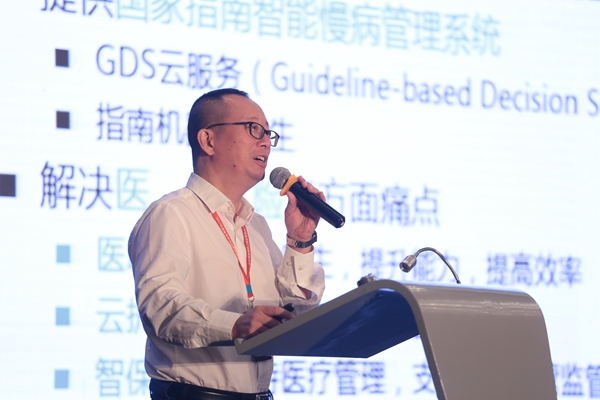
Jin Xin, Founder of Aiyisheng, holds an Executive Master of Business Administration (EMBA) from Tsinghua University and a Master’s degree in Computer Networks from Shanghai Jiao Tong University. He previously served as Director at Ericsson, Regional General Manager at HP, and President of Redback Networks’ Greater China Region, bringing 20 years of experience in market operations within multinational corporations across the internet, telecommunications, and IT sectors.
Beijing Aiyisheng Health Technology Co., Ltd., established in February 2014, specializes in the field of intelligent healthcare. Under the medical guidance of the Expert Committee on Prevention and Treatment of Cardiovascular and Cerebrovascular Diseases of the China Association of Senior Professors, the company provides a National Guideline-based Intelligent Chronic Disease Management System, known as GDS Internet Cloud Services (Guideline-based Decision Support). This system assists physicians, guides patients, and supports hospital administrators, government bodies, and insurance institutions in implementing performance-based operational oversight of chronic disease management services, thereby creating an intelligent medical engine for a chronic care ecosystem that integrates healthcare, medical insurance, and pharmaceutical services.
May 17-18, “2017The “China Primary Healthcare Innovation Practice Forum” was held in Chengdu, inviting professionals from various sectors of the industry to participate in keynote speeches, roundtable discussions, and other activities. This article is compiled from the stenographic record of Jin Xin’s keynote address, “National Guidelines-Driven Intelligent Chronic Disease Management Boosts Family Doctor Contract Services,” for reference by industry practitioners.
Jin Xin: Hello everyone, I am delighted to have the opportunity to share our practices in primary healthcare with you.
Aiyisheng Health Management was established in February 2014. With a decade of core technology research and development, the company specializes in the field of intelligent healthcare. It conducts translational medical research on clinical guidelines to develop clinical decision support tools, providing an AI-driven chronic disease management system aligned with national guidelines.
We provide an intelligent chronic disease management system based on national guidelines to boost family doctor contract services. It focuses on the three key terms of China’s healthcare reform.Family Doctor Contracting, Tiered Diagnosis and Treatment, Three-Medical CoordinationWe are aware that the Medium- and Long-Term Development Plan for “Healthy China” was officially released last year. Furthermore, in March, a significant milestone in grassroots health informatization was achieved when the National Health and Family Planning Commission and other relevant departments jointly issued the first benchmarking guideline for grassroots informatization development, namely the Guidelines for Standardized Construction of “Internet + Community Health Management.” We are also honored to have been appointed as one of the members of the working group responsible for this initiative.
The Evolution of Healthcare Information Technology (HIT)The development of Healthcare Information Technology (HIT) began with digital healthcare, exemplified by systems such as Hospital Information Systems (HIS) and Laboratory Information Systems (LIS). It then evolved into internet-based healthcare, featuring online appointment registration and telemedicine. Currently, we have entered the era of intelligent healthcare. Our goal is to leverage information technology to support clinical decision-making and address the practical problems physicians encounter in patient care. To this end, we have conducted translational medicine research based on national clinical guidelines, developing clinical tools that underpin a national intelligent management system for chronic diseases.
GDS services function as a guideline-based robotic physician. Well-versed in clinical guidelines, it integrates chronic disease analysis to formulate clinical treatment and continuous management plans, serving as an assistant to physicians. We have addressed the pain points of patients, providers, and payers, creating an intelligent medical engine for the chronic care ecosystem. This engine aligns closely with one of the forum’s key themes—empowerment—as our medical engine precisely empowers primary healthcare institutions.
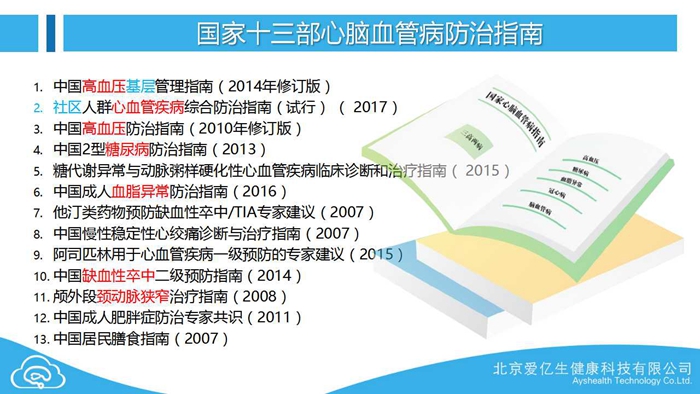
These are the 13 national guidelines on which the GDS system is based.
GDS comprises five components. The first is individual patient management, and the second is population health management. When a physician cares for a single patient, it constitutes individual management; however, when managing a cohort of 1,000 enrolled patients, it falls under population health management.
Chronic disease management must be delivered by a physician team. We provide collaborative management solutions that facilitate cooperation with health managers and coordination with specialist physicians.
Furthermore, patient education and the cultivation of patient adherence are of paramount importance; to this end, we have established a dedicated patient guidance section. Meanwhile, we also provide specialized support in management and operational oversight to hospital administrators, government authorities, and medical insurance agencies.
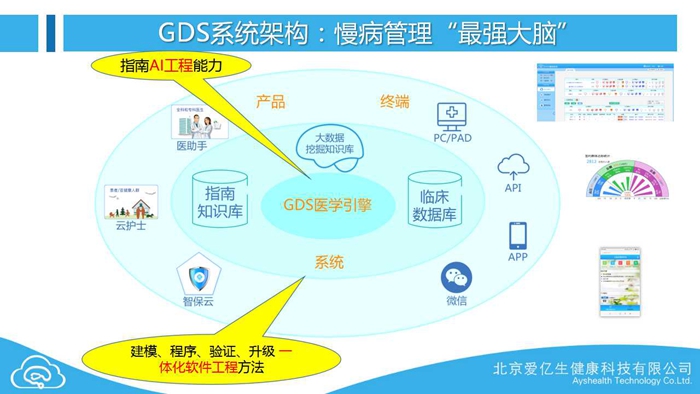
This is the internal structure of our product. Let me show it to you; it functions as a “chronic disease managementThe Super Brain”. At the core lies our GDS engine, followed by a clinical guideline knowledge base. Additionally, we leverage big data mining from clinical databases to develop three product suites: MedAssist, Cloud Nurse, and Smart Insurance Cloud. These solutions support various terminal types, including PCs for physician workstations, API interfaces for integration with platform systems, as well as mobile apps and WeChat.
Next, let me show you how our GDS helps family doctors at the primary care level deliver effective, high-quality contracted services. Herein lie the key components of our family doctor service model.
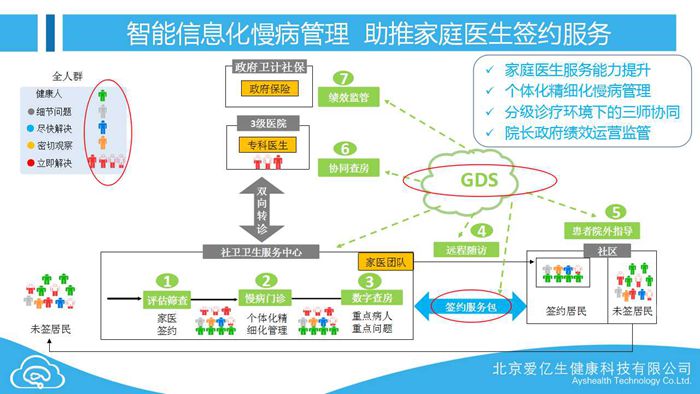
Please take a look at the three red circles highlighted here. The leftmost circle represents an essential component of intelligent medical informatization, namely the quantification of chronic disease management using a color-coded system: red, yellow, blue, and gray. In many communities, physicians using our system do not refer to it as GDS, but simply as “Red-Yellow-Blue.” Red indicates critical clinical issues that require immediate resolution; yellow signifies conditions needing close monitoring; and blue denotes issues that should be addressed as soon as possible.
In addition, regarding the contracted service packages in the lower right corner, many industry peers are also developing contracting platforms. Beyond scanning ID cards, the critical challenge for these platforms lies in creating actionable and regulable service packages supported by robust information systems.
Application of Chronic Disease Management Systems
This is a typical scenario for community-based applications, focusing on how to serve as a physician assistant, assist nurses, conduct patient assessments, and guide patients in self-managing chronic diseases at home.
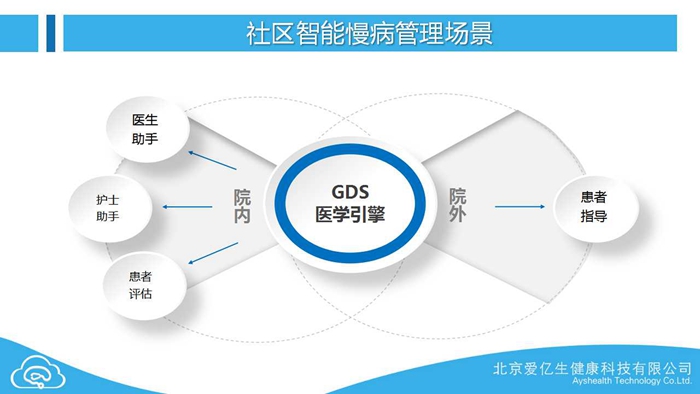
This is the first one: Yi Zhushou. In fact, we are very familiar with this interface in community-based primary care settings; it is a standard Hospital Information System (HIS) clinical workflow interface. However, on the right-hand side, this panel displays personalized and refined guideline-based information for chronic disease management, automatically generated in the background by GDS. As you can see, this information is presented to physicians instantly at the moment the patient’s health insurance card is swiped during the consultation.
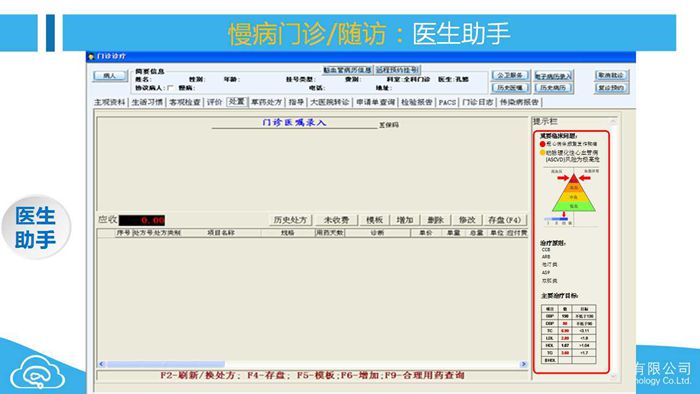
Key clinical issues are listed at the top, with red-flagged and yellow-flagged questions identified. Below, a triangular graphic displays hypertension grading and stratification on the left, and the latest guidelines for dyslipidemia on the right.ASCVD Risk Stratification and Guideline-Based Treatment Principles
According to the guidelines, the patient’s individualized treatment goals are listed at the bottom. We know that the treatment goal for hypertension is not90/140 or 80/120; rather, treatment targets vary for each patient based on their clinical condition.
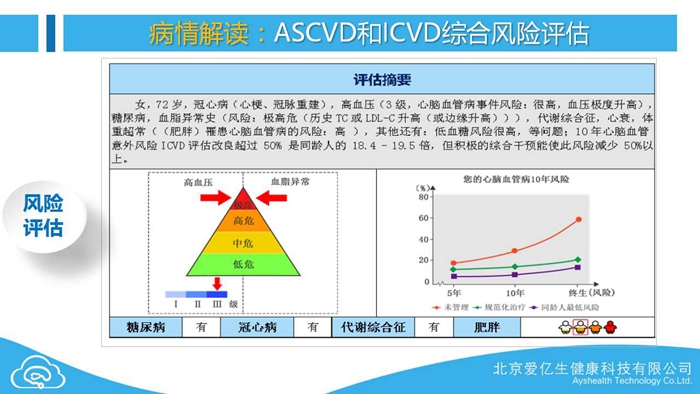
During the 5-minute consultation, the physician can identify the most critical aspects of the patient’s condition and communicate them vividly using this chart. The left side displays ASCVD risk, akin to a snapshot capturing the patient’s current blood pressure and lipid-based risk stratification. The right side presents the improved ICVD risk assessment, illustrating the patient’s 5-year, 10-year, and lifetime risks of cardiovascular and cerebrovascular events.
The red curve indicates that this patient’s 10-year risk of experiencing a cerebrovascular or cardiovascular event is 30%, while the 5-year risk is less than 20%. With standardized management, his risk profile shifts to the green curve, reflecting a 75–85% reduction in the risk of cerebrovascular and cardiovascular events. This outcome is consistent with findings from international evidence-based research on chronic disease management.
These visual aids are highly beneficial for communication between healthcare providers and patients. During follow-up visits, a report like this is generated, allowing doctors and nurses to discuss the patient’s overall chronic disease management with them.
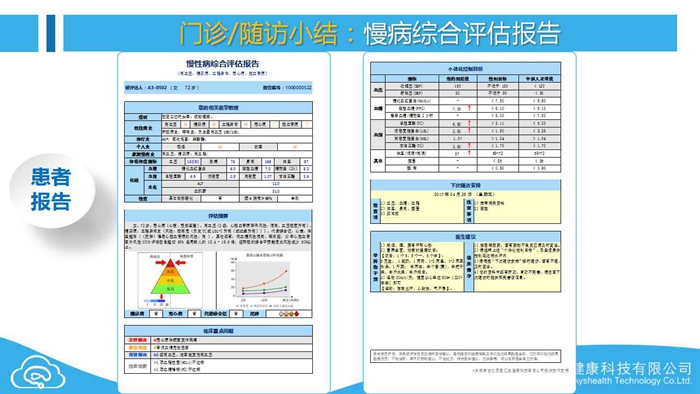
These are real-world scenarios from our support for family doctor contract services at the Fangzhuang Community Health Service Center in Beijing. During our exchanges with physicians in Wuhou District, they also found these tools highly beneficial, noting that they can enhance the efficiency of contract services, address key issues, improve guideline adherence, and elevate service quality. This aligns with the two key improvement themes highlighted in VCBeat’s White Paper on Primary Care: capacity building and efficiency enhancement.
For hospital administrators, medical insurance and social security agencies, and the National Health and Family Planning Commission, their primary concerns are the overall performance, team compliance rates, and adherence to clinical guidelines. GDS can provide intelligent management and operational support.
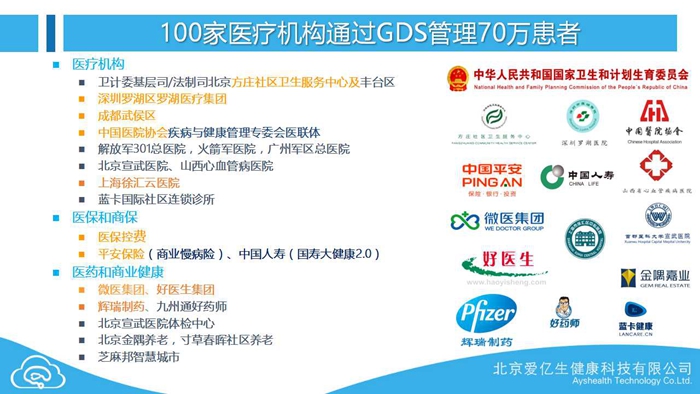
Currently, GDS is being utilized by 100 healthcare institutions, and the GDS database contains records of over 700,000 patients with chronic diseases. The first one is the Beijing Fangzhuang Community Health Service Center, known asA Model Community for China, this is a statement made by the Director of the Department of Legislation of the National Health and Family Planning Commission. In Fangzhuang, GDS is applied in communities, at home, and in hospitals.
The second is the Shenzhen Luohu Medical Group, which comprises one tertiary hospital, four secondary hospitals, and 48 community health service centers, serving a population of over 1.2 million in Luohu District. Dr. Sun, President of Luohu Hospital, famously stated, “Luohu Hospital becomes more profitable as the number of patients decreases.” This is because they have implemented a capitation-based prepayment model for medical insurance. We support Luohu’s approach to health management, emphasizing outcome-oriented chronic disease prevention and management.
The third component is an urban healthcare ecosystem, scaling from communities to regions and ultimately to the entire city. This represents an HMO and PBM model with integrated coordination among medical insurance, pharmaceuticals, and healthcare services, achieved in collaboration with our strategic partners. We implement an HMO-based chronic disease management model between healthcare institutions and patients, combined with a city-centered pharmacy PBM supported by Zhibao Cloud. Through the tripartite integration of medical insurance, pharmaceuticals, and healthcare services, we establish a genuine healthcare ecosystem that is affordable and sustainable for chronic disease care. Additionally, we employ an internet-based medical consortium model, which also integrates online and offline services to form a closed-loop system.
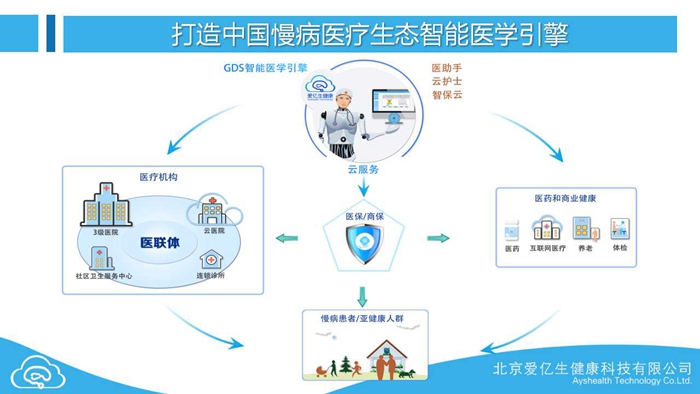
Therefore, GDS is not merely an intelligent information system for primary care; it serves as a medical engine empowering primary healthcare, facilitating the implementation of family doctor contract services, and comprehensively enhancing the service capacity and operational efficiency of primary care. This aligns with the key objectives for primary care informatization in 2017, as proposed by the Department of Primary Healthcare of the National Health and Family Planning Commission, and represents the strategic direction toward which we are fully committed. iYisheng Health: Caring for the lifelong health of hundreds of millions. Thank you.