

How Far Is the Realization of Medical Consortiums?
By Cheng Quan, Marketing Director at SandStone Data
——How Far Are We from Realizing Medical Consortia?
——Far away.
Recently, following the successive release of major healthcare reform announcements, “medical consortium”—a term that is not entirely new yet has gained renewed prominence—has become the hottest keyword in the industry. A reliable way to gauge the stage of a trend is to examine the frequency with which related concepts appear. Typically, the emergence of a new concept is accompanied by a plethora of associated terms, as seen with cloud computing in previous years and artificial intelligence today.
From a conceptual standpoint, the medical consortium discussed in this article bears more than coincidental similarities to currently popular concepts such as tiered diagnosis and treatment, precision medicine, internet-based healthcare, and medical cloud services.
The healthcare industry is one that heavily relies on accumulation. The reason is simple: compared to other industries, healthcare professionals face higher exit costs. In other words, their jobs are more stable—doctors remain steadfast while suppliers come and go.
Although some healthcare institutions have dared to be early adopters, the majority are still navigating uncharted waters. Against the backdrop of undefined standards and distinct regional market characteristics, entrepreneurs—particularly those from the internet sector—must rely on system service providers as partners to gain access to their target users.However, many companies mistakenly lead with a barrage of underlying technical details, which few users can fully comprehend. As a result, many seasoned sales professionals prefer to pitch a comprehensive, pre-packaged solution they have either selected or developed.
Compared to information silos, the fragmentation of healthcare systems is actually more thorny. Whether it is registration services on the patient side, system products for internal hospital operations, or the entire “patient-provider-pharma” industry chain, the characteristics of IT system fragmentation are very evident. While bridges can be built to connect silos, fragments are difficult to bond together.
Healthcare institutions suffer from insufficient investment in human resources and other areas within their information technology departments. Internal IT systems, including storage, networks, and operating systems, operate in silos. Core business systems such as Hospital Information Systems (HIS) and Picture Archiving and Communication Systems (PACS) still present single points of failure. Due to disparate interfaces, protocols, and vendors, information and data face significant barriers to seamless communication, compatibility, and interoperability. Furthermore, the adoption of disaster recovery systems remains low.
In this context, telemedicine, tiered diagnosis and treatment, and the recently proposed concept of “Medical Consortiums,”The goal is to integrate public medical institutions of different types and levels within a specific region by establishing collaborative alliances or forming healthcare groups, thereby creating communities of shared interests and responsibilities.In this way, patients can enjoy convenient, high-quality diagnostic and treatment services, including two-way referrals between primary care hospitals and tertiary Grade A hospitals, mutual recognition of laboratory test results, specialist consultations in community settings, and remote consultations. The aim is to guide patients toward implementing a tiered diagnosis and treatment system, rather than flocking indiscriminately to tertiary Grade A hospitals.
Compared with other industries, in the medical field, internet healthcare providers actually rely less on cloud computing than traditional medical institutions.
If you visit current healthcare industry exhibitions, you will inevitably get the sense that smart hardware displays have intruded into the space. Glucose meters, urinalysis devices, and various types of smartwatches are everywhere. Many healthcare professionals remain primarily business-driven; however, when it comes to more concrete approaches for implementing informatization, many struggle to provide clear explanations.
When discussing the development of internet healthcare, one must acknowledge the rapid advancement of smartphones and smart hardware in the previous wave. While numerous mobile apps carved out niches in medical service applications, they also attracted a significant influx of capital and resources. This trend created a handful of new elites, though, of course, not everyone achieved such status.
Last October,A survey conducted by a certain institution on 38 internet healthcare companies that have ceased operations revealed that 27 of them, accounting for 71%, had founders with backgrounds in the internet industry, while only 3, representing just 7.9%, had founders with medical backgrounds.。
It can be said that the tipping point for internet-based healthcare is still some time away. The user operations and product operations skills at which internet professionals excel struggle to identify genuine market pain points in the healthcare industry, making it difficult to establish effective profitability models.
The entry point for internet healthcare should first be the bottom-up transformation of internal information systems within medical institutions. Only by achieving data-level integration can innovation at the application level, such as medical consortia, be realized. Take the storage and usage issues of highly mature PACS (Picture Archiving and Communication Systems) as an example.
Currently, 90% of medical data originates from medical imaging, and 70% of clinical diagnoses rely on it. Revenue data from domestic Grade A tertiary hospitals also show that general medical imaging accounts for approximately 20% of total hospital revenue, with a growth rate significantly higher than that of pharmaceuticals. Consequently, PACS has become a highly mature product in terms of both its form factor and supporting hardware and software.
The core functionalities of a comprehensive PACS include image acquisition (via three methods: fully digital acquisition, video capture, and film scanning), data transmission and storage (adhering to the DICOM standard for Medical Digital Imaging and Communications), and image analysis and processing. With the continuous improvement of healthcare information exchange standards such as HL7 and IHE specifications, PACS has evolved from simple image storage and communication among a few radiology devices to enabling interoperability across all imaging equipment within hospitals and even between imaging systems at different institutions. Tiered diagnosis and treatment, telemedicine, and precision medicine are presenting significant opportunities for cloud-based PACS.
As the underlying architecture of PACS, storage systems are more of a generalized implementation. In other words, they need to meet various requirements as much as possible, but the interface definitions of the storage system itself limit the realization of some requirements. For example, object storage is suitable for cold storage and environments with large volumes of data.
Issues to be addressed include:
1. Heterogeneous Data Sharing: It is essential to address data sharing across different systems with varying data structures.
2. Non-invasive integration: Achieves seamless data integration without impacting the operation of existing systems
3. Ensure data consistency across systems
4. How to Centralize Clinical Data to Facilitate Clinical Diagnosis, Treatment, and Scientific Research
5. Ensure the scalability and reliability of the system to meet future development needs
6. Achieve compatibility for information exchange between the system and regional or external systems
Therefore, we need to first clarify the data types of PACS:
1. The larger the storage capacity, the better;
2. Data requires long-term retention and archiving;
3. Structured data is read and written frequently, with certain concurrent access requirements, imposing high demands on disk performance;
4. Large volumes of unstructured data and high bandwidth requirements necessitate rapid file query and retrieval capabilities,
5. Data backup and off-site disaster recovery
Having understood the data characteristics, let us now discuss the methods of data storage:
1. Adopting erasure coding to improve storage medium capacity utilization while ensuring data reliability.
2. Achieve online storage for hot data and archival for cold data through tiered and hybrid storage methods;
3. Enhance performance through distributed client-side read/write caching;
4. Utilize object storage interfaces and enhance data query and retrieval speeds through relevant algorithms;
5. Utilize data replication technologies at the application or storage layer, along with high-performance snapshots and linked clones, to achieve backup and disaster recovery for online imaging data;
From the current practical situation, there are significant differences in informatization capabilities among different medical institutions.
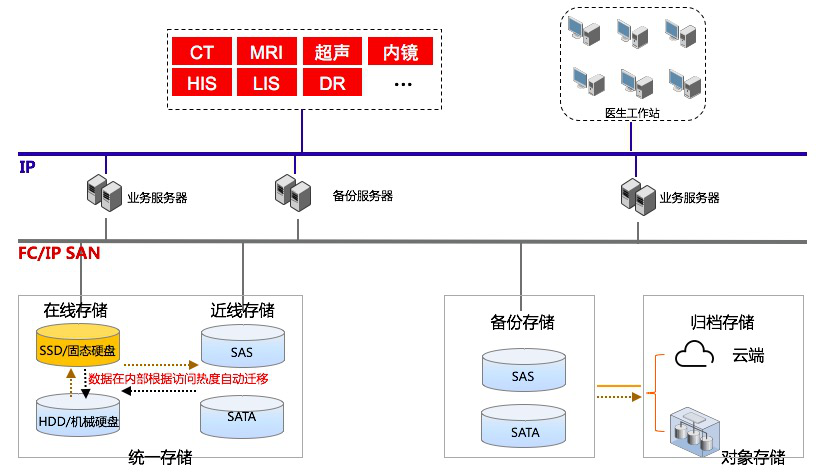
Tertiary Hospitals Can Adopt More Comprehensive Data Storage Systems
Regional hospitals and primary care institutions may consider an integrated approach:
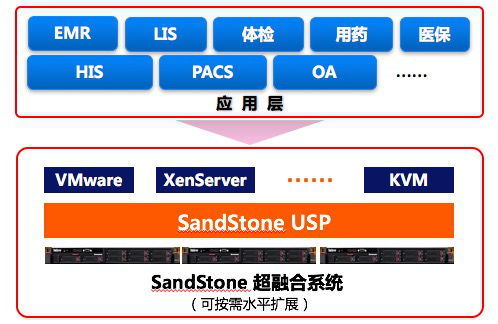
Although the architectures differ, both approaches adhere to the same integration philosophy: the convergence of upper-layer business operations with underlying infrastructure, the integration of on-premises and cloud environments, and the fusion of structured and unstructured data...
——How Far Is the Realization of Medical Consortia?
—Not far.
As the underlying data storage methods of information systems begin to change, and as hyperconverged infrastructure, software-defined technologies, private clouds, and hybrid clouds start to be implemented, medical consortia will truly be realized.
Note: This article was submitted by a reader and does not represent the views of VCBeat.