

Verily's Breakthrough Wearable Non-Invasive Diagnostic System Patent Enables Cancer Detection Without Biopsy
In April this year, VCBeat reported that Verily had launched a new health-tracking wearable device, the Study Watch, and planned to deploy it on a large scale for medical research, primarily to build a health database and support Parkinson’s disease research.
Recently, Verily has made new moves. According to the CB Insights patent search engine, one of its new patents has just been granted (the patent application was filed in February 2014 and approved on May 8, 2017).This patent provides a non-invasive diagnostic system applicable to a variety of diseases, with a diagnostic scope that includes hormonal disorders, infections, and even cancer.。
This diagnostic system utilizes wearable devices to monitor and evaluate specific substances introduced into or ingested by the human body. By monitoring the types of particles interacting with these substances, the system provides feedback to users regarding potential disease risks.
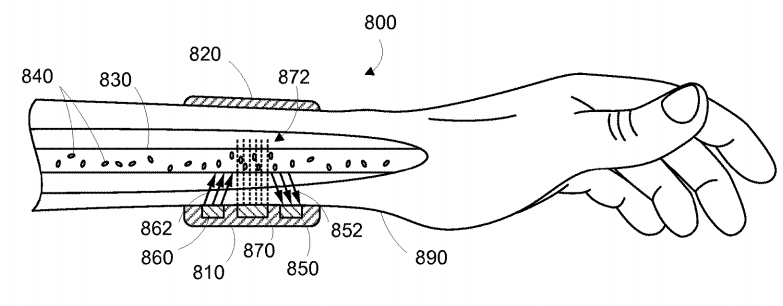 Schematic Diagram of Verily's New Patent System
The Magical “Engineered Particles”
This patent, freshly granted just two weeks ago, specifically pertains to a contrast agent substance, somewhat similar to the imaging agents injected into the body prior to an MRI (Magnetic Resonance Imaging) scan.
According to the patent description, the injectable substance consists of “engineered particles” designed to interact with analytes in the blood, such as human antibodies. This interaction is then captured by a device worn on the user’s wrist, thereby enabling the diagnosis of various diseases.
The official title of this patent is “Engineered Particles with Polarization Contraction and Linear Control for Enhanced Imaging.” Engineered particles in the blood bind to antibodies, DNA, peptides, or other proteins that can characterize underlying diseases. Electromagnetic waves penetrating the skin then interact with these engineered particles to detect disease-related information.There are various methods for introducing engineered particles into the body, including oral administration, inhalation, injection, transdermal delivery, and other routes.
The patent indicates that,Engineered particles can be specially prepared materials, or they can be molecules, viruses, conductive nanorods, or even quantum dots—often referred to as “artificial atoms.”It is also worth noting that these particles will be engineered to remain in the human vascular system or bodily fluids for extended periods.
Wearable Devices: A Proven Approach to Detection
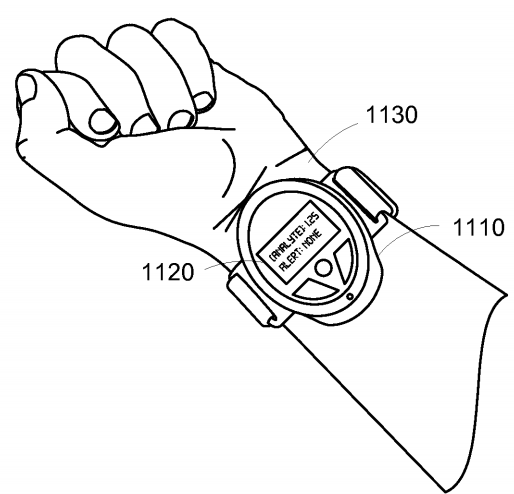
The electromagnetic wave emitter worn on the wrist generates energy pulses, then analyzes the response of engineered particles to these pulses to determine whether the engineered particles have attached to analytes such as cancer cells. Subsequently, as shown in the figure below, the device presents intuitive results to the user.
The following images and text illustrateVerilyThree Key Components of This Patented Design: Optical Absorber, Energy Emitter, and Biological Receptor (Image source: Verily patent; text compiled by VCBeat).
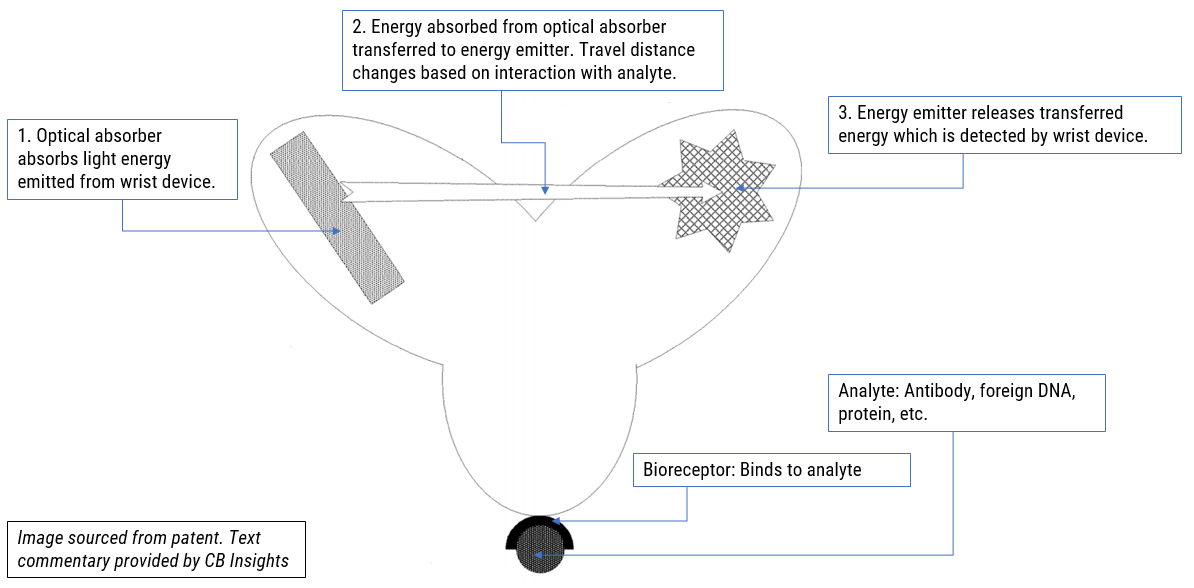
1. The optical absorber absorbs the light energy emitted by the wristband device;
2. The light energy absorbed by the optical absorber will be transmitted to the energy emitter, with the transmission distance depending on its interaction with specific analytes;
3. The wristband device detects the energy emitted by the energy emitter.
Can be used for cancer diagnosis
The actual workflow involves transmitting physiological data collected from users to a remote server, which may be a mobile device, computer, cloud platform, or other remote system.Potential physiological indicators that can be used for detection also include blood pressure, pulse, respiratory rate, and skin temperature.
The actual readings are then compared with standard values, and if any abnormalities are detected, recommendations will be provided to the user. Additionally, these physiological data can be remotely downloaded by physicians.
The patent further indicates that this diagnostic system can also be used to “disrupt, damage, or otherwise modify specific targets,”Therefore, it has the potential for practical targeting and curing of identified conditions, and can be used in applications such as anti-tumor therapy and targeted chemotherapy.。
References:
https://www.cbinsights.com/blog/google-verily-patent-wearable-diagnostics/