

Baidu Showcases Lingyi Smart Healthcare at UN AI for Good Summit, CDSS Deployed Across 13 Chinese Provinces
VCBeat (WeChat ID: vcbeat) has learned that the third AI for Good Global Summit opened in Geneva on May 28, with more than 2,000 participants from over 120 countries joining industry leaders, experts, and scholars in the field of artificial intelligence.
The Global Summit on AI for Good, co-organized by the International Telecommunication Union (ITU) in collaboration with the World Health Organization, the World Bank, and 37 other United Nations agencies, serves as the UN’s premier platform for inclusive dialogue on artificial intelligence. This year’s summit aims to build bridges of cooperation between AI enterprises and policymakers in the public and private sectors, explore the practical applications and value of AI in advancing education, healthcare, social equity, and safe mobility, and formulate action plans to scale high-impact AI solutions globally.
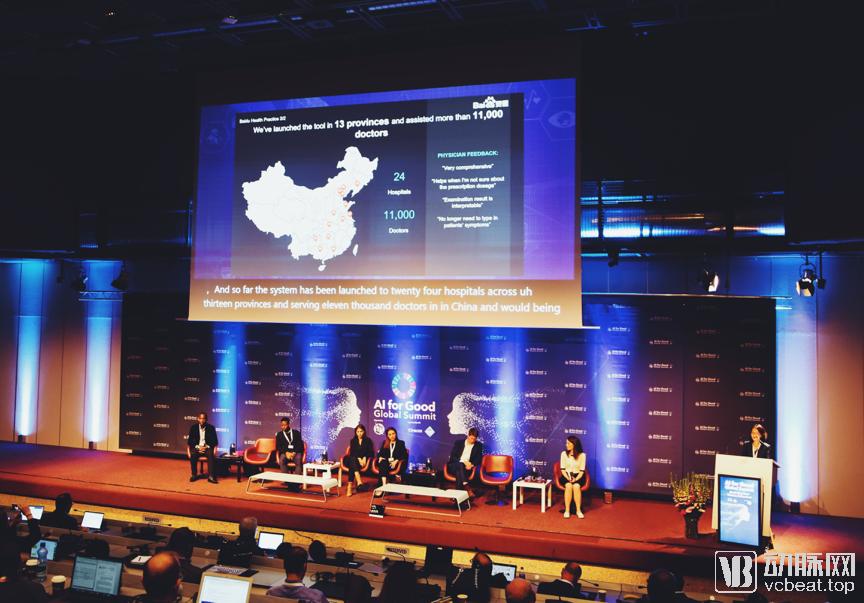
As the only company from mainland China invited to deliver a speech, Baidu provided a Chinese perspective at the global summit. Huang Yan, Senior Director of Baidu’s AI Innovation Business Division and General Manager of Smart Healthcare, delivered two keynote addresses at the summit’s main forum and the “Good Health and Well-Being” thematic forum, sharing examples of how AI benefits humanity and drives social progress.
As Huang Yan stated, “AI will be one of the key instruments for China to achieve its 2030 Sustainable Development Goals. In fact, AI can play a pivotal role in poverty alleviation, disaster resilience, promoting equity in education and healthcare, enhancing urban safety, and preserving and safeguarding cultural heritage, thereby driving the sustainable development of society and industries as a whole.”
Boosting Productivity, Saving Endangered Languages: The Power of AI Far Exceeds Your Imagination
“We should advance AI technology and better harness it to serve the common good of humanity,” urged UN Secretary-General Guterres in his address at this summit.
At the main forum of the summit, Baidu shared several examples of leveraging its AI technology to empower various industries. The first case comes from the manufacturing sector. The Guangzhou region is home to numerous suppliers of core components for electronic products and household appliances. These critical components require stringent quality control before leaving the factory. However, quality inspection is a tedious and eye-straining task: inspectors must bow their heads and keep their eyes wide open to detect defects on small parts, often requiring the use of magnifying glasses.
Under the immense pressure of repeating such tasks for 8–12 hours daily, high myopia and photophobia-induced tearing have become common occurrences among quality control inspectors. The AI-powered intelligent component sorting machine, developed using Baidu’s open-source deep learning platform PaddlePaddle, has brought a turning point to component quality inspection. Operating with remarkable efficiency, the intelligent sorter handles ten times the workload of an average quality control inspector. With AI assistance, inspectors have assumed new roles: they now only need to identify defective parts that the machine has not yet learned to recognize, working alongside technical staff to train the system.
Beyond liberating people from tedious and repetitive tasks, AI has also played a significant role in cultural heritage preservation. According to projections by relevant United Nations organizations, 50% to 90% of the world’s languages are expected to become extinct by the end of the 21st century. Many linguists have chosen to preserve endangered languages through oral documentation and linguistic archiving. However, this process involves not only recording audio but also phonetic transcription, annotation, comprehension, and translation, thereby transforming these recordings into accessible and understandable linguistic resources.
The difficulty of this task far exceeds what most people can imagine. Fortunately, the application of AI algorithms has greatly simplified the process: in the Tujia language preservation initiative, AI not only replaces manual labor with computational power to handle extensive phonetic transcription but also assists in sense-for-sense translation, establishing a foundational framework for translating endangered languages. As a result, Chinese translations of the Tujia language can be completed entirely by AI. Even if the language ceases to be spoken, it will be “frozen” rather than “extinct.”
Addressing the Challenge of Unequal Medical Resource Distribution: AI Empowers the Building of a Sustainable World
Beyond manufacturing and the cultural sector, AI holds significant promise in healthcare. At the “Good Health and Well Being” forum, Baidu showcased how AI can help bridge the gap caused by shortages of medical resources, citing practical applications of its AI healthcare brand, Baidu Lingyi, in primary disease screening and clinical decision support.
China has over 600 million people at risk of eye diseases who require regular screening, yet there are only 36,000 professional ophthalmologists and fewer than 1,000 grassroots physicians capable of interpreting medical images. To address the disparity between substantial demand and scarce resources, Baidu Lingyi has developed an “AI Fundus Screening System” that can generate multiple fundus reports within 10 seconds, achieving a diagnostic accuracy rate of up to 94%. Since last year, Baidu Lingyi has collaborated with the Zhongshan Ophthalmic Center of Sun Yat-sen University to deploy this AI system in numerous primary-care hospitals across Guangdong Province, earning widespread acclaim from local physicians and the public. According to Baidu’s internal statistics, as of April, the AI Fundus Screening System has helped diagnose 349 patients with fundus diseases such as diabetic retinopathy, thereby preventing the risk of blindness.
In addition to providing solutions for preventive screening, AI can also offer professional, real-time clinical decision support capabilities to primary care physicians, thereby “safeguarding” grassroots diagnosis and treatment. Baidu Lingyi has launched a “Clinical Decision Support System (CDSS)” tailored for primary care physicians with relatively limited clinical experience. The system includes multiple modules such as intelligent consultation, diagnostic assistance, and treatment plan recommendations, enabling primary care physicians to leverage the high-quality diagnostic and therapeutic expertise of doctors from Tier 3 Grade A hospitals.
The product covers over 4,000 diseases across 27 standard medical specialties, with the accuracy of its top-three disease recommendations reaching as high as 95%. Currently, Baidu Lingyi CDSS has been deployed in 13 provinces and municipalities across China, providing optimal support to more than 11,000 primary care physicians. Its timely medication recommendations and comprehensive consultation capabilities have received widespread acclaim.
At the conclusion of her speech, Huang Yan stated, “Equality in life and health for all is a long-standing goal pursued by humanity. This grand and noble vision may finally be realized in the AI era.”
Building on this summit, the World Health Organization (WHO) and the International Telecommunication Union (ITU) jointly established the Focus Group on Artificial Intelligence for Health (FG-AI4H). This focus group is dedicated to preliminary research on international standards for AI in health, with a particular emphasis on data formats, standard datasets, and algorithm evaluation and validation in the healthcare sector.
At the beginning of the year, Baidu Lingyi, as the lead organization, submitted two standard proposals covering fundus imaging and clinical decision support systems, which received strong endorsement from the organizers. Consequently, it participated in the Focus Group on Artificial Intelligence for Health discussions at this conference, working alongside international peers to advance global standards for AI in healthcare.
In its exploration of “AI+,” open empowerment and win-win collaboration have always been the core strategies underlying the development of Baidu AI. Since 2018, Baidu Lingyi has launched the “iChallenge” series of online and offline competitions, aiming to release large volumes of high-quality, finely annotated ophthalmic imaging data and foster in-depth communication and technical exchange among researchers in the AI healthcare sector. The competition has now grown into the largest and most authoritative international contest for ophthalmic medical image analysis. At the International Symposium on Biomedical Imaging (ISBI), a top-tier global conference on medical imaging that concluded this April, the PALM Challenge, part of the iChallenge series, attracted nearly 400 teams from institutions such as IBM, Ping An Technology, and the Johns Hopkins University School of Medicine.
In October, Baidu Lingyi will also host the world’s first competition on automated analysis of anterior chamber angle morphology using anterior segment OCT images at MICCAI, the premier conference in medical imaging, and will release the associated dataset, marking a global first.
According to VCBeat, Baidu Lingyi will open up more AI healthcare capabilities and data in the future to build an AI healthcare ecosystem, thereby accelerating the development of “AI + Healthcare.”