

What Kind of Medical Consortium Do We Really Need? Insights from a Newly Filed Prospectus
Following this year’s Two Sessions, medical consortiums have gained nationwide prominence across China, with various forms of medical alliances (including medical communities) emerging in rapid succession.
Vice Premier Liu Yandong’s Key Tasks for Healthcare Reform in 2017: Comprehensively Launching the Construction of Medical Consortia in Various FormsAll tertiary public hospitals must fully participate, taking the lead in establishing medical consortia, breaking down regional barriers, ensuring vertical integration, and decentralizing resources. Linked by shared interests, they will form a community of management, responsibility, and development. By the end of June this year, local Health and Family Planning Commissions will present specific implementation plans.
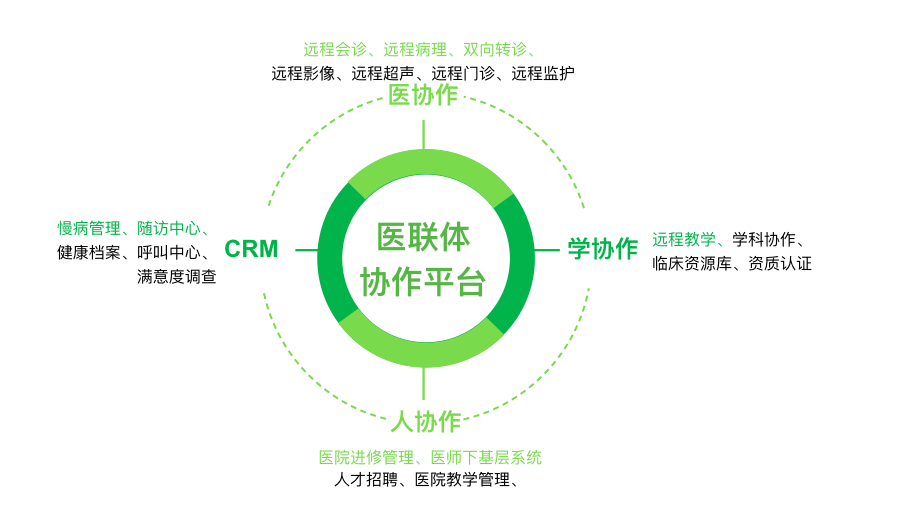
It is evident that advancing medical consortiums is no longer mere rhetoric, but rather an actionable plan with clear objectives and methodologies. For example,To meet new collaborative needs, a medical consortium collaboration platform is established using telemedicine and mobile internet technologies:
As is well known, medical diagnosis is not fortune-telling; effective care cannot rely solely on doctors making superficial visual assessments. Diagnostic tests are required for the diagnosis and treatment of nearly all diseases, as they critically influence diagnostic accuracy.
Current telemedicine and internet technologies have already enabled remote collaboration for diagnostic tests, ward rounds and follow-ups, consultations on complex cases, and even surgical procedures.Unlike on-premise hospital information systems, these cloud-based systems exchange data with in-hospital information systems via interoperability protocols, ensuring that the hospital’s core business operations remain unaffected.
Through practice and exploration, it has been summarized that a medical consortium collaboration platform should possess four key elements:Medical Collaboration, Academic Collaboration, Human Collaboration, and Patient Management。
Medical Collaboration
The Medical Consortium Collaboration Platform leverages remote technology to extend the high-quality medical technical services of tertiary hospitals, enabling resource sharing within the medical consortium. This facilitates mutual recognition of examination and test results, prescription portability, and resource sharing. The platform achieves interoperability of health records and medical histories, while implementing mutual recognition of test results, prescription circulation, and medication sharing. Additionally, it establishes centralized medical imaging and diagnostic centers to provide integrated services for collaborative hospitals within the medical consortium.
Take the largest medical consortium currently operating in China, the “Interconnected Smart Tiered Diagnosis and Treatment Platform” in Henan Province, as an example. It is one of the medical consortia with the most in-depth application of medical technology in China. Since its launch, it has been led by core hospitals, connecting downward with more than 20 municipal-level hospitals across the province and over 100 county-level hospitals in various counties (districts), and connecting upward with renowned domestic and international medical institutions such as UCLA (University of California, Los Angeles), Mayo Clinic, and the Chinese PLA General Hospital.
According to the platform’s statistical data, as of March 2017, it had facilitated over 35,000 free clinic consultations and more than 28,000 ward rounds. Remote electrocardiogram (ECG) and remote pathology diagnoses each exceeded 10,000 cases, while consultations for complex and refractory diseases totaled 8,436 cases, representing substantial figures.
It is also worth noting that specialized medical consortium collaboration platforms better demonstrate the advantages of “disease-focused collaboration,” such as pediatric and ophthalmology medical consortia.
Interdisciplinary Collaboration
Lower-tier hospitals within medical consortia generally seek training and guidance from superior hospitals with robust teaching capabilities to enhance their own medical service capacity and retain local patients. Previously, this was achieved through the dispatch of experts by superior hospitals and delegated training by lower-tier hospitals. Now, by fully leveraging the advantages of collaborative platforms within medical consortia, surgical expertise and teaching resources that are difficult to deploy on-site can be provided remotely to grassroots hospitals and physicians. Furthermore, an integrated online-offline approach is adopted. Issues identified online are addressed with focused guidance during offline expert support visits, enabling targeted assistance that truly strengthens the capabilities of grassroots physicians.
Remote education, interdisciplinary collaboration, clinical resource repositories, and credential accreditation are essential components for ensuring talent development and mobility within medical consortia. Standardized residency training for general practitioners is a key priority for teaching hospitals; medical consortia that fail to disseminate educational resources will struggle to motivate primary care institutions.
Patient Management
Following diagnosis and treatment at tertiary hospitals, patients return to their places of residence for rehabilitation and chronic disease management. This approach minimizes patients’ economic burden while ensuring the continuity of healthcare service quality. Functions such as health record sharing, follow-up center scheduling, and call center appointment and referral services are all implemented on the Medical Consortium Collaboration Platform. Patient satisfaction surveys and referral satisfaction surveys provide data support for the management of medical consortia.
Can Internet Hospitals Build Medical Consortia? Yes!
Recently, at the 2017 China Health Information Technology Exchange Conference, Jin Xiaotao, Deputy Director of the National Health and Family Planning Commission, provided reassurance to innovators in the internet healthcare sector.
Director Jin Xiaotao responded directly, stating that the National Health and Family Planning Commission (NHFPC) attaches great importance to internet-based healthcare. Building on accumulated experience, the NHFPC will further guide and promote this sector. After soliciting opinions from all parties through multiple channels, the NHFPC will issue guiding opinions as soon as possible to align with the development trend of “Internet Plus,” support the emerging model of “Internet Plus Healthcare,” steer its standardized development, and advance it toward a higher level of smart healthcare.
So, can “Internet Hospitals,” currently at the forefront of public attention, establish medical consortia? The answer is, of course, yes!
The 2017 Key Tasks for Healthcare Reform pointed out that medical consortia would break down barriers in administrative divisions, fiscal investment, health insurance payment, and personnel management. Led by tertiary public hospitals or hospitals with strong clinical capabilities and county-level hospitals, these consortia would be formed by urban and rural medical institutions of different levels and types, or among specialties, to achieve complementary advantages and division of labor through collaboration.
“Internet hospitals,” which extend medical service capabilities based on tertiary hospitals as their physical foundation, have rightfully become a core component of medical consortia.
Taking a large public Grade A tertiary hospital in Zhejiang Province as an example, the hospital launched China’s first online campus in February 2015. It has facilitated over 5,000 specialist consultations, served more than 10,000 patients, and conducted nearly 10,000 online consultations with renowned experts. Furthermore, using its branch hospitals as pilots and leveraging the deep integration of “Internet + Healthcare,” the hospital established a three-tier referral platform spanning provincial, municipal/county, and community/township levels, thereby introducing innovative measures for tiered diagnosis and treatment.
Interconnectivity has been established among remote consultation, multidisciplinary team (MDT) services, medical imaging, ultrasound, and pathology, extending high-quality healthcare resources to community health centers (village clinics). Notably, the platform features a self-developed “Two-Way Medical Referral System,” enabling electronic medical record sharing, interoperability of diagnostic tests, streamlined hospital transfers, remote consultations, and remote pathology services in collaboration with multiple hospitals.
Ultimately, whether through medical consortia or internet-based healthcare, the national mission of tiered diagnosis and treatment will be upheld. Enterprises must innovate within regulatory frameworks, ensuring that internet technology genuinely delivers convenience and safety to patients, making healthcare services readily accessible!
Note: This article was submitted by a reader and does not represent the views of VCBeat.