

Four Categories of Digital Tools Empowering Retail Pharmacies in the 'Internet+' Era File for IPO
What Will Pharmacies of the Future Look Like? We Can Simulate the Following Scenario:
Patients can undergo basic examinations at pharmacies and upload the results via remote consultation devices, enabling online communication and diagnosis with physicians without waiting in line at hospitals. Electronic prescriptions issued by doctors are transmitted to the pharmacy in real time, where pharmacists review the prescriptions and provide professional medication guidance.
If certain medications are out of stock at a pharmacy, the pharmacist can submit a demand request and directly report it to the pharmaceutical manufacturer or distributor via the backend system. The latter will then complete delivery in the shortest possible time, ensuring that patients’ medication regimens are not disrupted.
Meanwhile, for patients with chronic diseases, pharmacies will be staffed with professional pharmacists to provide rehabilitation guidance and advice on lifestyle precautions, enabling retail pharmacies to assume certain medical functions.
In terms of management, pharmacies fully mobilize employee enthusiasm, enabling management to easily monitor the operational status of frontline stores, down to the performance of individual employees.
Under the “Internet Plus” model, such a scenario may not be far off for retail pharmacies. An increasing number of internet-based startups are focusing on upgrading the retail pharmacy model, with the goal of enhancing management standards and endowing these pharmacies with medical capabilities, thereby transforming them into community health service centers.
VCBeat has conducted a preliminary scan of existing “Internet + Pharmacy” projects on the market, categorizing them by procurement, management, service, and marketing dimensions. This analysis delineates the various operational models of “Internet + Pharmacy” in detail to identify emerging industry opportunities.
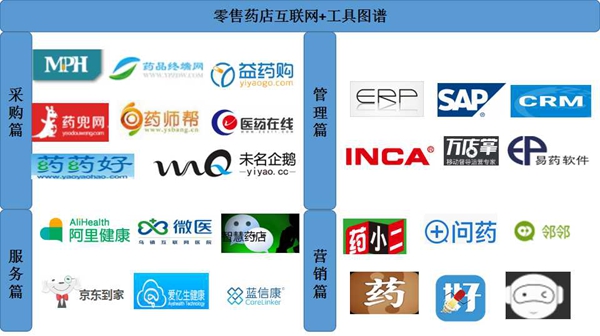
Procurement: B2B Pharmaceutical E-commerce Gains Momentum
After interviewing dozens of healthcare startups, it is easy to summarize the “problem-oriented” logic underlying healthcare ventures: founders’ initial motivation for developing products is centered on what problems they can solve, and they provide answers aligned with the characteristics of internet-based tools—namely, cost reduction and efficiency improvement.
This logic remains valid when applied to how the internet addresses the procurement pain points of retail pharmacies.
First, let us examine the issues existing in procurement at retail pharmacies. Firstly, due to their small demand for pharmaceuticals, retail pharmacies lack bargaining power against upstream supply chain enterprises. Secondly, the procurement process in retail pharmacies is lengthy, resulting in significant markups. Thirdly, procurement in retail pharmacies lacks flexibility, making them prone to either untimely purchases or inventory overstocking.
To address these three pain points, the primary direction for procurement in "Internet + Retail Pharmacies" is pharmaceutical e-commerce.
B2B pharmaceutical e-commerce platforms (such as My Medicine Network, Drug Terminal Network, YaoYaoHao, YaoPianYi, and YaoDou Network), including the recently established “Smart Pharmacy Alliance,” all leverage centralized procurement, flexible purchasing, and direct manufacturer access as their key marketing propositions. Taking this a step further, startups have developed pharmacy ERP systems that directly connect with industrial manufacturers, enabling automatic replenishment by pharmaceutical companies based on real-time inventory needs, thereby eliminating the need for pharmacies to manually submit purchase requests.
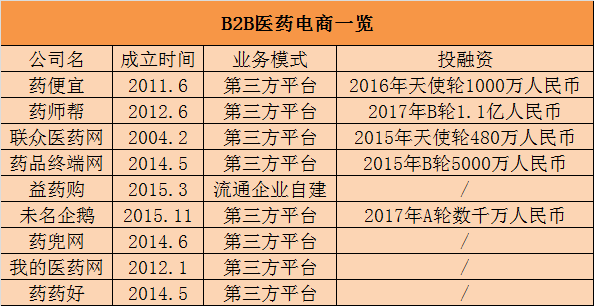
Undoubtedly, such initiatives can address the challenges faced by retail pharmacies to a certain extent, but they also have many inherent limitations.
A closer examination reveals that platform-based pharmaceutical e-commerce faces a fundamental limitation: it serves merely as an intermediary for information matching, without engaging in direct drug transactions. This results in high substitutability of such platforms. A senior executive from one such pharmaceutical e-commerce company candidly told VCBeat that the platform lacks sufficient core competitiveness, and its future development prospects remain unclear.
Another approach is to establish self-owned warehousing and distribution networks, yet balancing costs and revenues proves challenging. This strategy essentially competes with traditional pharmaceutical commercial companies for market share. It is difficult to gain significant traction against industry giants such as Sinopharm, China Resources Pharmaceutical, and Shanghai Pharmaceuticals, which have already established extensive layouts in pharmacy chains and primary healthcare systems. Competing directly with these dominant players for market share is evidently an uphill battle.
For startups, the challenge lies in identifying the right focal point amidst both pain points and difficulties.
First, in terms of industry scale, the pharmaceutical retail sector boasts a market size exceeding RMB 300 billion. Driven by policies such as the separation of prescribing and dispensing and the outflow of prescriptions from hospitals, the market potential for retail pharmacies will continue to expand. This implies that, over the medium to long term, retail pharmacies will need to procure approximately RMB 300 billion worth of products, with the key lying in identifying the most promising areas for growth.
Secondly, internet-based procurement is not merely about moving purchasing activities online; rather, it represents the integration of commercial flows, logistics, information flows, and capital flows. Internet platforms emphasize service by connecting retail pharmacies with upstream and downstream supply chain enterprises to facilitate resource integration and create new value.
What is certain is that by leveraging internet platforms as value-connecting hubs to link industrial manufacturers, distributors, and retail pharmacies, stakeholders can be empowered to ultimately achieve convenient procurement, supply chain finance, and supply chain services. Projects focused on enabling online procurement for retail pharmacies will continue to multiply, with services becoming increasingly specialized and business models growing more diverse.
Management: Maximizing Employee Motivation
Regardless of whether managers acknowledge it, as a company expands in size, the productivity of individual employees within the collective is significantly lower than when the company was smaller. Therefore, managers need to leverage various management tools to fully mobilize employee motivation, such as a well-defined organizational structure, KPI systems, and performance-based reward and punishment mechanisms.
The same holds true for retail pharmacies. As chain operations expand, they benefit from economies of scale—such as the spreading of fixed costs and diminishing marginal variable costs. However, this is accompanied by a linear increase in management costs.
As previously mentioned, the pharmaceutical retail sector is currently poised for growth. On one hand, driven by policy support, the market size of retail pharmacies continues to expand;
On the other hand, the use of internet tools enables retail pharmacies to precisely control cost expenditures (such as procurement costs). In this context, focusing on human resources and employee efficiency is also a key priority for startups in the “Internet + Pharmacy” sector.
In terms of practical products, there are not only traditional ERP tools but also emerging collaborative office systems and mobile management software. The focus of enterprise management varies, with different emphases on material requisition, task allocation, multi-person collaboration, and performance management.
Here, we take the “Wan Dian Zhang” mobile operations supervision system as an example to examine the application of internet-based tools in the management of retail pharmacies.
The system leverages surveillance equipment to provide real-time visibility into in-store operations, facilitating management inspections. This enables the identification of operational issues and deficiencies, allowing managers to mandate immediate corrective actions by store staff, while also issuing commendations for high-performing stores. Furthermore, each store employee is assigned an individual account to streamline vertical communication. The integration of features such as check-in, performance evaluation, Mobile Academy, and training modules helps ensure sustained engagement among frontline staff.
Based on partner feedback, the solution effectively addresses remote supervision, foot traffic analytics, and hotspot analysis for chain pharmacies, helping them improve operational efficiency and control costs.
According to official data from Wandiannzhang, after its star clients adopted the Wandiannzhang system, labor cost-related metrics accounted for a 13.2% decrease in total expenditures, representing a 0.6% decline compared to the same period in previous years.
We have also observed that some pharmacy chains have adopted mobile office automation (OA) systems and WeChat-based collaboration platforms. From a procedural standpoint, these tools facilitate online business reporting, employee discussions, and incentive management. From a managerial perspective, they enable leaders to maintain a stronger “on-the-ground” presence in frontline operations, break down multi-layered supervisory structures, and achieve flat organizational management.
Service Section: Empowering Retail Pharmacies
Functionally, retail pharmacies have traditionally been limited to basic medication sales, with ancillary pharmaceutical care services provided incidentally. In recent years, innovative initiatives have emerged to empower retail pharmacies by integrating services such as light consultations, membership management, chronic disease management, O2O (online-to-offline) platforms, and professional pharmaceutical care. These efforts aim to transform pharmacies into community health management hubs. Other initiatives, such as “Smart Pharmacies” and “Cloud Pharmacies,” similarly support diversified operations for retail pharmacies, driving incremental growth.
Here, we also present several case studies detailing how internet-based tools empower retail pharmacies. First is WeChat’s “Smart Pharmacy Solution,” followed by WeDoctor’s “Medi-Consult-Pharmacy” project, and thirdly, JD Daojia’s sub-category “Health at Home.”
WeChat’s “Smart Pharmacy Solution”
In April 2015, WeChat unveiled its “WeChat Smart Pharmacy” solution for the first time, providing services that connect individuals with pharmacies. By adopting the WeChat Smart Healthcare solution, traditional pharmacies can conduct online pre-consultations, arrange medication delivery, establish patient records, enable WeChat Pay, manage loyalty points, send medication reminders, and facilitate follow-up health communications and participation in marketing campaigns.
In August 2016, WeChat Smart Pharmacy was rebranded as “Internet+ Pharmacy.” Leveraging WeChat’s social and payment functionalities, the initiative aims to facilitate the smart transformation of pharmacies—shifting them from single-purpose drug retail outlets into diversified health service centers. This model centers on users, with drug sales as the foundation and physical stores serving as channels for communication and service delivery, thereby providing comprehensive health services and establishing a dual closed loop of service processes and marketing conversion.
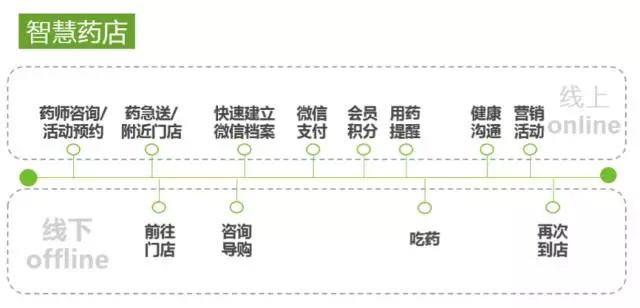
Data released by WeChat shows that more than 60,000 pharmacies had already enabled WeChat Pay at the time, and the platform collaborated with multiple pharmacy chains to provide medical services such as membership management, disease records, chronic disease management, and home delivery of medications.
Micro Medicine Clinic
The “Pharmacy-Clinic” model primarily involves installing remote consultation terminals in pharmacies, enabling users to conduct online consultations, receive electronic prescriptions from physicians, and pick up their medications on-site. Backed by WeDoctor, the Pharmacy-Clinic also offers services such as appointment registration and patient triage, effectively transforming pharmacies into comprehensive primary care centers. Crucially, this model leverages the electronic prescribing credentials of Wuzhen Internet Hospital and its extensive network of connected physicians.
As of April this year, Yaozhen Dian has connected with over 12,000 pharmacies, handling an average of 26,000 consultations per day.
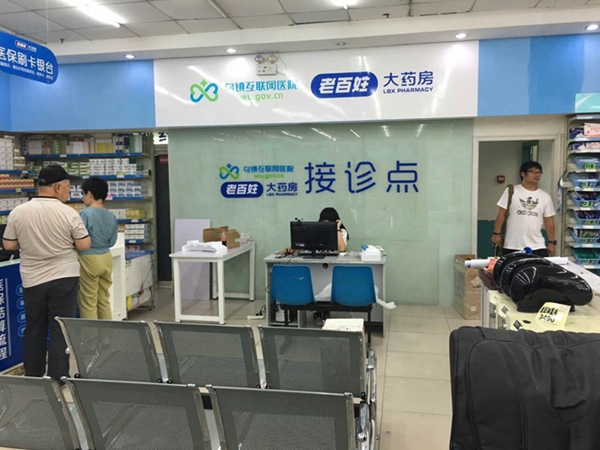
Wuzhen Internet Hospital Laobaixing Pharmacy Consultation Point
Pharmacies are willing to collaborate with Weiyao Clinic Stores primarily for two reasons: first, it drives an increase in prescription volume; second, it enables user retention by serving as an entry point for medical services. This is particularly relevant for patients with chronic diseases requiring long-term medication. Although Wuzhen Internet Hospital can be accessed through channels other than pharmacies, the frequent in-store customers typically have limited digital literacy. In this context, pharmacies effectively serve as “patient assistants,” a role that is regarded as part of their professional competency.
JD Daojia “Health at Home” Project
"Health at Home" is a sub-sector under the JD Daojia platform, providing medication delivery services to consumers through partnerships with offline pharmacies, with deliveries handled by Dada, its crowdsourced logistics platform.
As of April this year, the number of stores integrated with JD Health’s at-home service exceeded 5,000, with an average daily order volume of approximately 7,000 and an average transaction value ranging from RMB 53 to 56. Over-the-counter (OTC) medications accounted for 70% of sales, while daily chemical products, disinfection-grade items, and medical devices also held significant market shares.
The “Health at Home” initiative is relatively straightforward: users place orders on JD Daojia, and upon submission, Dada’s crowdsourced logistics network handles the delivery. JD Daojia positions itself as a pharmaceutical O2O service distinct from food-delivery scenarios. For pharmacies, it provides the capability to capture potentially lost orders—users who might otherwise forgo purchasing medications due to the inconvenience of visiting a store in person—thereby effectively driving incremental growth.
These three initiatives—ranging from member management and healthcare capability enhancement to O2O services—share a common goal: empowering pharmacies. Other solutions, such as specialized chronic disease management tools and health management platforms, may have different focal points, but they all aim to help pharmacies extend their services beyond traditional pharmaceutical retail. By adding greater depth and diversity to pharmacy services, these initiatives ultimately drive sustained long-term performance growth.
Marketing: The Chemical Reaction Between the Internet and Retail
Internet marketing is characterized by the use of substantial subsidies in the early stages to acquire users, with the aim of achieving long-term revenue recovery once a user base is established. Although this model entails significant cash burn and carries the hidden risk of uncertain outcomes, it may offer greater applicability for retail pharmacies compared to other sectors.
First, from the perspective of retail pharmacy user attributes, a significant proportion consists of long-term medication users, meaning that once these customers are attracted to physical stores, they generate sustained and stable demand. Second, practical experience with internet marketing in the food delivery and fresh produce sectors demonstrates that its effectiveness for offline consumption is predictable.
In fact, the aforementioned three types of internet tools all possess certain marketing effectiveness. Examined individually, procurement constitutes supply chain marketing, addressing the issue of product assortment stocking in pharmacies; flexible and convenient procurement can help pharmacies better meet customer demands;
Enhanced management mechanisms have effectively fostered an all-hands marketing approach, maximizing employee engagement by turning every staff member into a marketer—a strategy that proves more impactful than relying solely on independent marketing teams. Meanwhile, enablement tools are undoubtedly the most effective means for product marketing; the best marketing always lets the product speak for itself. Only through the combination of excellent service and high-quality products can marketing efforts achieve their full potential.
However, “even the finest wine fears a deep alley,” making professional marketing tools indispensable. Especially when both products and services are strong, moderate marketing can help users access service information more quickly, unleash the momentum of product deployment, and create synergy between products and marketing.
Currently, retail pharmacies have limited access to professional marketing tools, with their primary focus being on end consumers. Using “Linlin” as an example, we illustrate the application of professional marketing tools in retail pharmacies.
Linlin is a consumer-facing app that recently launched the “Health Public Welfare Fund” initiative, providing medication purchase subsidies to disadvantaged groups in need. Through this subsidy model, Linlin has rapidly attracted a large user base, while its partner pharmacies have seen a significant surge in sales.
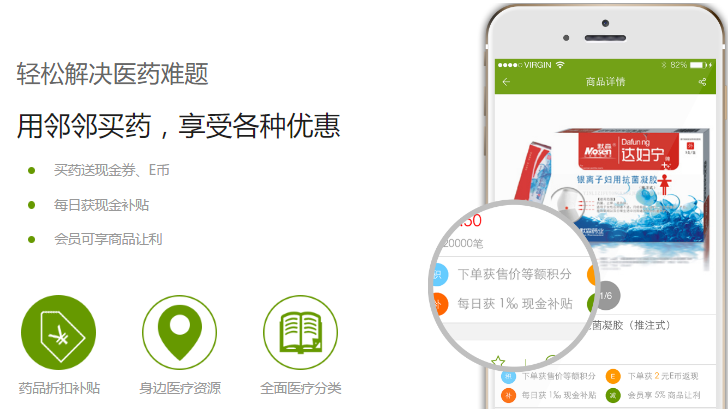
According to VCBeat, activity data from a pharmacy in Jiangsu Province showed that orders placed via the app totaled RMB 23,157 over the two-day promotional period, with an average transaction value exceeding RMB 300. Previously, the pharmacy’s daily revenue was only RMB 3,000, with an average transaction value of RMB 80.
Industry insiders believe that this model is essentially a replica of O2O-subsidized pharmaceutical retail. While it appears that platforms and pharmacies bear the cost of subsidies, the rapidly expanding sales volume and potential long-term user retention offset these expenses. Behind these marketing efforts, there is undoubtedly still room for profitability for the relevant stakeholders.
In fact, subsidies have long been a key marketing strategy for internet healthcare initiatives. For instance, online pharmacies often offer products at prices lower than those of brick-and-mortar stores; similarly, O2O (online-to-offline) projects, even after accounting for delivery costs, typically price their offerings below conventional pharmaceutical retail rates. Both approaches effectively incentivize user engagement on the platform and contribute to partial user retention.
From a business model perspective, third-party marketing is ultimately paid for by the product seller, as has been proven in group buying, food delivery, and fresh produce markets. The same applies to pharmaceutical retail: to build a third-party marketing product that benefits the industry, the product itself must deliver value, thereby incentivizing participating merchants to pay for it.
So, what are the value propositions of third-party marketing products in pharmaceutical retail? First, they form an integrated platform that is convenient for end-users to use, which creates a “traffic-driving” effect and may generate incremental growth.
Second, it enhances marketing efficiency. Previously, pharmacy marketing relied on methods such as free health screenings and gift giveaways, which often failed to identify precise target audiences or deliver the most appropriate marketing messages to specific customer segments. With the introduction of internet-based marketing tools, pharmacies can now leverage user profiling and behavioral analysis to enable precise, low-cost marketing. This is undoubtedly a key direction for the future.
The above provides a bird’s-eye view of the application of internet tools in retail pharmacies from several dimensions, including supply chain, management, empowerment, and marketing, and highlights that these dimensions are highly interrelated and complementary.
Retail pharmacies need to simultaneously utilize these systems to better facilitate product sales and provide continuous services to end consumers. Third-party tools can also benefit from the cost savings or incremental gains achieved by retail pharmacies, ultimately resulting in a win-win outcome that creates new value for industry participants.
Technological advancement is inherently a continuous process of problem-solving. In the pharmaceutical retail sector, which is relatively standardized yet subject to stringent regulatory oversight, internet-based tools undoubtedly hold significant potential for further application. Driven by growing consumer willingness to pay out-of-pocket for general health products, favorable policies such as the separation of prescribing from dispensing and the outward flow of prescriptions, alongside ongoing innovations within retail pharmacies themselves, this market segment holds considerable promise. There is ample room for growth, and new initiatives will continue to emerge.