

HaoYunBang Files IPO Prospectus to Build an Integrated Fertility Healthcare Platform

Huang Sen, Founder of Haoyunbang
On Mother’s Day, a 40-year-old woman from Inner Mongolia sent another thank-you message to Huang Sen via WeChat. After struggling with infertility for ten years and undergoing two unsuccessful IVF cycles, she accidentally discovered the Haoyunbang platform. Through the collaborative efforts of the patient, the platform, and medical experts, she achieved natural conception after three months of treatment. In early 2017, she gave birth to a baby boy weighing 3.6 kilograms.
Huang Sen, CEO of Haoyunbang, frequently receives messages of gratitude from patients with infertility. Infertility can be defined as a special type of “chronic disease,” with a relatively prolonged diagnosis and treatment process that typically takes one to two years. The World Health Organization predicts that infertility will become the third major disease, following only cancer and cardiovascular and cerebrovascular diseases.
According to a report released by the China Population Association in 2009, the number of infertility patients in China has exceeded 40 million. The prevalence of infertility accounts for 12%-15% of the childbearing-age population and continues to show a gradual upward trend. In particular, with the implementation of China’s two-child policy, the demand for infertility treatment has risen.
To this end, VCBeat conducted an exclusive interview with Huang Sen, founder of Haoyunbang, to hear how the company seized this market opportunity.
Entrepreneurship Began by Chance
Haoyunbang was founded in September 2014. According to reporters, as of the press date, the Haoyunbang platform has over 3 million users, covers more than 10,000 reproductive specialists, and collaborates with over 30 hospitals, including strategic partnerships with Shandong University Affiliated Reproductive Hospital, Beijing Chaoyang Hospital, Peking University People's Hospital, and other Grade A tertiary hospitals.
Why did you choose to enter the niche field of infertility? Huang Sen told reporters that it actually stemmed from a chance opportunity.
“I studied at Peking University Health Science Center for seven years. I am naturally inclined to tackle uncertainties and have been driven by an inner desire to start my own business, having previously ventured into projects in sectors such as elderly care and education.”
In 2012, Huang Sen also took on a healthcare informatics project, leveraging the opportunity presented by the National Health and Family Planning Commission’s tertiary hospital accreditation process. The primary clients were large Grade A tertiary hospitals. The core business involved conducting integrated analysis based on the hospitals’ existing data resources, in accordance with the requirements of tertiary accreditation, internal management, and quality improvement.
“This project has been ongoing for a relatively long period, providing us with a clearer understanding of the healthcare industry as a whole,” said Huang Sen.
In 2014, Huang Sen began seeking new projects again. The original plan was to launch care centers around large hospitals that could provide professional nursing services. However, during intensive field research near Peking University Third Hospital, he came into contact with a large number of infertility patients, nearly every one of whom had a heart-wrenching story.
“Deep conversations with these patients were profoundly moving. After thorough research, market analysis, and discussion, we sensed that this represented a new opportunity.” Upon recognizing these latent needs, Huang Sen launched the Haoyunbang project.
Currently, the Haoyunbang team has grown to over 40 members, recruited from prestigious institutions such as Peking University Health Science Center and leading internet companies like BAT, with women comprising two-thirds of the workforce.
“Assisting patients with infertility is a commercially viable business model. Two of our colleagues were previously users of Haoyunbang; after successfully conceiving with our assistance, they decided to formally join our team.”
A One-Stop Medical Fertility Assistance Platform Specializing in Infertility
An indisputable fact is that the infertile population lacks effective disease course management, and fragmented, discontinuous treatment severely compromises final outcomes.
HaoYunBang addresses this core pain point by leveraging disease course management as an entry point to facilitate communication and connectivity among patients, between patients and physicians, and between patients and the platform, thereby helping users manage their treatment journeys more effectively and achieve pregnancy sooner.
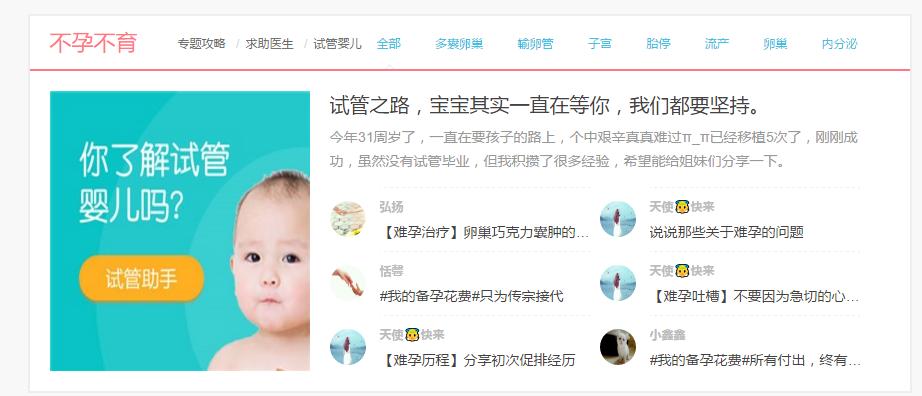
Haoyunbang Online Community: Covering Various Subspecialties
Haoyunbang aims to leverage its online platform (disease management and human consultants) to help users address minor issues, thereby minimizing detours; through its fertility clinics, it tackles more complex problems, particularly the treatment of specific sub-specialties; further along the continuum, reproductive centers provide solutions via assisted reproductive technologies. This creates a relatively complete closed-loop ecosystem spanning the online platform, clinics, reproductive centers, and overseas services.
“The online platform is a core component of Haoyunbang’s development and key to unlocking its future value.” Huang Sen has consistently emphasized the importance of Haoyunbang’s online platform. The platform’s value is reflected in areas such as disease course management, professional content, and emotional support.
From a broader market analysis perspective, technologies for infertility treatment are becoming increasingly standardized. Although public hospitals currently dominate the reproductive medicine sector in China, the degree of marketization in this field is expected to rise steadily over the long term. Given the severe supply–demand imbalance in public hospitals, the entry of private capital is an inevitable trend. In Beijing, for instance, private institutions such as Baodao, Jiaen Deyun, and Jiayuan have already obtained reproductive medical licenses.
As fertility centers return to a market-driven competitive landscape, competition over brand strength and customer acquisition will become the most critical factors. The growing user base and brand equity accumulated by Haoyunbang will make its future commercial value increasingly apparent.
“This requires patient waiting and a well-managed pace for entrepreneurship. While many companies have completely abandoned their platform strategies, we increasingly recognize the opportunities and value that platforms bring.”
Therefore, Haoyunbang continues to prioritize its platform as the core strategy for corporate development, enhancing disease management capabilities. Leveraging reproductive specialists partnered with the platform, it delivers more professional PGC (Professionally Generated Content). Meanwhile, it consolidates and optimizes the UGC (User-Generated Content) production system, firmly establishing its position as a leading platform in the field of infertility treatment.
Regarding Haoyunbang’s revenue, Huang Sen told VCBeat: “In 2016, we began exploring commercialization and achieved break-even by October of the same year, with business revenue gradually scaling up. Currently, the value of disease management and medical services is evident, and user trust is what underpins this closed loop.”
Establishing a Proprietary Preconception Care Clinic: Deepening Commitment to Physical Operations
After three years of operation, Haoyunbang has not only accumulated user and physician traffic but also gathered more industry resources, continuously deepening its understanding of the sector.
Haoyunbang was established just one month before securing RMB 4 million in angel funding in October 2014. In October 2015, it completed a Series A financing round of RMB 30 million. In December 2016, the company secured tens of millions of RMB in Series B financing, led by Chongshan Capital, with participation from Puhua Capital, Sinovest Capital, and Gene Capital. To date, Haoyunbang has raised three rounds of funding over three years, totaling nearly RMB 100 million.
Huang Sen stated that hospitals in the reproductive health sector remain predominantly public. After online platforms establish contact with clients, services must be delivered through physical institutions, where associated costs are also incurred. As a specialized niche, a business model relying solely on patient referral is unlikely to succeed.
Number of Domestic Reproductive Centers: In April this year, the National Health and Family Planning Commission released a list of institutions nationwide approved to provide human assisted reproductive technologies. As of December 31, 2016, there were 451 such institutions. However, many reproductive centers have not operated smoothly, lacking precisely the platform-based brand and marketing capabilities, as well as the multidimensional operational capabilities centered on the reproductive clinics themselves.
Based on its accumulated resources and industry insights, Haoyunbang has begun to actively establish a physical presence, including building its own preconception clinics and partnering with assisted reproductive technology centers.
“Establishing self-operated preconception care clinics is essentially a response to the online user demands of the platform. Merely focusing on infertility makes it difficult to unlock commercial value; however, by delving into specific sub-specialties, such as premature ovarian insufficiency and polycystic ovary syndrome, and designing products tailored to these conditions, the commercial value becomes significantly more apparent.”
Fertility clinics can provide institutional support for products targeting these specific conditions. Conversely, the fertility clinics established by Haoyunbang represent a new model of clinical practice.
“On one hand, it has its own characteristics in the field of specialized diseases; on the other hand, its customer acquisition and marketing rely on platforms and online marketing. Of course, Haoyunbang will still cooperate with reproductive centers. We need to gain a more detailed understanding of the needs of reproductive centers and, during the cooperation process, explore the value that the platform’s accumulated users, platform resources, and three-dimensional resources can bring to individual reproductive centers.”
Not a pure internet company
The needs of users with infertility are stratified. Some users can be helped with minimal medical intervention, such as guidance on optimal timing for intercourse or ultrasound monitoring of ovulation, while others require surgery, long-term internal medicine treatment, or assisted reproductive technology (ART). The resources and services provided by the Haoyunbang platform cover all these levels.
“I have a medical background, my previous projects were also hospital-related, and I spent three years immersed in the reproductive health sector. We do not define Haoyunbang purely as an internet company, nor do we classify it as a traditional brick-and-mortar enterprise. We integrate ‘Internet Plus Healthcare,’ which may represent a new business model,” stated Huang Sen regarding the company’s positioning.
Compared with internet companies, Haoyunbang has a deep understanding of the physical sector and will further strengthen its offline layout in clinics and hospitals; compared with traditional reproductive centers, Haoyunbang benefits from the support of an online platform and more multidimensional marketing capabilities based on online channels.
In terms of business model, the reporter learned that overseas IVF serves as an important supplement to its domestic operations. Haoyunbang has also launched the Haoyun International brand, which offers two key advantages: first, patients can choose hospitals and doctors with genuinely guaranteed medical quality; second, it provides truly professional services with full-process consultant companionship. In addition, Haoyunbang has established reproductive centers overseas.
Two Pathways to Help Patients Achieve Precision Disease Management
In the interview, Huang Sen also highlighted the importance of disease course management for patients with infertility. The core concept of disease course management is to provide guidance and oversight throughout the entire diagnostic and therapeutic journey of infertility, helping patients avoid unnecessary detours, expedite matching with suitable physicians or hospitals, and maintain a clear understanding of their treatment process. This approach aims to prevent fragmented care, such as seeking medical advice from multiple unrelated sources or undergoing discontinuous, jump-style treatments.
This represents the core pain point faced by individuals struggling with infertility. Based on a clear understanding of this critical issue, Haoyunbang decisively chose disease progression management as the entry point for its platform from the very beginning of its founding.
Disease course management is achieved through two approaches. The first is an intelligent disease course management system based on clinical pathways, which automatically provides users with targeted feedback. As long as users input the corresponding data, the system automatically delivers key information for that specific node along with potential recommendations for the next steps. Haoyunbang has developed a comprehensive data model based on the clinical treatment pathway for infertility.
Second, leverage professional medical advisors for manual support. Professional medical advisors effectively manage users through segmented grouping, providing targeted advice and assistance to specific user groups.
“This model operates smoothly thanks to two key factors: first, we possess a deeper understanding of patients’ conditions than the vast majority of patients themselves; second, we have more comprehensive knowledge of hospitals and specialists in this field than most patients. We help users clarify their medical conditions, match them with appropriate experts, provide targeted recommendations, and support them throughout the entire diagnosis and treatment process.”
From a commercialization perspective, disease course management involves designing bundled packages tailored to specific sub-categories of diseases, which also constitutes a portion of Haoyunbang’s current revenue.
2017: Key Focus Areas in Four Dimensions
“This is a virtuous endeavor. Patients struggling with infertility bear immense pressure, and behind each individual lies an unimaginably poignant story. Every time we see our users successfully conceive, the sense of fulfillment makes us feel that all our efforts are worthwhile,” said Huang Sen, founder of Haoyunbang.
On one hand, Haoyunbang’s intelligent disease progression management system provides tailored medical recommendations based on user-submitted information, helping patients clarify issues throughout the diagnosis and treatment process. On the other hand, its medical consultants assist patients in organizing prior test results and matching them with the most suitable physicians.
In fact, patients assisted by Haoyunbang are deeply grateful to the platform. “Our office frequently receives local specialties sent by users from all corners of the country, which greatly encourages and moves our entire team.”
In 2017, Haoyunbang will focus on advancing its projects in several key areas:
First, continue to strengthen platform development and user acquisition, while enhancing brand value;
Second, we are actively implementing physical healthcare services, including preconception care clinics and brick-and-mortar hospitals. This year, our focus is on operating two preconception care clinics, one of which has already opened in Beijing;
Third, actively collaborate with reproductive centers;
Finally, continue to strengthen the disease management team, enhance productized disease management services for specific conditions, and build a professional medical advisory service brand in the field of infertility.
Over the past three years, the Haoyunbang team has conducted extensive surveys of patients and mid-level hospital administrators, engaging with numerous hospitals to gain profound insights into patient needs and the current state of hospital management.
For patients, opting for assisted reproductive technologies, particularly in vitro fertilization (IVF), is often viewed as their last resort. Each cycle of ovarian stimulation, each hysteroscopic examination, and every course of pharmacological treatment imposes significant physical and psychological burden on the patient.
Haoyunbang is dedicated to serving patients with infertility, standing by their side to tackle various challenges during treatment and providing convenient solutions. Although medical science still has many limitations in treating infertility, the Haoyunbang team always strives to offer every possible assistance to each client.