

Yasen Technology and Xiamen Second Hospital Co-Develop AI-Powered Micronucleus Cell Detection System with Over 90% Automated Detection Rate for Occupational Disease Prevention
Recently, Yasen Technology joined hands with the Central Laboratory of the Second Affiliated Hospital of Xiamen Medical College (hereinafter referred to as "Xiamen Second Hospital") to announce the collaborative development of an intelligent inspection system for lymphatic micronucleus cells.This system utilizes cutting-edge artificial intelligence technology to assess the micronucleated lymphocyte rate, enabling a fully automated workflow that encompasses slide preparation, scanning, identification, and statistical analysis. Currently, the system achieves an automatic detection rate of over 90% for micronucleated cells., the two collaborating parties will conduct comprehensive research and testing on this system. In the future, they aim to increase the accuracy rate to over 95% through extensive image training, thereby advancing the prevention and control of occupational diseases into a new era of artificial intelligence.
Traditional micronucleus cell assays are time-consuming and inefficient.
The lymphocyte micronucleus rate refers to the number of binucleated cells containing micronuclei per 1,000 binucleated cells in the micronucleus assay. The normal reference range is 0–6‰. ForFor occupational groups frequently exposed to radiation sources (such as nuclear power plants, hospital radiology departments, and customs inspections), the measurement of lymphocyte micronucleus frequency is one of the important indicators for evaluating radiation-induced damage.。
For a long time, this examination has primarily relied on manual microscopic visual inspection; however, due to the extensive number of fields of view and the vast quantity of blast cells, morphological counting is challenging.Not only is it time-consuming, inefficient, and repetitive, but it also easily leads to fatigue., leading to missed diagnoses and, in more severe cases, permanent vision impairment for physicians. Limited physician resources further constrain the efficiency of such examinations and the coverage of the eligible population.
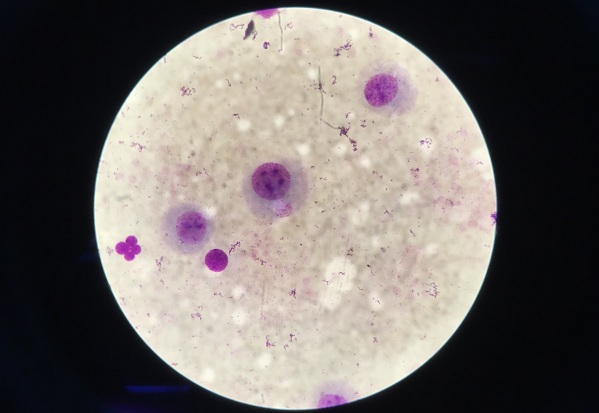
Lymphatic Micronucleus Cells, abbreviated as MCN
Artificial intelligence can enable automatic recognition, automatic annotation, and statistical analysis.
As one of the few hospitals in Fujian Province qualified to conduct occupational disease examinations, Xiamen Second Hospital has long sought to leverage new technologies to achieve a breakthrough in examination efficiency. Through collaborative research with Yasen Technology, future examinations will utilize advanced technologies such as deep learning algorithms and feature extraction from Yasen Technology to enable automatic identification, automatic annotation, and statistical analysis.
This is not only expected to improve physicians' work efficiency, but also to achieve an accuracy rate of over 90% while minimizing the false-negative rate.. Currently, Xiamen No. 2 Hospital performs this examination on 3,000 patients annually, while the population across the province eligible for this procedure exceeds 100,000 person-visits per year. Through this collaboration, both parties aim to achieve a significant increase in examination capacity by the end of 2017, initially meeting the regional demand for such services.
Due to its advantages of being cost-effective, simple, and rapid, the micronucleus test is currently mandated by many countries and international organizations as a mandatory assay for the independent safety evaluation of new drugs, food additives, pesticides, cosmetics, and other products.In addition, the micronucleus test holds significant value in assessing the genotoxicity of xenobiotics, monitoring genetic damage in occupationally exposed populations, and conducting on-site ecological environmental assessments. It possesses even broader implications for the diagnosis and prevention of malignant tumors such as liver cancer, esophageal cancer, and lung cancer, showing promise as a novel, rapid, and effective method for cancer screening.
Lymphocyte Micronucleus Test Will BecomeYasen Tianji Artificial Intelligence PlatformAs part of the integrated analysis (including imaging analysis, medical record analysis, and pathological analysis), Yasen will continue to deepen its expertise in this field in the future, providing artificial intelligence-based testing services to more relevant hospitals and third-party testing centers, and delivering timely and efficient inspection services to frontline workers operating in radioactive environments.