

106 AI-Driven Healthcare Startups Surge in Five Years, Pioneering Advances in Diagnostic Assistance, Chronic Disease Management, and Drug Discovery
With the advancement of AI technology, the era when companies could differentiate themselves merely by leveraging this technology is now a thing of the past. The general public is no longer unfamiliar with AI and can tangibly feel its impact in daily life. Today, it is difficult for tech companies to find any venture capital firms or partners who are not interested in such machine learning technologies.
However, the threshold for leveraging AI technology to revolutionize the healthcare industry is significantly higher than in other sectors. Even by capitalizing on the AI hype, enthusiasm wanes rapidly, because in healthcare, an algorithmic error often means the difference between life and death.
What mindset should we adopt toward medical AI, and where are its current applications concentrated? To address these questions, VCBeat (WeChat: vcbeat) has curated and translated the latest in-depth article from mobihealthnews for our readers.
It’s Not Yet Time to Bet Everything on AI
Over the past five years, digital health companies leveraging various AI technologies have sprung up like mushrooms after rain.CB Insights tracked 106 healthcare companies specializing in AI technologies this year. The report noted that since January 2015, 50 of these companies have conducted their initial public offerings (IPOs). The number of transactions involving the covered companies rose from 20 in 2012 to 60 in 2017. Several new unicorns also emerged in 2017, such as iCarbonX and Flatiron Health, which focuses on oncology.
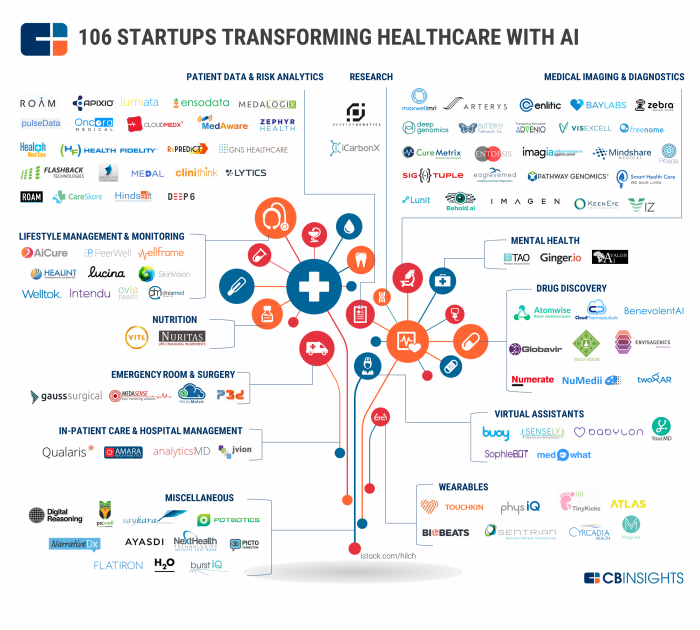
From Virtual Nurses to Drug Discovery: CB Insights Profiles 106 AI Companies
A recent survey revealed that more than half of hospitals plan to adopt AI technologies within the next five years, while an additional 35% intend to implement them within the next two years. Recently, Boston-based Partners HealthCare also announced a ten-year collaboration with GE Healthcare to integrate deep learning technologies into its network. However, the application of AI in healthcare will by no means be limited to improving clinicians’ workflows and accelerating insurance claims processing.
The two-day Light Forum has just concluded, bringing together numerous corporate CEOs, health information technology experts, and physicians from Stanford University. During the conference, Andy Slavitt, a former administrator at the Centers for Medicare & Medicaid Services (CMS), stated:“What we are currently addressing is the issue of productivity. We need to cater to those facing resource shortages, rather than blindly pursuing business models and overly complex issues, or constantly attempting to invent new tools. These approaches do not truly improve productivity. I believe this is where data and machine learning should ultimately focus.”
Respondents in the hospital survey indicated that AI technology could have a significant impact on population health status, clinical decision support, diagnostic tools, and precision medicine.Even in drug development, AI can make data collection and trial progress faster and more precise, while reducing costs. But it is not yet time to bet our entire fortune on AI.
“While computers hold immense promise, the human brain remains a powerful decision-maker. Currently, their reliability is not yet sufficient for us to place our full trust in them,” said Andrew Maas, Chief Scientist and Co-founder of Roam Analytics, during the Light Forum.
What Are Apple, Google, and Microsoft Doing?
Everyone is captivated by the allure of AI, but how much longer will it take before we witness a truly transformative impact on the healthcare industry? Recently,We have witnessed AI applications spanning from the simplest mobile apps to the most complex diagnostic tasks, with forms ranging from natural language processing and image recognition to leveraging powerful algorithms to analyze medical research databases accumulated over decades.
Like other technologies in the healthcare industry,Entering this industry entails numerous challenges, including regulatory hurdles, interoperability issues with legacy hospital IT systems, and barriers to accessing critical medical data. For AI technologies to establish a firm foothold in this sector, it is imperative to overcome these significant obstacles.。
However, this does not mean we should halt innovation; rather, we must pursue it with greater rigor. Digital health professionals have begun to recognize that unlocking the true potential of AI requires establishing strategic partnerships, leveraging high-quality data, and maintaining a clear-headed understanding of statistical evidence.
As the healthcare industry’s understanding of AI gradually matures, the greatest technical challenges do not actually lie in regulatory hurdles or difficulties in acquiring critical data encountered during the innovation process.
In mid-June, Google announced that it had applied its consumer-grade machine learning technologies, originally developed for translation and image recognition, to the healthcare sector. Its research team, Google Brain, will collaborate with prestigious institutions such as Stanford University and the University of California, San Francisco, aiming to collect data from millions of patients.
As Google CEO Sundar Pichai stated at the Google I/O developer conference two weeks ago, the tech giant’s initiatives extend far beyond this. Last year, it established the Tensor Computing Center, which Google refers to as an AI-first data center.
“Google has now consolidated all its AI efforts under Google.ai, a division that is the culmination of numerous teams and initiatives dedicated to making AI beneficial for everyone,” said Pichai. “Google.ai will focus on three key areas: research, tools and infrastructure, and applied AI.”
In November last year, Google researchers published a paper in JAMA,Demonstrates that Google's deep learning algorithm, trained on a large dataset of fundus images, can achieve over 90% accuracy in diagnosing diabetic retinopathy.. Pichai revealed that they are actively applying AI to pathology.
He stated, “Pathology involves massive data challenges, yet machine learning is well-positioned to address them. We have developed neural networks to detect whether cancer has metastasized to adjacent lymph nodes. Although this work is still in its early stages, it has already demonstrated the ability to improve accuracy from 73% to 89%. Of course, we remain cautious about the high rate of false positives in our diagnoses; however, we have entrusted this issue to pathologists, who can enhance diagnostic accuracy.”
Beyond Google, another example is Apple’s recent acquisition of an AI company named Lattice, which has a technical background in developing algorithms for medical applications.
Naturally, Microsoft has not lagged behind. A few months ago, it launched the Medical NExT initiative, integrating AI, cloud computing, research, and industry partnerships. This initiative includes projects focused on genomics analysis and health chatbot technologies, and has established a partnership with the University of Pittsburgh Medical Center.
A few weeks ago, Microsoft and Validic, a data connectivity platform provider, established a partnership to incorporate patient engagement into the HealthVault Insights research program.
Applying Patient Data to Real-World Diagnosis
Tech giants are ramping up their efforts, while startups are showcasing their unique capabilities. We have already witnessed a diverse array of AI applications, ranging from Ginger.io’s behavioral health monitoring and health analytics platform and Sensely’s virtual assistant, to wearable devices and various apps launched by companies such as Ava, and most recently, Clue’s fertility prediction window. Another notable example is Buoy Health’s recently launched medical-specific engine; Buoy’s database encompasses 18,000 clinical publications and over 17,000 medical conditions, with a patient sample size exceeding 5 million.
In addition to symptom search, Buoy first asks users to input filtering criteria such as age, gender, and symptoms. It then determines subsequent questions after segmenting the data, thereby continuously narrowing the search scope. After approximately two to three minutes, the questions become increasingly specific, providing users with a list of potential conditions and next-step options.
Another highly promising field is medical imaging.Last November, Zebra Medical Vision, an Israeli machine learning-based medical imaging analysis company, launched a new platform that enables users to upload and receive analyses of their medical scans via the internet anytime and anywhere.
Zebra, founded in 2014, is dedicated to developing algorithms that enable computers to automatically identify medical images and diagnose a wide range of conditions, from orthopedic disorders to cardiovascular and cerebrovascular diseases. The company has steadily built its own database and leverages deep learning technologies to develop algorithms for automated medical diagnosis. Another Israeli company in the same field, AiDoc, has just raised $7 million in funding.
However,No matter how large a tech company is or how advanced its technology may be, the true key to success lies in applying patient data to real-world diagnostics; this is the dividing line between mere hype and effective algorithms. It is therefore no surprise that so many companies are still in the exploratory learning phase of AI.
Joe Lonsdale, CEO of venture capital firm 8VC, stated during Stanford’s Light Forum conference, “The initial challenge lies in creating data.”
Maya Peterson, a professor of biostatistics at the University of California, Berkeley School of Public Health, offered a clearer perspective. Speaking during the HIMSS Big Data and Healthcare Analytics Forum recently held in San Francisco, she stated: “Real-world data are highly complex, and we have yet to fully understand the interconnections among them.“In exploring more complex domains, machine learning has become somewhat overly ambitious, which may not be a good thing.”
A Good Algorithm Is Worth a Thousand Gold Pieces
Machines can only learn from the data provided, so researchers, engineers, and entrepreneurs are all scrambling to build larger, higher-quality databases.
Last month, Verily partnered with Stanford University School of Medicine and Duke University School of Medicine to launch the Baseline Project, a study that has collected extensive phenotypic health data to establish clear reference standards for human health.
This project aims to collect data from 10,000 participants, each of whom will be followed for four years, to establish a “baseline” map of human health and explore the mechanisms underlying the transition from health to disease.
Data collection takes various forms, including clinical data, self-reported data, medical images, sensor data, and biological samples. The study’s database will be built on Google Cloud Infrastructure and stored on the Google Cloud Platform.
“If the government is willing to enable data sharing, the landscape will become much clearer,” said Andrew Maas, Chief Scientist at Roam Analytics, a San Francisco-based machine learning analytics platform company focused on the life sciences sector, speaking at the Light Forum. “It would also be highly beneficial if the private sector were willing to do so and collect large volumes of data. Provide us with the data, and we will deliver remarkable results. However, if effective data collection is hindered by public fear, we will achieve nothing.”
The availability of patient data and algorithms is the litmus test that distinguishes empty promises from effective practices. Let us turn our attention toIBM’s Watson Health has accumulated vast amounts of data through numerous partnerships, empowering its cognitive computing models with insights into patient health. However, due to the lack of empirical evidence demonstrating its effectiveness, public opinion remains sharply divided.
During the Light Forum conference, Chris Potts, who simultaneously serves as Chair of the Department of Computer Science at Stanford University and Chief Scientist at Roam Analytics, stated, “Watson is perhaps the most promising in the medical field.” However, others disagreed; for instance, Chamath Palihapitiya, CEO of Social Capital, dismissed it as a joke.
However, as indicated by the numerous collaborations we have previously reported,These doubts have not affected Watson’s ability to attract new partners.. Just two weeks ago, they joined MAP Health Management, introducing their machine learning technology into the treatment of substance use disorders, while IBM’s research and development division is collaborating with Sutter Health,They will develop methods to predict heart failure based on underutilized EHR data.。
IBM Watson Health was actually established in 2011, when its machine-learning algorithms won the Jeopardy! competition. This success gave the team the confidence to continue developing and applying this technology.
Shiva Kumar, Vice President and Chief Strategy Officer at Watson, stated at the Light Forum conference, “We must vigorously advance AI technology in the healthcare sector, as this industry is highly complex, with significant variations across different medical specialties. We need to strengthen machine learning to enable systems to understand medical language. The first step is natural language processing. Does AI already possess sufficient knowledge to provide medical insights? Can it deliver the best answers during conversations? We must continue engaging with patients, accumulating experience and data, and persistently driving technological development.”
Kumar stated that, to achieve this goal, addressing the challenge of unstructured data was the top priority for IBM Watson.
“We tend to use cognitive vocabulary technology, as it goes beyond machine learning and deep learning. This endows AI with insight and enables autonomous integration and learning.”
“The healthcare industry is unique in that it is subject to stringent regulation, with many data sets not freely available for use; therefore, it is a field with substantial room for technological improvement. Ultimately, however, success or failure hinges on the professionals within the industry.”
Application Pathways of Artificial Intelligence in the Healthcare Sector
Many experts predict that AI technology will cause a major upheaval in the healthcare industry. Dr. Fatima Paruk, Chief Medical Officer of Allscripts Analytics, revealed to Becker’s Hospital Review thatShe anticipates that the initial application of AI in healthcare will be in the field of chronic disease management, followed by technological advancements driven by increased availability of patient health data and environmental or social factors. Subsequently, integrating genetic data into clinical care management will make precision medicine a reality.。
In fact, industries that entered the AI technology race later may be most profoundly affected by it; pharmaceutical companies, for instance, have already begun their transformation.
During the Light Forum conference, Jeff Kindler, former Chairman and CEO of Pfizer and current partner at Lux Capital, described pharmaceutical companies as “a classic example of the innovator’s dilemma,” because their financial positions have never been dire enough to force them to change their business models.
However, the potential of AI is simply too significant to ignore, even though it entails substantial costs to engage with healthcare professionals in order to identify viable implementation pathways for AI.
“If you talk to consumers, they don’t understand pharmaceutical companies, nor do they grasp AI or big data. They simply think, ‘I’m just going to leave it in their hands.’ So how can we bridge this trust gap?” Kindler stated, “Historically, pharmaceutical companies and medical device manufacturers were never clearly delineated due to data unavailability. However, as AI technology becomes increasingly powerful, operational costs and expenses will become decoupled and cease to be significant, as they serve the purpose of enhancing therapeutic efficacy.”
Efficacy is the critical factor in drug development,Especially with the FDA’s encouragement of AI technology, AI may more readily impact the industry.。
Judy Sewards, Vice President of Strategy and Data Innovation at Pfizer, stated: “We operate in an industry where launching a new product takes 12 years, during which 1,600 scientists conduct follow-up research, carry out 3,600 clinical trials, and involve thousands of patients. We must ask ourselves whether AI can accelerate this process, make it more intelligent, and connect breakthrough therapies with the patients who need them most.”
Sewards also revealed that their immunology research conducted in collaboration with IBM Watson is an initiative to turn this idea into reality. “Some peopleThere may be concerns that AI will one day replace doctors and scientists, but in reality, it is better suited to serve as a research assistant or in a supportive role.”
Rajeev Ronanki, Head of Deloitte’s Life Sciences and Health Care practice, told Becker's Hospital Review thatAdvancing machine learning technology requires the convergence of three powerful forces: the exponential growth of data, faster distributed systems, and algorithms that can identify and process data more rapidly.
Ronanki predicts that when this trio is realized, chief information officers will gain greater insight into expected returns, thereby improving workforce decisions. By leveraging AI tools and AI-driven automation in equipment and processes, organizations can further develop deep, specialized expertise within their domains.
Ronanki cited an IDC report, stating to Becker’s: “We expect AI technology to maintain its growth momentum, with spending on artificial intelligence rising to $31.3 billion.”
Alex Turkeltaub, CEO and co-founder of Roam Analytics, stated, “Essentially, we have yet to achieve any meaningful outcomes. Although we have sketched out some business models, our current capabilities are limited to basic data statistics, making it difficult to integrate and manage data effectively. Most deep learning algorithms, even the most cutting-edge ones, were developed in the 1960s and remain rooted in outdated conceptual frameworks from the 17th century. We must seek better approaches.”
Judy Sewards of Pfizer Pharmaceuticals particularly emphasized one point: “In our industry, you must be 100% accurate; any error is directly linked to patient safety.”
Note: The above content is compiled and organized by VCBeat, with key points extracted.
References:
http://www.mobihealthnews.com/content/depth-ai-healthcare-where-we-are-now-and-whats-next
https://www.cbinsights.com/blog/artificial-intelligence-startups-healthcare/