

Global Innovation Drivers in Early-Stage Lung Cancer Diagnosis: Mapping the AI and Liquid Biopsy Landscape
VCBeat came across such a story on the Lung Cancer Community forum of Yixiangwang—“A Lung Cancer Patient’s Firsthand Account from Onset to End”—which recounts the protagonist Wang Li (a pseudonym)’s journey from the onset of lung cancer through treatment.
Wang Li, a senior female university student, was diagnosed with lung cancer during her internship at a hospital in Guangzhou.However, her path to diagnosis was exceedingly long.From the very beginningIrritating Cough Mistaken forPneumonia Treatment: No Improvement Observed Despite Subsequent Administration of Various Medications. Although Lung Cancer Was Never Ruled Out by the Physician, It Remained Undiagnosed. The Condition Was Repeatedly Delayed,After three monthsAt the time of her lung cancer diagnosis, her cancer cellsThe disease had already metastasized, and the patient ultimately passed away despite treatment.
According to the 2015 survey data from the National Cancer Center,Among the 733,000 new lung cancer cases diagnosed annually in China, Wang Li is just one. But for her family and herself, she is everything.It took Wang Li three months from the onset of symptoms to receive a final diagnosis.However, is the diagnosis of lung cancer really that difficult?
Conventional methods can only diagnose lung cancer in its middle and late stages.
WithThe exacerbation of smog, the increase in the number of smokers, and the influence of certain chemicals in work and living environments,Lung cancer has become one of the malignant tumors posing the greatest threat to population health and life.. According toAccording to statistical data from the National Health and Family Planning Commission in 2015, the incidence of lung cancer in China is currently increasing at an annual rate of 26.9%. Results from China’s third national survey on causes of death among residents indicate that the lung cancer mortality rate has risen by 465% over the past three decades.
Lung cancer poses such a significant threat to public health, but nowThe 11 mainstream diagnostic methods for lung cancer can only detect patients in the middle to late stages of the disease.
11 Mainstream Diagnostic Methods for Lung Cancer:
1. Chest X-ray examination: This is an important method for diagnosing lung cancer, allowing detection of pulmonary opacities through fluoroscopy or posteroanterior and lateral chest radiographs;
2. Chest CT: Can detect and clearly display the size, shape, and extent of involvement of lesions in the hilar regions, within the lungs, and in the mediastinum at an early stage, aiding in the determination of whether lung cancer lesions are resectable;
3. Magnetic Resonance Imaging (MRI): To determine the extent of lung cancer infiltration, stage the disease, and assess the resectability for surgical removal;
4. Positron Emission Tomography (PET): Helps differentiate between benign and malignant tumors;
5. Sputum cytology: Sputum examination can confirm the diagnosis in some lung cancer patients and determine the histological type of lung cancer; however, 4 to 6 consecutive tests are required to obtain results.
6. Fiberoptic bronchoscopy: It can obtain a pathological diagnosis and is helpful for determining the extent of the lesion and clarifying the surgical approach;
7. Digital subtraction angiography: It can determine whether there is lymph node metastasis at the hilum and the extent of tumor invasion into the bronchial wall, and clarify whether there are specific lesions within the pulmonary lobe opacities;
8. Percutaneous lung biopsy: Indicated for cases where sputum cytology and bronchoscopy fail to yield positive results; peripheral masses with small intrapulmonary lesions; new peripheral pulmonary lesions; lesions with an unclear growth history; multiple pulmonary nodules; patients with incurable disease tendencies; and lesions not requiring resection.
9. Mediastinoscopy: Facilitates tumor diagnosis and TNM staging;
10. Thoracoscopy: Primarily used to determine the nature of pleural effusion or pleural masses;
11. Serum Tumor Marker Testing: Indirectly determining the presence of malignant lesions by detecting specific substances secreted by the lesions into the bloodstream.
Early- and even mid-stage lung cancer are typically asymptomatic; obvious symptoms usually do not appear until the disease progresses to an advanced, incurable stage. Once symptoms manifest, lung cancer is already at a middle or late stage.. Even when patients undergo examinations at hospitals during the mid-to-late stages of disease, misdiagnosis or missed diagnosis may still occur due to factors such as physicians’ lack of experience, fatigue, and suboptimal image quality.
Therefore, the development of new technologies for early screening and diagnosis of lung cancer offers new possibilities for achieving early detection and treatment, thereby reducing missed diagnoses. Through market observation, we have found thatArtificial Intelligence,Liquid BiopsyNew technologies have made some progress in the early diagnosis and treatment of lung cancer. To this end, VCBeat (WeChat ID: vcbeat) has compiled a list of companies involved in the research and development of related technologies and products in the field of lung cancer, providing an overview of the situation both domestically and internationally.
AI-Assisted Lung Cancer Diagnosis
Early-stage lung cancer often manifests as pulmonary nodules, which are characterized by small size, low contrast, and high heterogeneity in shape. Physicians typically assess the presence of such nodules through radiological examinations, including computed tomography (CT) scans. However, the screening process is largely dependent on manual interpretation by radiologists. Each patient’s thoracic CT scan comprises approximately 200 images, with high-resolution scans containing up to 600 slices, thereby requiring a substantial amount of time for thorough evaluation.
Furthermore, during the diagnostic process, physicians’ experience and fatigue levels can affect the detection of pulmonary nodules, leading to missed or misdiagnoses.As a tireless “physician assistant,” artificial intelligence can help doctors identify nodules and, in the future, combined with pathological research, determine whether nodules are benign or malignant.。
Among domestic AI medical imaging companies, over 60% are involved in lung cancer diagnosis
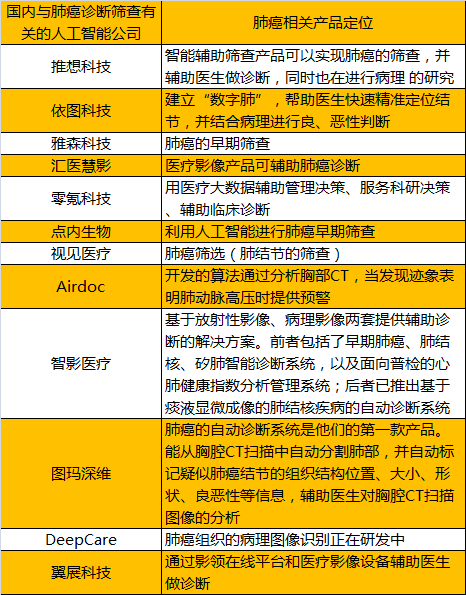
Among the 20 domestic AI medical imaging companies collected by VCBeat,Engaged in Lung Cancer Diagnosis ServicesThere are 12 companies, accounting for 60%.Other companies are currently focusing onBreast Cancer Imaging, Thyroid Cancer Imaging, Fundus Imaging...research on medical imaging, among other areas. Additionally, as the company currently uses the term “auxiliary diagnosis” extensively in its external communications,Tumor, without specifying which cancer types were diagnosed; the actual figure is higher than 60%.
Although domestic artificial intelligence technology is still in its early stages, AI-based techniques for pulmonary nodule detection using radiological images such as CT scans are relatively mature.. Many companies, such as Infervision and Yitu Technology, have already seen their products adopted in clinical practice. According to VCBeat, AI products are being used at Zhejiang Provincial People's Hospital, Shanghai Changzheng Hospital, Peking Union Medical College Hospital, Xiangya Hospital, and other institutions.
CurrentlyAI products achieve a detection accuracy of approximately 90% for pulmonary nodules (while performance varies across companies, all reported AI solutions claim to surpass the average performance of physicians). However, the use of medical AI in differentiating between benign and malignant pulmonary nodules remains in the research and development stage, and final diagnostic decisions must be made by physicians based on clinical assessment.。
In addition to leveraging radiological images such as CT scans for the auxiliary diagnosis and screening of lung cancer, some companies are also utilizing pathological images and big data models for auxiliary diagnosis and screening., for example, DeepCare utilizes pathological images to assist physicians in the auxiliary diagnosis of lung cancer; however, this technology is still under development. The company previously applied this technology to breast cancer detection, where it has currently achieved an accuracy rate of 92.5%.
Intrapulmonary points are often well utilized.Big data models for early diagnosis of lung cancer: The company integrates currently mainstream international lung cancer risk prediction models., by integrating artificial intelligence and machine learning technologies, and validated on 20,000 lung cancer cases in China, we have optimized and developed “Fei Chang Hao,” an intelligent lung cancer screening engine tailored for the Chinese population. Currently, Diannao Biology has partnered with Yangpu District in Shanghai to conduct lung cancer screening for all residents in the district.
Among overseas AI medical imaging companies, reports indicate that less than 10% are involved in lung cancer diagnosis.
Unlike most domestic companies that focus primarily on radiological imaging, international AI medical imaging firms are involved in both radiological and pathological imaging. Their research covers a wide range of conditions, including ophthalmic diseases, thyroid cancer, breast cancer, cardiac disorders, acne, and chronic obstructive pulmonary disease (COPD), rather than showing the particular preference for lung cancer and thyroid cancer seen in China.
VCBeat has identified a total of 125 medical AI startups among overseas-related companies (excluding traditional CAD companies). Among them, 28 are engaged in medical imaging diagnosis, with only three—VoxelCloud, Enlitic, and Imagia—explicitly involved in lung cancer diagnosis.
VoxelCloud (Tisu Technology) is dedicated to providing precise and personalized medical diagnostic services based on deep learning, with its headquarters located in Los Angeles, USA,The co-founder is of Chinese descent.Ding Xiaowei. The company's business has currently coveredScreening and Diagnosis of Early-Stage Lung Cancer, Diabetic Retinopathy, Cardiovascular Diseases, and Liver Lesions, and provide end-to-end solutions based on corresponding clinical needs. The companyCompleted in early 2017Led by Sequoia Capital$10 Million Series A Financing.
In the publicly available LIDC lung cancer screening dataset, Enlitic’s technology assessed the malignancy of nodules on chest CT images more accurately than expert radiologists. Enlitic’s technology can interpret medical images in milliseconds, which is 10,000 times faster than the average radiologist.
Imagia segments images from X-rays, MRI, and CT scans into minute pixels, analyzes and classifies the features of each pixel individually, and leverages deep learning technology to analyze individual images, ultimately providing a diagnostic assessment.
It is undeniable that the discrepancy in this data between domestic and international figures is partly due to statistical inconsistencies,In current reports, a small number of foreign companies claim to be able to diagnose cancer, but do not specify the particular types of cancer.. For domestic companies, VCBeat verifies each one individually; however, for foreign enterprises, clues can only be gleaned from their official websites or media reports.
Another possible reason is the relatively small patient population abroad, which allows physicians sufficient time to interpret imaging scans for lung cancer patients. In contrast, screening for diseases such as breast cancer and thyroid cancer is conducted on a nationwide scale, requiring substantial physician time. Consequently, startups have targeted breast cancer and other conditions as their entry point in response to market demand.
It is worth mentioning that,None of the AI-based products for assisted diagnosis of lung cancer, whether developed domestically or internationally, have currently obtained certification from the CFDA or FDA.. According to information obtained from VCBeat,Some Chinese companies are expected to obtain certification by the end of this year.
Given that AI and machine learning possess the capacity for self-improvement, product functionality and safety continuously evolve through use and operation; consequently, the regulatory approval process for AI-based medical products is exceedingly slow. To address this,The U.S. FDA has established a new department dedicated to the review of digital health and AI technologies, aiming to accelerate the approval process for AI-based products.。
Liquid Biopsy-Assisted Early Diagnosis of Lung Cancer
As previously mentioned, early-stage lung cancer is asymptomatic and difficult to diagnose even with “sputum cytology plus chest X-ray/CT.” Therefore, developing new technologies to detect and eliminate lung cancer at its earliest stages has been a persistent focus of scientific research.
The Emergence of CTC (Circulating Tumor Cell Detection) Technology Has Made Early Cancer Detection Possible, this technology emerged over a century ago; however, due to insufficient cell detection capabilities at the time, it did not achieve widespread application.Until the advent of liquid biopsy technology.
Liquid biopsy refers to a non-invasive blood test that monitors circulating tumor cells (CTCs) and circulating tumor DNA (ctDNA) released into the bloodstream by tumors or metastatic sites. As an emerging technology, its primary clinical applications focus on early cancer screening, rapid assessment of treatment efficacy, monitoring the risk of cancer metastasis and recurrence, and research on tumor drug targets and drug resistance. In 2015, “liquid biopsy” was named one of the Top 10 Breakthrough Technologies by the authoritative technology media outlet MIT Technology Review.
Liquid biopsy achieves the diagnostic objectives of tissue biopsy through a simple blood draw, directly avoiding many issues associated with invasive procedures and eliminating complications caused by tissue damage. It also enables real-time monitoring of treatment efficacy via serial blood tests as therapy progresses, and has already been implemented in clinical practice.
According to clinical data statistics from HSMAP liquid biopsy, the indications for liquid biopsy clinical trials are extensive, totaling 20 types, with the top three beingNeoplasms, Diseases of the Musculoskeletal System and Connective Tissue, and Certain Infectious and Parasitic Diseases. In 2016, there were as many as 243 clinical cases involving tumors, accounting for 77% of all indications.Liquid biopsy technology can be used for the diagnosis and detection of common tumors, so lung cancer detection is not an issue.
The market size of liquid biopsy for lung cancer in China is RMB 3.4 billion.
Clinical data from over 2,000 cases have confirmed thatCTC combined with chest CT can increase the diagnostic specificity for patients with small pulmonary nodules suspected of lung cancer to approximately 95%,The specificity of relying solely on chest CT for diagnosing early-stage lung cancer is only 65%.
In August 2016, the “Global Liquid Biopsy Market Report” released by FMI showed that, Over the next decade, the liquid biopsy market is projected to grow at a compound annual growth rate (CAGR) of 21.7%, reaching $28.937 billion by the end of 2026.
Guosen Securities Research Report proposes,The domestic liquid biopsy market size is around 20 billion yuan.。
They estimated that in 2015, ChinaThere were approximately 4.292 million new cancer cases,Assuming each patient undergoes an average of four tests per year, the projected market size for liquid biopsy in China is calculated as 5 million (target patients) × 50% (penetration rate) × RMB 2,000 (end-user price) × 4 (annual test frequency) = RMB 20 billion. (Note: The end-user price per CTC test using CellSearch in hospitals ranges from RMB 4,000 to RMB 5,000. With the increasing adoption of next-generation CTC and ctDNA technologies in the future, the end-user price is expected to decrease to RMB 2,000.)
According to the 2015 survey data from the National Cancer Center, there were 733,000 new lung cancer cases in 2015.Accounting for 17.07% of newly diagnosed cancer patients, the market size for liquid biopsy in lung cancer in China is estimated at approximately RMB 3.4 billion.。
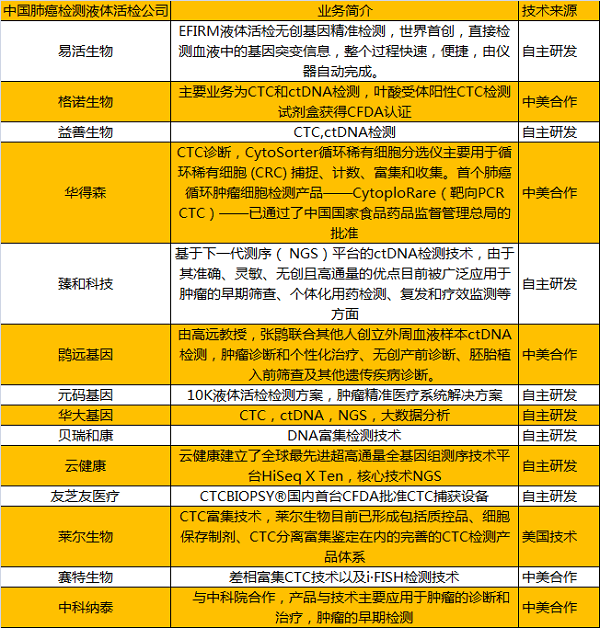
Overview of Domestic Liquid Biopsy Companies
Overview of Overseas Liquid Biopsy Companies
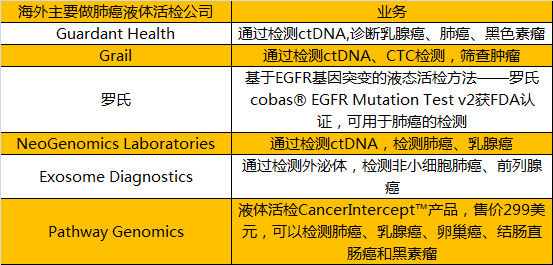
From the perspective of development progress, some detection platforms or instruments independently developed by foreign CTC testing companies have entered the market. For example, Roche’s cobas® EGFR Mutation Test v2 has received FDA approval and can be used for the detection of lung cancer and other tumors. Pathway Genomics’ liquid biopsy product, CancerIntercept™, priced at $299, can detect lung cancer, breast cancer, ovarian cancer, colorectal cancer, and melanoma.
There are also many domestic companies that have independently developed CTC detection instruments and reagents. For example, Youzhiyou Medical’s CTCBIOPSY® is the first CTC capture device approved by the CFDA in China; Genobio’s folate receptor-positive CTC detection kit has obtained CFDA certification; Beijing Zhongke Natai, in collaboration with the National Center for Nanoscience and Technology of the Chinese Academy of Sciences, has jointly developed a high-sensitivity peptide-coated nanomagnetic bead technology for capturing and isolating CTCs; and Huadesen’s CytoSorter is a circulating rare cell sorter.
However, it should be noted that most technologies and products of domestic enterprises are provided by foreign companies. For instance, Cytelligen directly supplies CTC-related technological products to CytoGene from the United States; similarly, Lairui Biotechnology and Huadesen are themselves Sino-foreign joint ventures.
Finally, it must be emphasized that the lung cancer situation in China is extremely severe, and early diagnosis and treatment are key to improving survival rates for lung cancer patients. Although artificial intelligence and liquid biopsy provide new technical support for early screening and diagnosis of lung cancer, there are still some challenges in terms of approval and pricing. After all, these technologies are unprecedented, and stakeholders are still navigating uncharted waters.
For more articles related to respiration, please click:
380,000 Sleep Reports Generated Daily: Snail Sleep Begins to Explore Data Services Business
Huihuxi: The World's First Gamified Smart Breathing Trainer, Visualizing Training Outcomes