

BlueXinKang Files IPO Prospectus: Empowering 20,000 Pharmacies Through Chronic Disease Management and Membership Services
“Are you a technology-driven company?” During the interview, VCBeat posed this question to Liu Kai, CEO of Lanxin Kang.
“I view the issue as follows: the healthcare or health industry will ultimately face the challenge of a limited number of professionals against the infinite demands of the general public. This imbalance in supply and demand is becoming increasingly pronounced with aging populations and accelerating urbanization,” Liu Kai responded. “The application of technology can, to some extent, alleviate this imbalance. The core of the solution lies in enhancing the efficiency with which professionals deliver services by screening users based on their varying needs and providing decision support for service delivery.”
What Lanxinkang is doing is leveraging technology to help address the imbalance between medical needs and healthcare services, as well as the inefficiencies in healthcare system operations.
Therefore, Lanxinkang is a technology-driven company.
Liu Kai is a postdoctoral fellow in medicine at Harvard University and formerly served at Shanghai Ruijin Hospital. In 2014, he co-founded Shanghai Keling Medical Technology Co., Ltd. with several other co-founders. Lanxinkang is a brand under Keling that leverages health and consumer data from pharmacy members to provide retail pharmacies with SaaS-based big data platforms for chronic disease management and personalized service solutions.
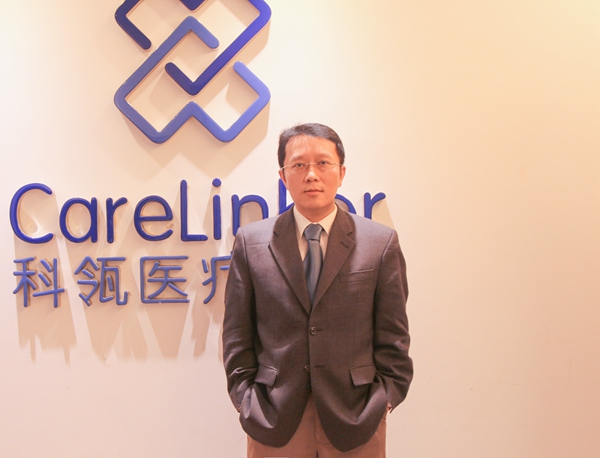
Dr. Kai Liu, Founder of Lanxinkang
Lanxinkang’s founding team boasts a “golden lineup.” Wang Ti, Vice President of Operations, holds an MBA from Northwestern University in the United States and previously served as Sales Director for the Southwest Region of Eli Lilly and Company’s Diabetes Division. Chen Qi, Vice President of Marketing, earned an MBA from Indiana University in the United States and formerly worked as OTC Marketing Manager at Sanofi France. Zhang Hongguang, Chief Technology Officer, received his Ph.D. from Shanghai Jiao Tong University and previously worked at Samsung’s R&D Center in South Korea.
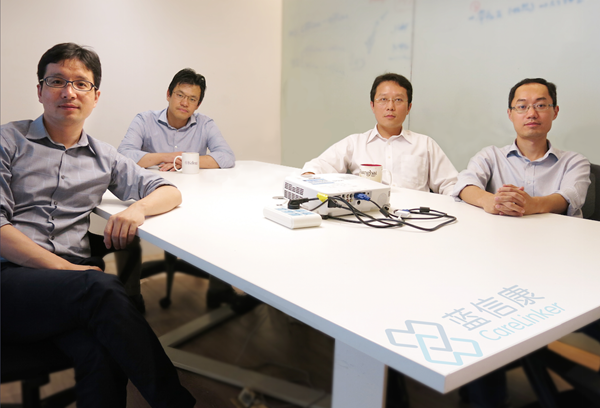
Lanxin Kang’s core team members, from left to right: Wang Ti, Chen Qi, Liu Kai, Zhang Hongguang
Hardware + App + Algorithms: How Lanxinkang Manages Chronic Diseases
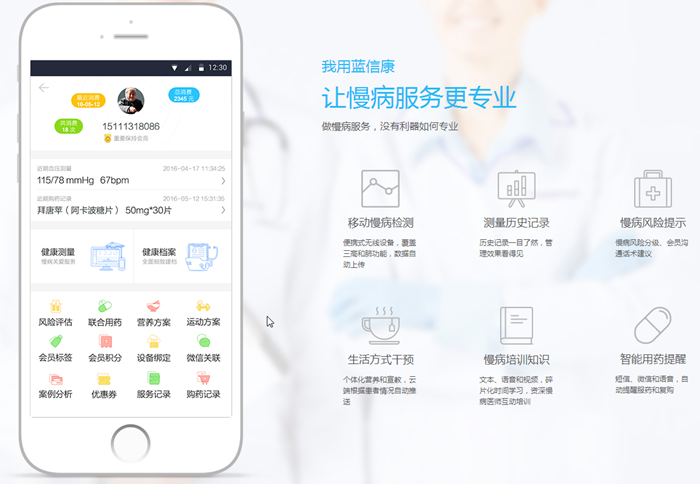
Lanxinkang Chronic Disease Management System
According to Liu Kai, Lanxinkang’s offering is a big data analytics–based solution comprising hardware, a mobile app, and cloud-based algorithms.
Among these, the hardware consists of portable medical devices, categorized into pharmacy and home versions, including blood pressure monitors, blood glucose meters, lipid profile analyzers, and glycated hemoglobin (HbA1c) analyzers.
The app is categorized into three versions: Pharmacy, Doctor, and Individual. The Pharmacy version can be installed on pharmacists’ mobile devices and integrates with hardware systems. When customers visit the store, they can leverage pharmacists’ services to enable automatic uploading of health data.
Liu Kai further emphasized that Lanxinkang prioritizes the pharmacist-facing client over the individual consumer version. This strategy acknowledges that patients with chronic diseases are predominantly middle-aged and elderly individuals, who generally exhibit low proficiency in using mobile apps. Within the pharmacy setting, leveraging pharmacists to deliver end-to-end health services to members via the app represents the most feasible approach. This model also mitigates numerous issues arising from users’ unfamiliarity with app operations, thereby reducing customer churn.
Cloud-based databases and algorithms are the core of Lanxinkang’s products, comprising two components: the Chronic Disease Management (CDM) system and the Customer Relationship Management (CRM) system.
The Chronic Disease Management (CDM) system integrates members' health records with automatically uploaded test results to conduct disease risk assessments, provide personalized nutrition and meal plan recommendations, deliver tailored educational content, and offer guidance on associated medication use, thereby providing decision support for healthcare interventions to professionals such as pharmacists.
The CRM system for member management primarily conducts precise profiling based on members' health status and medication purchase behaviors, thereby enabling pharmacists to provide more targeted pharmaceutical care and other membership services.
In addition, Lanxinkang offers an online training and examination system for pharmacists, which helps enhance the professional competence of staff at chain pharmacies, thereby enabling them to better serve customers.
Leveraging Chronic Disease Management to Drive Membership Management: Going with the Flow
Lanxinkang’s chronic disease management solutions have effectively helped retail pharmacies create new value. Chronic disease management services drive customer foot traffic to stores, thereby increasing store visitor volume; furthermore, chronic disease management training for pharmacy staff enhances their professional capabilities, fosters customer trust, and improves user retention.
Next, Lanxinkang aims to assist retail pharmacies in implementing precision membership management centered on pharmaceutical care, thereby enhancing medication safety and adherence while fostering long-term user retention.
“We entered the market through chronic disease management and came to understand that retail pharmacies also have needs for member management. During implementation, we enriched our service system; expanding from chronic disease management to member management was a natural progression,” Liu Kai told VCBeat.
Lanxinkang leverages its proprietary H-RFM model technology to uncover the latent health needs of pharmacy members, thereby enhancing personalized services and health solutions. Based on the H-RFM model, Lanxinkang categorizes pharmacy members into six major types: Key Retention, Key Development, Key Win-back, General Important, General, and Non-Valuable Customers.
With the implementation of membership tiering, the system can then provide users with precise pharmaceutical care services. This is primarily approached from four perspectives:
1. Post-purchase intervention: "Medication Adherence" reminds users to take medications as prescribed by their physicians, covering six aspects including drug indications, precautions, and disease knowledge;
2. Post-test intervention: After testing, provide a series of SMS messages covering metric interpretation and health recommendations, and invite users to visit the facility for follow-up services;
3. Health Assessment Report, automatically generated by the cloud to facilitate patients in providing comprehensive information during medical consultations;
4. Medication Assistance Integration: Based on disease-specific prevention and treatment guidelines and prescribing practices, the system generates personalized medication guidance tailored for pharmacists within the pharmacist-facing mobile application.
According to Liu Kai, after the system was implemented, an analysis of patients’ medication purchasing behavior showed that the average purchase frequency per customer increased by approximately 30%, and medication adherence improved by 25%–67%. As a result, while patients’ health outcomes improved, pharmacies also experienced an increase in sales volume.
According to data provided by Lanxinkang, the company has partnered with nearly 20,000 pharmacies.The number of users in chronic disease management has reached over 2 million.
In terms of business planning, Lanxinkang has enhanced pharmacy member stickiness and average transaction value through technology- and data-driven membership services. Moving forward, Lanxinkang plans to integrate online and offline data marketing and advertising technologies to enable precise customer traffic direction for pharmacies, facilitate a comprehensive upgrade of their operational processes, and boost their profitability.
Business Model and Financing
From the current market perspective, China currently has 400 to 500 million patients with chronic diseases. As aging, urbanization, and environmental pollution intensify, both the number of patients and their healthcare needs will continue to grow. Services for chronic disease patients have also spurred the emergence of a market worth hundreds of billions of yuan.
Lanxinkang’s solutions enhance retail pharmacies’ capacity to serve patients with chronic diseases. The highly integrated solution is also scalable across China, unaffected by regional differences or varying staff competency levels.
From the perspective of competitors, there are nearly 100 active chronic disease management service providers in the current market. Some target C-end consumers, while others focus on in-hospital settings; few companies have entered the market through retail pharmacies.
In terms of business model, the primary payers are retail pharmacies and pharmaceutical manufacturers, as the solution enhances patient adherence and drives incremental sales for pharmacies.
In terms of financing, Keling Medical secured RMB 8.5 million in angel-round funding in early 2015, jointly invested by Shanghai Jianmeng Investment Management Co., Ltd. and Shanghai Super Partner Investment Co., Ltd. On March 30, 2016, Keling Medical closed a Series A financing round of RMB 25 million, jointly invested by Yongtai Technology and Yinke Capital.
Overall, the market for chronic disease management services is vast. Lanxinkang’s existing practices have demonstrated recognition of its services by retail pharmacies and pharmaceutical companies, while investor endorsement undoubtedly provides a strong guarantee for its sustained development. In light of this, Lanxinkang’s future growth is promising.
During the interview, Liu Kai repeatedly emphasized to VCBeat that Lanxinkang has consistently adhered to the principle of letting data and outcomes speak for themselves, strictly following evidence-based medicine. Its real-world data related to chronic disease management have been published in peer-reviewed academic journals, including two studies on diabetes management,RecentIt was also included in the American Diabetes Association (ADA) 2017 Scientific Sessions.
“Respecting outcomes and upholding professionalism and academic rigor are distinctive features of Lanxinkang.“Liu Kai thus evaluated Lanxinkang’s unique competitiveness.”