

With 16 Million Registered Users, SoYoung Files IPO Prospectus to Tighten Its Grip on Minimally Invasive Aesthetic Consumers Through Five Strategic Pillars
MPCi
Venture Capital Institutions in High-Tech Startup Fields
Jin Xing, the typically low-key CEO of SoYoung, has not made a public appearance for quite some time. In the coming days, he will travel to Wuhan to attend the Meivos Medical Aesthetics Conference, where he will share insights on digital marketing for medical aesthetics institutions.
The medical aesthetics market is undergoing significant fragmentation. Some medical aesthetics O2O platforms are actively transitioning into community-based e-commerce to enhance brand awareness and achieve product premium pricing, while others are leveraging online traffic redirection to establish their own offline physical medical aesthetics institutions, thereby completing a closed-loop ecosystem.
After four years in operation, New Oxygen, a leader in the medical aesthetics O2O sector, is seeking a path to break through amidst fierce competition.
Medical aesthetics O2O enterprises have, on one hand, genuinely enhanced industry transparency by educating patients, thereby reducing the likelihood of exorbitantly priced hyaluronic acid and botulinum toxin treatments. On the other hand, they have provided hospitals with new channels for customer acquisition.
However, the stickiness and repurchase rates of young customers acquired through medical aesthetics O2O platforms remain highly questionable.
So, what stage is New Oxygen currently at in its development? Reporters examine New Oxygen’s current strategic direction from five perspectives: customer acquisition, customer retention, monetization, repeat purchases, and ecosystem building.
Customer Acquisition: Capturing Precise Users Through New Media Content
High customer acquisition costs have long plagued offline medical aesthetic institutions. Industry insiders reveal that the average cost to acquire a customer in the medical aesthetics sector is 7,000 yuan, with over 50% of revenue going to intermediary channel partners.
These are the well-known pitfalls of traditional marketing in the medical aesthetics industry. So, what fresh changes can medical aesthetics institutions bring by embracing the internet? According to data from 35 clinics cooperating with New Oxygen, the average customer acquisition cost for hospitals listed on New Oxygen ranges from 300 to 500 yuan per person, primarily calculated based on the first order. Repeat purchases will further reduce the customer acquisition cost.
Such a low customer acquisition cost can be attributed to only two reasons: either So-Young is willing to operate at a loss, subsidizing hospitals to seize market share, or its own customer acquisition costs are inherently lower.
In response, Liu Xiao, COO of New Oxygen, told reporters: “Currently, the penetration rate of cosmetic procedures per 1,000 people in China is only 1.7‰, which is significantly lower than South Korea’s 14‰. Consumers require long-term education. The continuous production and dissemination of new media content is the most effective way to identify and engage precise target consumers for cosmetic procedures from the general population.”
It is evident that the cost of acquiring traffic for aesthetic hospitals or clinics is rising, representing a major trend. Consequently, the value of entry-level platforms is increasing, particularly those serving as gateways through premium content. The New Oxygen new media matrix constitutes such premium content within the aesthetics sector.
Reporters opened the So-Young WeChat official account, which updates 3–5 articles daily, with nearly every post surpassing 100,000 views. The content often features celebrities as case studies, revealing the stories behind their beautiful appearances. According to So-Young, the account currently has over 7 million followers.
In addition to its WeChat Official Account articles, as early as April 2015, New Oxygen collaborated with video platforms such as Youku, iQIYI, and Tencent Video to launch the program “New Oxygen Celebrity Plastic Surgery Classroom.” It subsequently introduced “New Oxygen Weekly Plastic Surgery News Update,” with content closely following current trending topics, such as the TV series *Ode to Joy* and *Fighter of the Destiny*. Currently distributed across 60 platforms nationwide, the programs have accumulated over 600 million views.
New Oxygen has invested significant effort into new media operations. It is reported that its operations team consists entirely of post-90s professionals, currently numbering more than ten members. By producing high-quality content at low cost and disseminating it through online platforms, New Oxygen has effectively identified and engaged users interested in plastic surgery.
We have identified our target users, but many challenges remain: how can we retain them on the platform and achieve monetization?
User Retention: Plastic Surgery Diaries for User Comfort and Education
Those familiar with the medical aesthetics industry know that cosmetic procedures can be addictive, yet consumers remain highly cautious about spending on such treatments, making it difficult for platforms to establish trust. The second major hurdle in a platform’s development is how to retain valuable, high-precision users over the long term once they have been acquired.
In May 2014, So-Young decided to launch its Plastic Surgery Diary feature. At the outset, there was internal debate within the company about posting the most gruesome content from plastic surgery procedures online. Would users be willing to use it?
At that time, Jin Xing pushed back against prevailing opinions, stating, “Consumers experience significant anxiety before undergoing cosmetic procedures and intense fear during the one-week recovery period afterward, largely due to their lack of understanding about the surgeries. If they discover on the So-Young platform that others who have undergone similar procedures have documented their experiences, feelings, symptoms, and outcomes, it would provide both reassurance and education. Therefore, we were determined to launch post-operative recovery diaries, which served as the initial prototype for what became our cosmetic surgery diaries.”
After all, safety risks associated with surgery remain the primary concern for consumers. New Oxygen addresses these concerns by showcasing real-life cases through its Plastic Surgery Diaries.
Currently, the cumulative number of cosmetic surgery diaries posted by influencers on So-Young has reached 3.2 million, covering a wide range of aesthetic procedures. Data from So-Young shows that the app is launched an average of five times per user per day, with an average session duration of 20 minutes.
Monetization: Community-Driven Entry into E-commerce
“Communities have a lifecycle. If product features are not iterated in a timely manner, the product will generally become obsolete within two to three years, leading to the loss of a segment of users. For vertical communities, transactions must underpin their operations,” said Jin Xing.
How Does So-Young Leverage Its Community to Drive E-Commerce?
In July 2014, SoYoung launched its e-commerce functionality. After reading user diaries, users could, if interested, navigate to the profiles of the hospitals and surgeons who performed the procedures, review other diary-based evaluations of the surgeon, and send private messages for consultation. Orders were placed online, services were delivered offline, and post-operative outcomes were reported online, thereby completing the O2O (Online-to-Offline) closed loop.
Jin Xing told VCBeat that, thanks to authentic and credible consumption scenarios and brand endorsements, products performing well on SoYoung typically achieve a user conversion rate of 27%, meaning that out of every 100 viewers, 27 place orders. Meanwhile, the average transaction value on SoYoung is approximately RMB 3,000.
In 2016, SoYoung’s online GMV exceeded RMB 2 billion, achieving annual profitability. In the first quarter of 2017, it already matched the full-year GMV of 2016.
Repurchase: Focus on minimally invasive cosmetic procedures to enhance standardization
After overcoming the first three hurdles, it seemed that the platform had passed its most difficult stage and its business model had been validated. However, as scale increased, challenges in management and service emerged one after another.
In May 2017, New Oxygen launched the “Strict Selection Plan” on top of its previous “Safety 100 Plan,” establishing five layers of security guarantees: 100% authentic products, 100% on-site inspections, Oxygen Insurance, Lightning Refund, and Advance Compensation.
Slogans are easy to shout, but execution is difficult. With the So-Young platform operating in 160 cities, partnering with over 5,000 hospitals, and processing millions of orders annually, how can it ensure 100% authentic products and 100% on-site verification?
Liu Xiao stated that SoYoung has deployed business development personnel in 160 cities to conduct on-site verification of hospital qualifications, and has established strict internal management and incentive mechanisms.
However, non-surgical aesthetic procedures, as SoYoung’s core category, are medical services. Even when performed at licensed hospitals by certified physicians, 100% safety cannot be guaranteed, and adverse events may still occur. Therefore, to provide the best consumer experience for aesthetic seekers, SoYoung has partnered with Wukong Insurance and Taikang Online to launch “Oxygen Care,” a medical aesthetics insurance product. It covers 37 aesthetic procedures, and the entire claims process is conducted online, from document submission to claim resolution, within 30 days.
Micro-aesthetic procedures are non-surgical medical aesthetic treatments that utilize hyaluronic acid, botulinum toxin, skin-whitening injections, lipolytic injections, and laser technologies to achieve rapid rejuvenation and aesthetic enhancement without the need for surgical incisions.
Jin Xing believes, “The proportion of minimally invasive cosmetic procedures will rise rapidly in the coming years. As technology advances, treatments that previously required surgery can now be performed without it.”
In addition to its significant growth potential, minimally invasive aesthetic procedures are characterized by high repurchase rates and easily standardized processes. As these treatments are typically non-permanent, maintenance is generally required every six months.
As for specific data, New Oxygen reports a secondary repurchase rate of 92%, with users making more than six purchases accounting for 27%.
Ecological Construction: +Internet
Before 2010, the number of plastic surgery hospitals was limited, while the consumer base grew rapidly. Hospitals could simply hire two doctors, secure a location, decorate it attractively, run advertisements, or establish partnerships with beauty salon owners, and patients would flow in continuously. There was no need to consider issues such as customer satisfaction or repeat purchase rates. In a rapidly growing incremental market, “naive and gullible” consumers were everywhere.
However, in recent years, as the number of hospitals has increased and the existing pool of high-end users has been largely exhausted, the influx of younger, mid-to-low-end users—who have limited spending power but a strong awareness of their consumer rights—has intensified the survival pressure on medical aesthetic hospitals.
The Internet holds inherent advantages in patient education and customer acquisition. How to “+Internet” and realign with the demands of the healthcare industry’s new development stage is an urgent challenge that hospitals must address.
Liu Xiao stated, “It is better to teach a man to fish than to give him a fish. It is SoYoung’s responsibility to help hospitals overcome their difficulties and provide better services. SoYoung primarily focuses on continuously refining its offerings in two areas: medical aesthetics tools and education.”
In terms of medical aesthetics tools, New Oxygen currently possesses an exclusive medical aesthetics database, containing accumulated data from 16 million registered users and transactions.
Leveraging this data, So-Young has developed precise user profiles across different regions and built a data-driven hospital operations platform and CRM (Customer Relationship Management) system, enabling patients to enjoy features such as one-click appointment booking, convenient responses, and automated post-operative follow-ups.
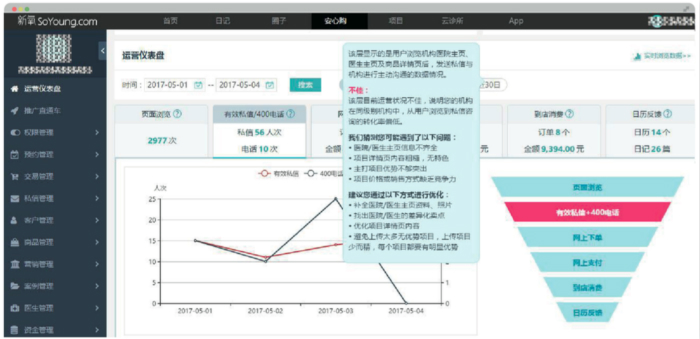
NewNew Oxygen Digital Hospital Workbench
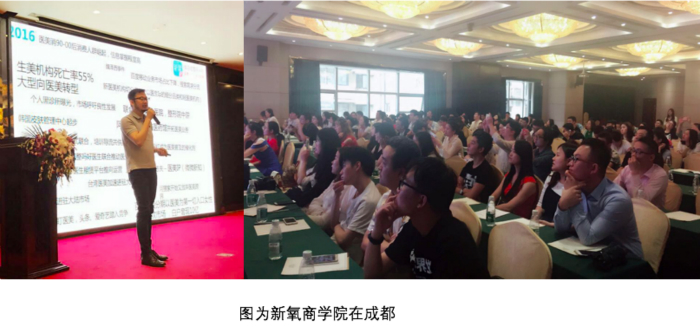
In terms of education, So-Young has established a Business School. This institution serves as a university for internet marketing in the medical aesthetics industry, aiming to help all certified hospitals on its platform achieve a higher return on investment (ROI) and guide them to refocus from marketing efforts back to the essence of medical services. For projects that receive poor feedback from hospitals, So-Young can leverage backend data to propose improvement plans.
SoYoung Business School instructors comprise an elite group of top-tier medical aesthetic industry leaders, including hospital directors, physicians, operations experts, and senior consultants. Collectively, these instructors oversee transactions involving 5,317 hospitals, 19,544 doctors, and 16 million users on online platforms. They possess expertise in both internet technologies and the operational dynamics of hospitals and consumer behavior. To date, SoYoung Business School has held five large-scale lectures in Beijing, Shanghai, Hangzhou, Chengdu, and Zhengzhou, and offered 24 online training courses, attracting participation from over 700 hospitals and more than 2,300 individuals.
Currently, the New Oxygen platform hosts over 5,000 hospitals and 15,000 physicians, providing aesthetic seekers with access to accredited medical institutions and licensed practitioners. Furthermore, it assists users in making informed decisions through authentic cosmetic surgery diaries shared by fellow patients.
New Oxygen strives to build its core competitiveness across five key areas—customer acquisition, customer retention, monetization, repeat purchases, and ecosystem development—and continuously widen this moat.
SoYoung is working hard to solidify its foundation, awaiting a breakout.
Note: The data mentioned in the text are provided by the interviewed enterprises.