

Apple's ResearchKit: Two Years of Transforming Medical Research Through Mobile Technology
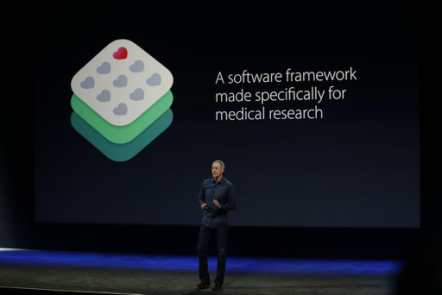
Apple Senior Vice President Jeff Williams Releases ResearchKit in San Francisco
In March 2015, Apple launched the ResearchKit medical research platform, following its earlier releases of the HomeKit smart home platform and the HealthKit health application platform.
The launch of this platform has transformed hundreds of millions of iPhones worldwide into powerful medical research tools, designed to help medical researchers collect health data on a large scale. Apple’s ambition is to change the world once again by revolutionizing the way medical research is conducted.
Two years since its launch, what achievements has ResearchKit made, and what challenges has it encountered? VCBeat has compiled and translated the latest reports from STAT and pocket-lint for our readers.
What Is ResearchKit All About?
Built on the iPhone and Apple Watch, ResearchKit provides a free, open-source application development framework that enables medical researchers to develop specific research-oriented apps. Alongside the platform’s launch, Apple also released five apps developed in collaboration with leading medical institutions, targeting conditions including diabetes, Parkinson’s disease, breast cancer, asthma, and cardiovascular disease.
The diabetes-focused app, GlucoSuccess, developed by Massachusetts General Hospital, reminds patients with diabetes to perform daily routine data monitoring, such as measuring body weight. Additionally, it provides exercise tracking and dietary monitoring for users, aiming to explore the impact of lifestyle on blood glucose levels from multiple perspectives.
Parkinson mPower, launched by Sage Bionetworks in collaboration with the University of Rochester, is dedicated to advancing Parkinson’s disease research. The app tracks disease progression in patients through memory games, finger-tapping tests, and assessments of speech and gait.
“Share the Journey,” a breast cancer-focused initiative developed collaboratively by the Dana-Farber Cancer Institute, Penn Medicine, Sage Bionetworks, and the UCLA Jonsson Comprehensive Cancer Center, aims primarily to investigate why breast cancer survivors exhibit greater resilience.
The app dedicated to cardiovascular disease, named MyHeart Counts and developed by the Stanford University Medical Center, can assess users’ cardiac activity using exercise data, thereby helping researchers investigate the relationship between lifestyle and cardiovascular health.
Within days of ResearchKit’s launch, the number of registered users reached tens of thousands. Over the following two years, a wave of high-quality research applications emerged. For instance, one app enables users to document moles on their skin and track changes over time, while another team is working on developing an application for autism screening, among many others.
Thanks to Apple’s vast user base, such apps can quickly garner more than 10,000 downloads shortly after being listed on the App Store. Jeff Williams, Apple’s Senior Vice President of Operations, stated at an event last March, “Almost overnight, some of the studies we launched through ResearchKit reached a scale rarely seen in the history of medical research.”
ResearchKit data can also be shared with Apple’s HealthKit. Coupled with its massive user base, this approach clearly outperforms traditional data collection methods.
However, initially, many researchers believed that ResearchKit, in essence, did not constitute clinical data collection but rather represented a feasibility study on the use of mobile apps for health data collection.However, as of today, ResearchKit appears to have gone even further, achieving more breakthroughs in the usability of medical research.
In recent months, researchers have published data on epilepsy, asthma, and heart disease sourced from the ResearchKit platform. Scholars are already looking to the future, believing that the next milestone for this technology will be transforming ubiquitous mobile devices into life-saving medical monitors.
Upcoming Epilepsy Management and Monitoring Protocols
For patients with epilepsy and their physicians, there are many standardized questions during diagnosis and treatment, such as how many seizures occurred in the previous month and how many doses of medication were missed. Patients often struggle to provide precise answers to these questions; some rely on memory, while others record this data in logs or charts.
To address this issue, a recent study from Johns Hopkins University has pioneered a solution leveraging the ResearchKit platform. Dr. Gregory Krauss and his colleagues developed an app called EpiWatch, which not only resolves the burdensome task of symptom logging for patients but also feeds patient data back to research teams for epilepsy studies.
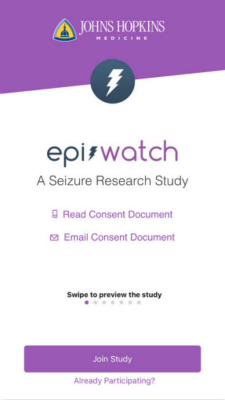
EpiWatch User Interface Display
Over the past two years, Dr. Krauss has leveraged this technology to collect extensive real-time data from patients with epilepsy, covering the pre-ictal, ictal, and post-ictal phases. If users sense an impending seizure, they can immediately launch the app on their Apple Watch, which promptly initiates assessments of the patient’s memory and level of consciousness.
Once the patient stops responding to the test, the program determines that they have lost consciousness; the seizure is considered ended only when the patient responds to the app again. The app’s data collection also incorporates heart rate and accelerometer data.
Dr. Krauss’s team achieved the groundbreaking feat of obtaining first-hand data both before and after epileptic seizures, a milestone that had been notoriously difficult to accomplish in prior research.
According to data presented by the American Academy of Neurology at its annual meeting on April 27, sleep deprivation, reduced medication adherence, and excessive stress can all lead to an increased frequency of epileptic seizures. The team plans to submit the collected data to peer-reviewed journals as soon as possible, integrating it with findings already published by other ResearchKit study teams.
Now, Dr. Krauss and his team have ambitiously embarked on the next phase of research. They analyzed the collected data and, based on this, developed a seizure monitor that alerts users before a seizure occurs and informs patients of the potential risks associated with an impending episode.
EpiWatch’s monitoring function will leverage physiological data collected by the Apple Watch to enable real-time detection of epileptic auras and alert users.“As Shaina Mims stated in Apple’s official promotional video, this will be an excellent solution for patients with epilepsy.”
Mims candidly admitted that, as a patient with epilepsy, she often worries about having a seizure while driving. However, with such seizure monitoring technology, she and her loved ones can be assured that she will have pulled over to a safe location before an episode occurs.
Dr. Krauss stated that the seizure monitoring feature will be released to users before this fall, and in the future, their app may also offer functions such as tracking the efficacy and side effects of epilepsy medications.
Let Data and Results Speak
An indisputable fact is that an increasing number of research findings utilizing ResearchKit are being published or cited in the scientific literature.
MyHeart Counts, one of the five apps launched alongside the platform, serves as a vivid example. The app is designed to investigate the impact of physical activity on cardiovascular health, and its preliminary findings were published in JAMA this January.
Through the app, over 20,000 participants transmitted their physical activity pattern data to researchers, while approximately 4,900 others completed the six-minute walk test, a common health assessment tool. Data analysis revealed that nearly two-thirds of the participants were physically inactive for about half of each day, and those with the lowest levels of physical activity exhibited a higher incidence of cardiovascular disease.
Another research team from the Icahn School of Medicine at Mount Sinai published data collected from their asthma-focused app in Nature Biotechnology in March. Their findings confirmed that the likelihood of asthma exacerbations is higher in summer than in spring, and that air quality has a significant impact on asthma.
In the aforementioned cases, there has been a qualitative leap in both sample size and data collection duration. Dr. Krauss, an epilepsy specialist, stated that their research would have been truly difficult to conduct without ResearchKit. “We can now study patients across a wide age range and with diverse types of epilepsy extremely rapidly, with samples drawn from across the United States.” To date, their team has analyzed data from nearly 1,000 patients.
Returning to the asthma research at Mount Sinai, one of its projects collected data from more than 2,000 asthma patients—approximately the same number of adult asthma patients identified in the CDC’s (U.S. Centers for Disease Control and Prevention) 2015 National Health Interview Survey. Pei Wang, a professor at the Icahn School of Medicine at Mount Sinai, pointed out that in the past, it could take several days to obtain data from a single asthma patient, and in the CDC’s survey, only one data point was collected per patient.
Androids Chasing Head-On
Despite its prominent advantages, ResearchKit still faces two major obstacles: one that was evident from the day of its release, and another that only began to emerge after various data had been collected.
First and foremost, study participants are required to enroll using their personal Apple devices, which means they must first be able to afford an iPhone or an Apple Watch.
According to a report by the Pew Research Center, only about half of households with an annual income of $30,000 or less could afford a smartphone in 2015. Of course, this survey did not further break down the results by phone brand. Therefore, we can assume that many low-income households still lack the opportunity to participate in medical research through ResearchKit.
User engagement on mobile platforms is also a concern; for instance, in an asthma survey, only 30% of users remained engaged for more than six months, which compromises the integrity of much of the data.
Secondly, research efforts based on ResearchKit also face severe challenges regarding sample diversity.Teams interviewed by STAT expressed high satisfaction with the large sample size provided by ResearchKit, but noted that participant numbers were significantly more concentrated in cities or regions with a high density of Apple enthusiasts, such as San Francisco.
Although the geographic distribution of the sample in the aforementioned asthma study is largely consistent with that of the CDC census, the Mount Sinai Asthma Study sample included a higher proportion of male, younger, wealthier, and more highly educated patients. Additionally, there was less racial diversity in the sample: only 5% of participants were Black, whereas CDC census data indicate that approximately 14% of adult asthma patients are Black.
Regarding the sampling issue, several potential solutions are currently available. First, the price of mobile devices may continue to decrease. Second, an increasing number of research teams may be willing to donate Apple devices to enhance sample diversity. Finally, developers can create applications for other platforms, enabling them to run on a variety of device types.
To implement the latter approach, a group of programmers is working diligently to develop ResearchStack, a platform for Android devices similar to ResearchKit. In theory, research teams that have already developed apps on ResearchKit could also release apps with identical functionality on Android devices. In practice, however, the issue is not so straightforward.
Dario Salvi, a postdoctoral researcher at the University of Oxford, spent considerable time developing the MyHeart Counts app for Android, largely because the ResearchStack software still lacked adequate user-friendliness.
Android boasts a massive user base. Expanding research apps to the Android platform not only broadens the participant pool for studies but also enriches the types of data researchers can collect. Lara Mangravite, President of Sage Bionetworks, stated, “The Android system is more open than iOS, allowing researchers to easily collect users’ phone usage information. For instance, with user consent, call logs and internet usage data can be gathered.”
The potential of the Android platform is nothing short of remarkable. Mangravite provided another example: many people have a habit of reading on their phones while using the restroom. By combining internet usage data with GPS data, it is possible to develop an algorithm that predicts whether a user suffers from irritable bowel syndrome (IBS).
For Dr. Krauss, he was unwilling to wait for ResearchStack to conduct his research. He stated that it would likely take several more years for Android to provide a research system, and importantly, his study required wearable devices in the form of smartwatches. Dr. Krauss said, “A major advantage of ResearchKit is that it is already available off the shelf, and I believe the Apple Watch is more sophisticated and intelligent than other smartwatches on the market.”
“Of course, I believe that ultimately all smartwatches will be capable of biosensor data collection, feature user interfaces with a good user experience, and support medical research. But the Apple Watch is something we can use right now.”
References:
https://www.statnews.com/2017/05/26/two-years-APPle-researchkit/
https://www.theverge.com/2017/3/13/14908402/APPle-researchkit-health-asthma-study-APP-data-smartphone
http://www.pocket-lint.com/news/133132-APPle-researchkit-and-carekit-everything-you-need-to-know
Related Reading:
Apple Releases Medical-Grade Open-Source App CareKit to Assist Users in Health Management
What Exactly Is the Difference in Positioning Between ResearchKit and HealthKit?
Infographic: Google Fit vs. HealthKit
Apple’s Digital Health Platform ResearchKit at a Crossroads, with Questionable Professionalism
Detailed Analysis of 137 Apps on Apple HealthKit
How Do the Focus Areas of Apple’s ResearchKit and Google’s Baseline Study Differ?