

From a Tiny Disc to a Big Opportunity: How Walnut Medical Spotted a Niche in Hospital Medical Records
Walnut Medical, founded in 2006.Since 2016, officially entered the medical data field, within one year,The products have covered multiple regions, including Beijing-Tianjin-Hebei and Shandong.。
Founder Ren Wei studied at Beijing University of Technology, where he majored in computer hardware during his undergraduate years and shifted his focus to software during his master’s studies. He has developed profound expertise in both hardware and software. In 2016, Hutu Medical secured investment fromAn LongjiGold Investment1RMB 0 million angel round financing。

Ren Wei, Founder of Hutao Medical
Small Disc, Big Utility
Medical records are documents created by healthcare professionals to document the process of disease diagnosis and treatment. They provide an objective, comprehensive, and continuous account of a patient’s clinical progression, diagnostic and therapeutic interventions, treatment outcomes, and final disposition. Serving as foundational data for clinical care, medical education, and scientific research, medical records constitute primary archival materials in medical science. In addition to paper-based formats, medical records are preserved in various forms, including electronic health records, medical imaging films, and pathological slides.
It can be said that,Medical records are the most reliable and secure data source for both hospitals and patients.. The core of Walnut Medical Solutions also lies in medical records.
At the current stage, the images generated by PACS devices are generallyDICOM Format. Many hospitals still rely on traditional film, which is both wasteful and polluting. A 17-inch film not only has limited image storage capacity but also suffers from significant distortion after printing. If patients present it to doctors at another hospital as a basis for diagnosis,There is a high probability of misdiagnosis and missed diagnosis, so its practical value is not high.。
In addition to imaging films, paper-based medical records also present a series of challenges. For hospitals, adopting paper-based medical records not only incurs high material costs but is also extremely time-consuming due to multiple processes such as stamping and printing. In many hospitals, the medical records department alone occupies an area of 2,000 square meters. Given the severe shortage of clinical space in hospitals, dedicating such a large area to archival storage undoubtedly constitutes a serious waste of resources.
In 2012, the Ministry of Health (later restructured as the National Health and Family Planning Commission) and the National Development and Reform Commission jointly issued the fee standards for medical services. Page 74 explicitly stipulates that hospitals must use optical discs for storage when there is a large volume of image data.
Although optical discs have been largely phased out in consumer applications, their write-once capability, security, stability, and data storage accuracy make them the most suitable medium for archival storage among all current storage options.
To address this situation, Walnut Tech has developed a product named「KRM-EK」 medical record CD/DVD burning equipment. Patients use「KRM-EK」 , automatically burn their medical records onto CDs using methods such as ID cards and QR codes,thereby replacing traditional media such as film and paper, and completely liberating hospital medical records departments。
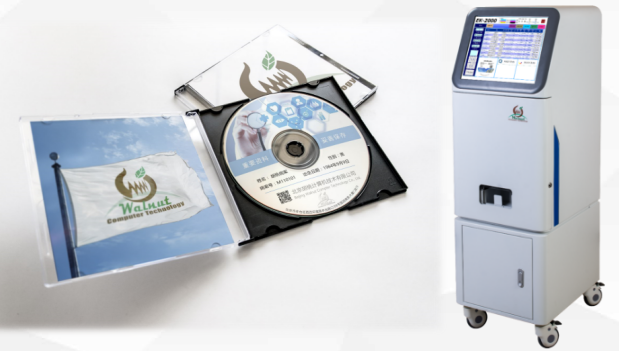
KRM-EK
For hospitals, Walnut Medical’s digital distribution solution can significantly reduce costs. For patients, it enables faster and more convenient access to complete and accurate medical records.
In fact, whether patients take their medical record data or not has no impact on Grade A tertiary hospitals. According to national standards, the rate of Grade A medical records in these hospitals is ≥90%. Therefore, their medical records are essentially as standardized as textbooks and hold high reference value. In contrast, smaller hospitals tend to have more issues with medical records, resulting in lower value. Thus,Walnut Medical primarily serves top-tier (Grade A tertiary) hospitals across various regions.
Business Model for Medical Record Construction
Hutao Medical in「KRM-EK」ofThe disc also contains an embedded upload program. When patients access the data and open the disc, a prompt will appear, guiding them to upload the data to“Walnut PHR”(on the Personal Health Record Platform).
「“Walnut PHR”Developed on the WeChat platform, its core feature is a data timeline that encompasses medical record information uploaded by patients across all time periods. Through this tool, physicians can access nearly all of a patient’s medical records, including CT images, the front sheet of the medical record, admission notes, consultation records, laboratory test reports, discharge diagnosis certificates, and long-term physician orders.
Meanwhile, in terms of data security, Hutao strictly adheres to regulations, thus “"Hutao PHR"The data above belongs to the patient.""Hu Tao PHR"Just like a bank, providing patients with encryption keys. In general, only the patients themselves can access the uploaded data. However, patients can use the “"Hu Tao PHR", thereby authorizing physicians to access medical records. In this way, physicians authorized by patients can also view medical record data. Furthermore, the duration of authorization is set and controlled by the patients themselves. Once the authorization period expires, physicians will no longer be able to access the records.
Huatao Medical’s business model, on one hand, supports project operations through the sale of consumables (optical discs). On the other hand, it involves revenue sharing with third-party medical service enterprises. The underlying logic lies in building an information circulation channel among hospitals, patients, and third-party medical service providers.
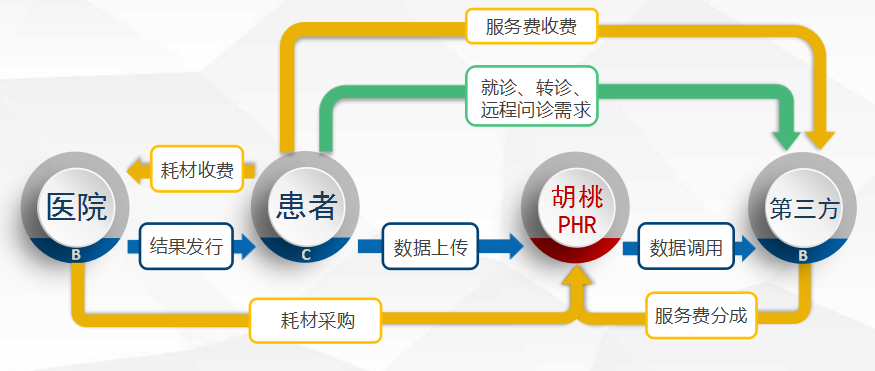
Example Diagram of Walnut Medical's Business Model
Hutao Medical, through collaborations with these enterprises, integrates more healthcare services into “"Hu Tao PHR", and as a value-added service, provided to patients. Including health management, physical examinations, online light consultations, and other services.
The crux of medical care lies in the fact that physicians cannot diagnose or treat patients without diagnostic test results. Therefore, the core of the Hetao Medical model is the establishment of a platform for the flow of patient medical records. Furthermore, these medical records consist of authentic, accurate, and reliable data.
In the Hetao Medical model, the driving force for third-party healthcare service providers, such as mobile health companies or physician groups, lies in the high offline promotion costs of their products. As Hetao Medical’s platform continues to expand,Many third-party medical service providers have proactively assisted in product promotion by integrating these products into the healthcare institutions with which they partner.. Because, once patients within the hospital begin using “"Walnut PHR", these third-party medical service companies will also gain opportunities to provide services.
Essential Demand, Promising Future
Currently, computers capable of reading optical discs have become virtually extinct, whether for personal use or within hospitals. In response, Ren Wei stated: “Treatment of patients’ diseases is an essential need, which drives them to seek every possible means to obtain better care. For those with genuine needs, purchasing a disc reading device is not difficult.。”
HuTao Technology has already completed the development of media to replace optical discs and is currently filing for patents. This means that even if technological changes occur in the industry in the future, HuTao Medical, as a technology-driven company, will be able to keep pace in a timely manner. More importantly, HuTao Medical has established authentic and comprehensive information channels among hospitals, patients, and third-party medical service providers.