

Smart Movement Core Files IPO Prospectus: Delivering Scenario-Based Health Solutions via Integrated Terminal-Interaction-Cloud System
From Apple’s launch of the Apple Watch in 2014, which propelled the smart wearables market into the spotlight, to the decline in sales of screen-based smartwatches in 2015 and the stagnation of the fitness tracker market in 2016, followed by Meizu’s release of its analog-style smartwatch and Huami’s launch of its smart fitness tracker in 2017, smartwatches appear poised to shine once again.
According to NPD DisplaySearch, shipments of wearable devices will reach 72 million units in 2016, with smartwatches accounting for 40% of the consumer market share. Shipments of wearable devices are projected to reach 173.4 million units by 2019.
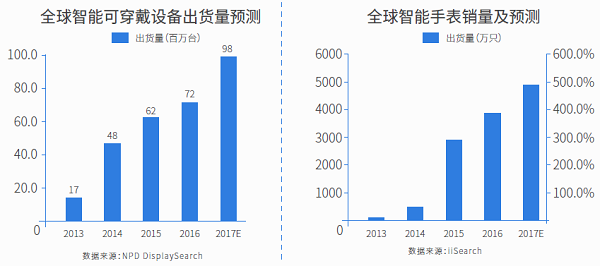
Data provided by the smart watch movement
Behind the Strong Sales of Smart Devices, Issues Persist in the Smartwatch MarketFor instance, poor battery life, lengthy product R&D cycles, an overly long supply chain for wearable device terminals, homogeneous designs of screen-based smartwatches, and inadequate health guidance.. Shenzhen Smart Watch Movement Technology Co., Ltd. has developed a one-stop solution to address these issues, helping B-side clients resolve them while providing C-side users with personal behavior and health data services. In this regard, VCBeat (WeChat ID: vcbeat) has conducted follow-up reporting.
Personal Behavior and Health Data Service System
When asked why the company entered the health market through smart watch movements, He Qingjun, Chairman of the Smart Watch Movement Division, told VCBeat that internal and external environmental factors affect human health to varying degrees: genetics account for 17% of health determinants, environment for 15%, healthcare services for 8%, and personal behavioral habits for 60%. Therefore, the most effective approach to better health management is to provide personalized guidance on behavioral habits, thereby achieving the goal of “preventive care,” as advocated in traditional Chinese medicine. Since wrist-worn devices cause minimal disruption to daily life, they represent an ideal entry point.
Consequently, He Qingjun joined forces with two other founders, Wang Hui and Zhou Wenbin, to establish Smart Watch Core. Both co-founders are graduates of Nanjing University of Aeronautics and Astronautics. Wang Hui brings over 15 years of project management experience from world-renowned electronics and telecommunications companies, with deep expertise in technical areas such as automated testing for communication systems and new product introduction (NPI) into mass production. Zhou Wenbin has more than 10 years of experience in managing chip solution design for low-power consumer electronics and is well-versed in the system development of watch-related products.
Shortly after its establishment, the company launched the Personal Behavior and Health Data Service System—PMPD, or Personal Motion & Physical Data. The PMPD service system consists ofHardware Terminals, Interaction Design, Backend Data ServicesComposed of three major components, it addresses the diverse health needs of different populations across various scenarios and provides long-term personal data services.
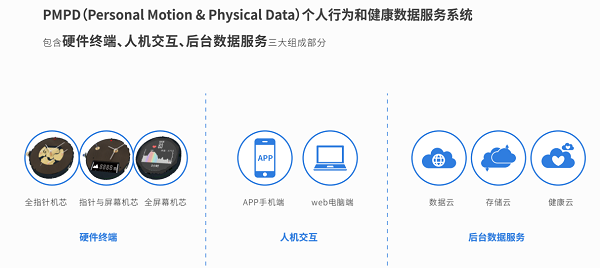
Hardware Terminal
Current wristband products are primarily divided into two major value systems: one represented by Switzerland and Japan, which includes precision timekeeping tools such as mechanical, quartz, and electronic watches, along with psychological values like taste and decoration; the other represented by Apple and Android, which includes products like smart bands. These products condense all or part of the functions of a mobile phone onto the wrist, aiming to solve all problems for everyone.
Smart Watch Core aims to build a new value system for wristband products—a comprehensive framework grounded in user scenarios, big data, and cloud computing, with personal data services at its core. This system addresses the diverse needs of different users across various contexts, positioning Smart Watch Core as a provider of industry-level intelligent wristband solutions and content services.
To this end, Zhixin has launched a one-stop solution to eliminate the five major barriers to smart wearables.
By integrating high-quality domestic suppliers, we bundle ten core industrial modules, including multi-gearbox control, physical pointer and display systems, circuit optimization, structural modules, aesthetic design and manufacturing references, supply chain integration, quality inspection systems, marketing resource referrals, backend database management, and app design. In terms of backend data management, we centrally manage and control user backend data and deliver global synchronized updates via OTA (Over-the-Air) technology.
VCBeatThe R&D cycle for the completed form was compressed from 390 days under independent development to 65 days, addressing the challenges of prolonged timelines and high investment.
The intelligent watch module streamlines the process from commercial contract signing to final watch delivery, reducing the timeline from the industry standard of 390 days for typical smartwatches to under 65 days. This allows clients to devote more time and energy to customer operations and delivering user value, thereby inevitably enhancing operational efficiency. In the future, the intelligent watch module will further compress this timeframe to 45 days, and even down to 25 days.
Throughout the collaboration process,Clients are not required to bear any R&D costs. During the initial pilot production phase, they only need to pay a negligible fee for sample movements to produce small batches of finished watches. Compared with other product-type solution providers, Smart Watch Movements (an industry-type solution provider) has shortened the entire R&D and mass production cycle to one-fifth of the original duration and reduced the cost of sample production to one-thousandth.。
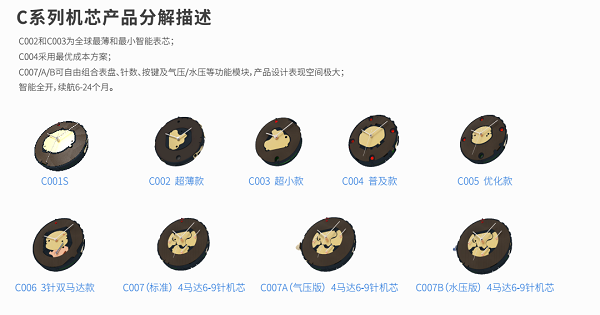
In addition, the new generation of smart movement products developed by Smart Movement Core,Standby Time Successfully Exceeds 24 Months。Integrated Smart Core ModuleAddressing the instability issue of the cover plate design.Integrated Ultimate Structural DesignAddressing the issue of monotonous designs in screen-display smartwatches.
Interaction Design
In terms of interaction design, the company has launched the D-MAP Personal Data Map, which meets users’ needs in specific scenarios through data retrieval and display.
After hardware terminals collect users’ personal vital signs, such as heart rate, body temperature, and electrocardiogram (ECG) data, the D-MAP system transmits this information to a backend cloud-based big database via companion software and a mobile app. It then compares the data with personal health records and the cloud database to generate personalized health assessments and recommendations, guiding users on exercise and dietary adjustments, traditional Chinese medicine (TCM) therapies, or medical consultations and examinations as appropriate.
To put it simply,ZhiXin focuses not on the value of a single measurement, but on the results presented through continuous data recording., these results reflect users' behavioral habits and health status; Zhixin informs users of this information to enable timely adjustments.
In addition to health monitoring, He Qingjun told VCBeat that Zhixin’s technology can also be applied to health care and the management of patients with chronic diseases. Through continuous monitoring, the system will alert family members or medical institutions whenever user data shows abnormalities.
Backend Data Services
In terms of backend data services, the company focuses on individual behavioral data, aiming to statistically refine insights into personal efficiency management, health management, personal preferences, and lifestyle and work behaviors through collection, organization, filtering, assessment, analysis, feedback, aggregation, comparison, and interaction, thereby providing intervention-based recommendations to a certain extent.
For example, when a customer wears the smartwatch on their wrist, the hardware device can track how much time they spend sleeping, driving, and working. By analyzing this data to assess the customer’s work-life balance, the system helps them manage their time more effectively.
The smart watch movement system features exceptional openness.It is compatible with a variety of smart hardware devices, forming and providing a unified data system and a clear user value framework. Through cloud-based data storage, data is not merely presented in its raw form but is analyzed to yield actionable insights. Furthermore, data silos are eliminated, enabling the construction of a comprehensive data system that spans different age groups and usage scenarios.
In general,What Zhixin provides to users is neither traditional watches that merely tell time and serve as accessories, nor smartwatches or fitness bands from Apple or Android that simply compress smartphone functionalities. Instead, it offers continuous data services and targeted scenario-based services with ultra-low power consumption.。
He Qingjun told VCBeat,Zhixin has now launched nearly 20 movement models across its C, F, and H series, with over 100 prospective clients. The projected sales target for this year is 5 million units.. At this stage, Zhixin’s primary task is to capture market share as quickly as possible in collaboration with its partners. He Qingjun stated that Zhixin’s substantial investment in user services is not intended to generate direct fees from customers; rather, it aims to attract clients by offering service as a value-added component. Zhixin’s profit model remains centered on generating revenue through partnerships with B-end (business-to-business) clients.
Currently, the smart watch movement is undergoing Series A financing...