

IoHT Investment Trends Report: Market Value to Reach $163 Billion by 2020, with Institutions Investing Over $200M Allocating 13.7% to IoHT
Internet of Health Things (IoHT) has emerged alongside the development of mobile healthcare. It refers to the process of interaction and integration between “things” in the medical field (such as doctors, patients, and medical devices) and the “network” (standard-based processes), thereby forming a connected ecosystem. IoHT can transform raw data into simple, easily shareable, and interoperable information among different entities. This approach enhances operational efficiency, provides more convenient healthcare services, and delivers a smoother patient experience.
The adoption of various interconnected devices in the Internet of Medical Things (IoMT) has begun to impact the entire healthcare industry.The Internet of Healthcare Things (IoHT) can help vendors achieve tangible cost savings, but maximizing its potential requires sustained investment.To succeed in the digital economy, healthcare providers (referring to entities delivering medical services) and payers must fully leverage today’s Internet of Medical Things (IoMT) to achieve long-term, robust business growth.
Accenture, the world’s largest multinational corporation specializing in management consulting, information technology, and business process outsourcing, is headquartered in Dublin, Ireland. In its “2017 Internet of Things in Healthcare Survey,” the company pointed out that the Internet of Things (IoT) is expected to deliver significant financial value to healthcare providers and payers within the next three years. If healthcare executives continue to lack an understanding of how to leverage IoT, they may fail to achieve effective cost savings. VCBeat (WeChat ID: vcbeat) has compiled the key highlights of this report to help you understand the critical role and development prospects of IoT in healthcare.
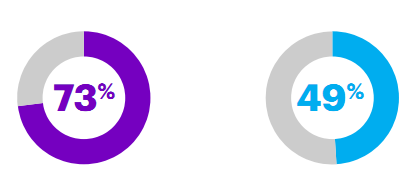
At the outset of its report, Accenture points out that although many healthcare organization executives recognize the importance of the Internet of Medical Things (IoMT)—with 73% of respondents indicating that IoMT will bring disruptive changes to the field within three years—49% of respondents still believe that their organization’s leadership has a limited understanding of the positive impact of IoMT on their organization.
The report points out,By 2020, the market value of the Internet of Things (IoT) in the healthcare sector will reach $163 billion, with a compound annual growth rate (CAGR) of 38.1% from 2015 to 2020.。
As IT budgets grow, investments in the Internet of Healthcare Things (IoHT) are also increasing, with funding sources extending beyond just IT departments. Reports indicate that 57% of healthcare institutions identify their IT departments as the primary drivers of IoHT investment; 26% of respondents state that their R&D departments are the main investors; and approximately 10% report having dedicated subsidiaries or departments responsible for IoHT initiatives.
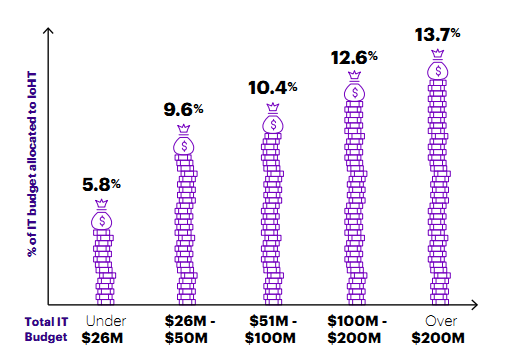
According to the report, healthcare institutions’ investment in Internet of Healthcare Things (IoHT) solutions is increasing in proportion to their overall IT budgets. As shown in the figure below, healthcare institutions with total IT budgets under $26 million allocate 5.8% of their budgets to IoT investments; those with total IT budgets of $26–50 million allocate 9.6%; those with budgets of $51–100 million allocate 10.4%; those with budgets of $100–200 million allocate 12.6%; and those with budgets exceeding $200 million allocate 13.7%.
Today’s healthcare providers and payers are primarily investing in the Internet of Health Things (IoHT) across three key areas: Remote Patient Monitoring (RPM), health and prevention, and operations, and these investments have begun to deliver value.: We can observe savings in medical or administrative/operational costs, improvements in patient/consumer experience, and revenue growth driven by attracting and retaining consumers.
RPM Field
1. Overview
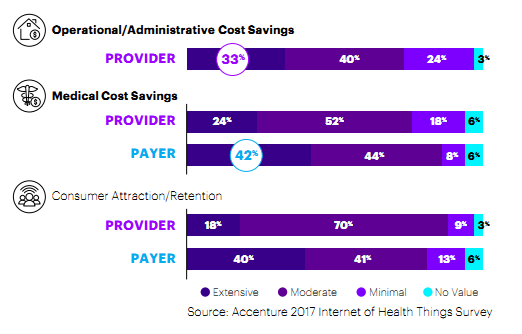
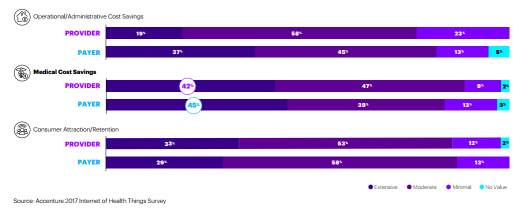
33% of suppliers stated in interviews that implementing IoHT solutions in the RPM sector has significantly reduced their operational costs; 42% of payers also reported substantial cost savings from these solutions; and 40% of payers indicated that the solutions are highly effective in attracting and retaining consumers.
2. Investment Focus
The report indicates that suppliers and payers have different investment priorities in the field of Remote Patient Monitoring (RPM). Currently, suppliers’ investments in the Internet of Health Things (IoHT) within the RPM sector lag behind those in the health and prevention sector as well as the operational sector, but this gap is expected to narrow gradually in the short term. As of May, 43% of suppliers had invested in this area; by the end of 2017, this figure is projected to rise to 56%. In contrast, payers’ current investment rate stands at 69%, but it is anticipated to decline to 48% by the end of 2017.
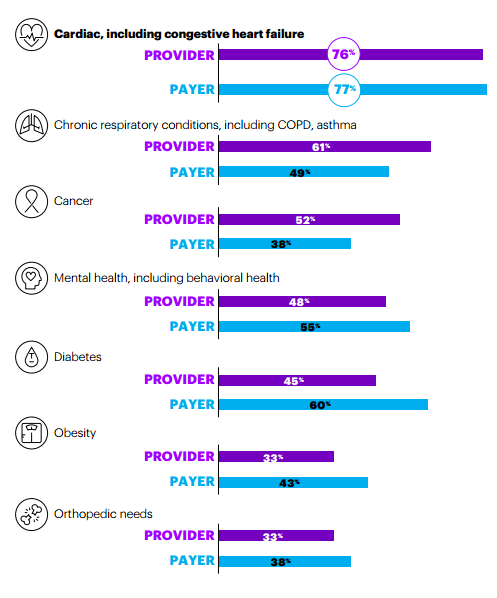
As shown in the figure below, the majority of suppliers (76%) and payers (77%) have concentrated their IoHT investments in the RPM sector on cardiac diseases.Notably, behavioral health was previously undervalued and failed to attract investment levels comparable to those in traditional high-cost sectors (such as the aforementioned cardiac diseases); however, investment in this field is now flourishing.RPM IoHT solutions in the mental health sector (including behavioral health) have relatively high investment priority among vendors and payers, at 48% and 55%, respectively.
Investment proportions in other areas are as follows: chronic respiratory diseases (including chronic obstructive pulmonary disease and asthma), with suppliers accounting for 61% and payers 49%; cancer, with suppliers at 52% and payers at 38%; diabetes, with suppliers at 45% and payers at 60%; obesity, with suppliers at 33% and payers at 43%; and orthopedic conditions, with suppliers at 33% and payers at 38%.
Furthermore, when asked about the drivers for implementing IoHT solutions in this field, 82% of vendors considered patient satisfaction to be very important, and 88% of vendors took measures to understand their patients’ attitudes toward RPM IoHT solutions; similarly, 81% of payers stated that member satisfaction was very important to them.
Health and Prevention Sector
1. Overview
IoHT solutions have also delivered significant value to this sector. Forty-two percent of vendors reported that implementing IoHT initiatives in health and prevention has substantially reduced their healthcare costs, while 45% of payers indicated that these solutions have yielded substantial cost savings.
2. Investment Focus
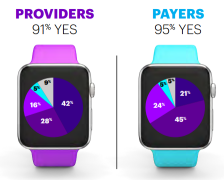
Wearable devices play a pivotal role in Internet of Things for Healthcare (IoTH) solutions within the health and prevention sector. As many as 91% of vendors and 95% of payers indicate that wearable devices are an indispensable component of IoTH solutions in this field.
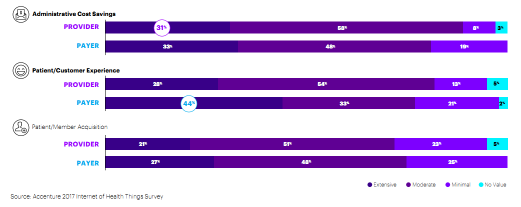
Furthermore, nearly half (44% each) of the respondents indicated that patient/member satisfaction is also the primary driver for implementing IoHT solutions in this field.
Operations Sector
1. Overview
IoHT solutions in the operational domain have also yielded high satisfaction among suppliers and payers. Hospital administrators can leverage IoHT solutions not only to manage medical supply inventories but also to enhance consumer experiences. Thirty-one percent of suppliers reported that implementing IoHT solutions in operations had significantly reduced their administrative costs, while 44% of payers indicated that these solutions had substantially improved patient/consumer experiences.
2. Investment Focus
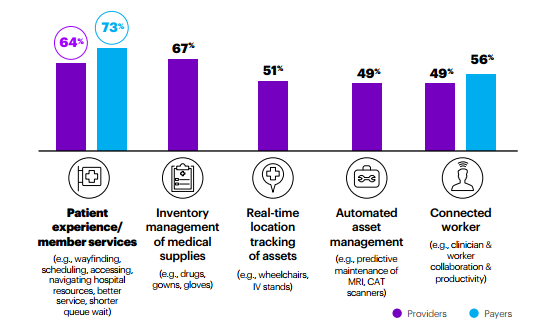
64% of suppliers stated that they have focused their IoHT solution investments in the operational domain on patient experience; 73% of payers also indicated that their focus lies in member services.Additionally, suppliers’ investments in medical supplies inventory management, real-time asset location tracking, automated asset management, and connected employees (collaboration and productivity among clinical workers) stood at 67%, 51%, 49%, and 49%, respectively, while payers’ investment in connected employees was 56%.
1. Seize the Opportunity
Although the implementation of the Internet of Healthcare Things (IoHT) presents significant challenges in terms of security and privacy, this should not serve as an excuse for suppliers and payers to remain on the sidelines. Non-traditional healthcare institutions, facing similar challenges, are actively adopting IoHT solutions to seize development opportunities. If traditional healthcare suppliers and payers remain indifferent, they are likely to miss the opportunity to create substantial value through IoHT, ceding market share to non-traditional competitors and failing to achieve sustainable growth and development.
2. Establish criteria for measuring success
Many suppliers and payers have demonstrated the value of the Internet of Healthcare Things (IoHT) through practice, but they still need to continue investing to better understand where solutions are most successful, in order to prepare for future value quantification. They need to measure the areas where new technologies have remarkable effects, then promote them on this basis, thereby contributing value to the overall business development. By showcasing existing achievements, suppliers and payers can consolidate their businesses, encourage the adoption of IoHT, and drive improvements in interoperability.
3. Implement the concept of consumer priority
Healthcare providers and payers must continue to deepen the implementation of Internet of Health Things (IoHT) solutions to deliver better patient experiences, improve health outcomes, and reduce medical and administrative costs. IoHT solutions can seamlessly collect patient-generated health data, enabling providers and payers to offer more convenient, personalized, and effective healthcare services. They must provide professional training for their staff to make IoHT a “new normal” in daily operations.
4. Establish Flexible Partnerships
Seeking partners in technology and innovation can help suppliers and payers rapidly test and learn how to leverage Internet of Healthcare Things (IoHT) solutions to drive commercial value growth and quantify future implementation goals. Flexible partnerships facilitate the integration of these new technologies into their existing workflows, corporate culture, and training programs.
Reference link:
http://www.mobihealthnews.com/content/report-iot-healthcare-will-top-163b-2020