

Tenez Secures Tens of Millions in Series A+ Funding Within Three Months of Previous Round, Files IPO Prospectus
Unnamed Penguin Secures Funding Yet Again.
VCBeat (WeChat ID: vcbeat), June 5 – B2B pharmaceutical e-commerce platform Unnamed Penguin announced today that it has completed its A+ round of financing, raising tens of millions of yuan. The round was led by Hongshi Chengjin Venture Capital, with existing investors from the Series A round, Chengwei Capital, and the angel round, Matrix Partners China, participating as follow-on investors.
Just this February, Unnamed Penguin announced the completion of its tens-of-millions-yuan Series A financing round, led by Evergreen Fund’s Chengwei Capital, with participation from Matrix Partners China, Chuanghehui, and other institutions. The funding amount was also in the tens of millions.
Unnamed Penguin Announces Two Financing Rounds in Less Than Four Months, Both Backed by Top Domestic Healthcare Investors: Why Has It Repeatedly Won Over Capital?
According to historical financing information, with this round of funding, Unnamed Penguin, which has been established for just over a year, has completed three rounds of financing.
Unnamed Penguin, founded on November 18, 2015, is a startup in the “Internet Plus” big health sector, with its core business focused on B2B pharmaceutical e-commerce. Aiming to reduce costs and enhance transaction efficiency, the company leverages logistics, supply chain finance, and other services to promote standardized, healthy, and rapid industry development, thereby building the infrastructure for pharmaceutical commerce.
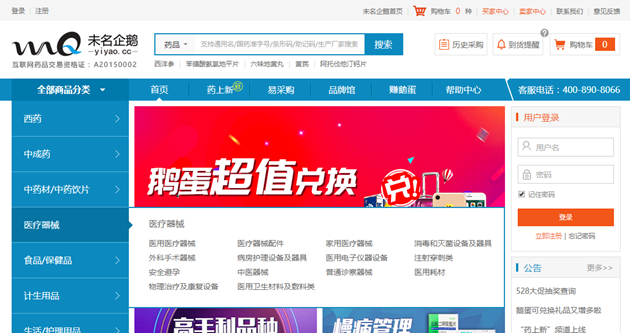
Unnamed Penguin Website Page
Unnamed Penguin was founded by former Tencent executive Zou Xiaoliang, with a founding team of nine members. Mr. Zou brings 11 years of senior management experience at Alibaba and Tencent. Of the nine founding team members, seven are from Alibaba and Tencent, and two are senior executives from pharmaceutical companies.
In the first half of 2016, Unnamed Penguin acquired Minsheng Pharmaceutical Network, which held a Class A license, as a wholly-owned subsidiary, and established a deep strategic partnership with Jointown Pharmaceutical Group. The platform was officially launched in September of the same year.
Unnamed Penguin stated that by the beginning of this year, it had completed its key strategic layout in the Yangtze River Delta region, covering more than a dozen cities including Hangzhou, Ningbo, Wenzhou, and Xianju, with tens of thousands of online pharmacies. Since its launch five months ago, its monthly transaction volume has maintained a growth rate of over 100%.
High growth potential may be a key factor attracting investors.
Dr. Shi Hong, Founding Partner of Hongshi Chengjin Venture Capital, the lead investor in this round, stated that pharmaceuticals, medical devices, and healthcare services are among its key investment focuses. Hongshi Chengjin is optimistic about companies that address fundamental challenges in the current pharmaceutical and healthcare service sectors through technological and business model innovations. With the mindset and commitment of a co-founder, it will provide critical resources in the pharmaceutical and healthcare industries to deeply support the rapid growth of Unnamed Penguin (Beijing) Technology Co., Ltd.
Founder Zou Xiaoliang also stated that following this round of financing, the company will continue to strengthen its product and technology team to build a healthy, self-sustaining industry ecosystem. Unnamed Penguin will remain committed to addressing customer needs and enhancing platform value. With the mission of “connecting health,” it aims to provide convenient products and services, making users’ transaction processes more hassle-free.
According to VCBeat (WeChat ID: vcbeat)’s scan of China’s pharmaceutical e-commerce industry, B2B pharmaceutical e-commerce is an absolute hotspot.
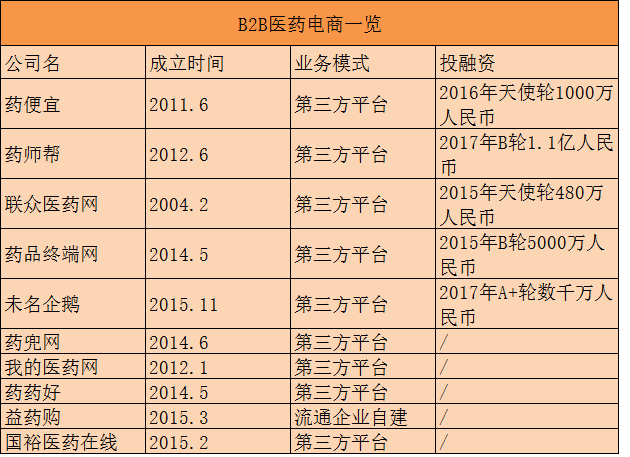
Yao Pianyi, Yaoshibang, Lianzhong Medicine, and Drug Terminal Network have successively secured financing ranging from several million to over 100 million yuan, indicating investors’ continued confidence in this business model.
From a policy perspective, the “13th Five-Year Plan for Pharmaceutical Circulation” requires thatPromotion“Internet+Drug Distribution”。Promoting the widespread application of information technologies such as mobile internet and the Internet of Things (IoT) in the pharmaceutical distribution sector, encouraging enterprises to carry out service innovations based on the internet, and enriching pharmaceutical distribution channels and development models have significantly facilitated the growth of B2B pharmaceutical e-commerce.
Additionally, driven by reforms such as the replacement of business tax with value-added tax (VAT) and the “Two-Invoice System,” pharmaceutical manufacturers and pharmaceutical commercial companies also have their own impetus for business transformation, either by establishing proprietary pharmaceutical e-commerce channels or byThird-party B2B pharmaceutical e-commerce platforms have become mainstream.
For instance, pharmaceutical distributors such as Shanghai Pharma, Jointown Pharmaceutical Group, and Huadong Medicine are actively collaborating with third-party platforms while building their own e-commerce channels, thereby strengthening their strategic layout in the “Internet + Pharmaceutical Distribution” sector.
From a business model perspective, B2B pharmaceutical e-commerce platforms can generate revenue by charging fees to listed manufacturers and procurement entities, leveraging strategies such as cost reduction through streamlined transaction processes, resolving information asymmetry, or providing supply chain finance services.
In terms of the competitive landscape, no dominant leader with monopolistic power has yet emerged in the B2B pharmaceutical e-commerce sector; the industry remains in a fragmented, “Warring States” phase. Looking ahead, those who can better serve the upstream and downstream segments of the pharmaceutical supply chain and create value for participants will stand out in the industry.
The injection of capital may provide a solid foundation for its development.