

Jian Qimin: Future Big Data Will Enable Precision Decision-Making in Healthcare
On the morning of June 3, the 2017 Beijing Ivy League Medical High-End Talent Alliance Health Industry Forum, hosted by the Beijing Ivy League Medical High-End Talent Alliance, WuXi AppTec New Drug Development Co., Ltd., and the Research Association on Health-Preserving Conduct under the China Law Society, and co-organized by the Administrative Office of Wuhan National Bio-industry Base, officially opened. The theme of this forum was “The Present and Future of Medical Big Data.”
Jian Qimin, Director of the Peking University Health Science Center and an Academician of the Chinese Academy of Engineering, shared his insights on big data and modern medicine.
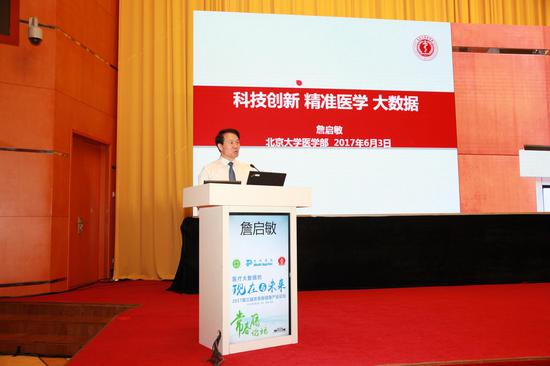
The full text of the speech is as follows (abridged):
Speaker:Jian Qimin, Director of the Peking University Health Science Center, Academician of the Chinese Academy of Engineering
Respected experts, distinguished leaders, and dear friends:
Good afternoon, everyone! It is a great pleasure to attend the 3rd Ivy Health Industry Conference. The theme of today’s conference is big data. Big data has attracted worldwide attention and serves as a crucial pillar for the development of China’s healthcare sector. In line with the conference theme, I would like to share my perspectives on health big data from three aspects: technological innovation, precision medicine, and big data.
In fact, the concept of health discussed today is that of “comprehensive health.” First and foremost, it should focus on the entire life cycle and cover the entire population—from the very first day of life’s formation through to end-of-life spiritual care. This constitutes the comprehensive health development strategy.
Secondly, the Great Health Strategy must focus on the entire health continuum, encompassing a holistic approach that spans from general well-being to sub-health status, the emergence of high-risk factors for disease, pre-symptomatic stages, disease management, rehabilitation, and elderly care.
Furthermore, the “Big Health” strategy must prioritize health management, with a focus on individual health, family health, occupational health, and hospital health. Today, China’s Belt and Road Initiative and its broader international strategy necessitate that the healthcare sector also address global health.
The broader health sector serves as a critical pillar for the sustainable development of China’s economy. Since 2015, the Central Leading Group for Comprehensive Reform has launched a series of major national initiatives aimed at addressing three “95%” challenges: first, over 95% of clinically used drugs in China are currently covered by foreign intellectual property rights; second, 95% of large-scale medical equipment is of foreign origin; and third, 95% of clinical practice guidelines for disease management are developed abroad.
China’s healthcare sector is primarily divided into four components: medical scientific research, disease early warning and surveillance, clinical treatment, and health management and services.
Health big data is not merely a simple process of collection; it inherently embodies scientific thinking. It also necessitates research into the standards governing data generation, as well as issues related to data analysis, ethics, and security. More importantly, scientific research represented by big data must be closely integrated with community health needs. This integration reflects the primary source of big data: starting from clinical and community problems or needs, conducting translational research to generate scientific outcomes, and feeding these back into clinical practice and community health services through new interventions and management measures, or through novel molecular biomarkers and early diagnostic methods.
The past development model was largely sustained by environmental pollution and resource depletion, which is unsustainable. Therefore, China has been seeking a new economic growth model. Strategic research has identified a new highlight in China’s economic development: the health economy. Currently, the health economy contributes approximately 7% to China’s GDP, whereas developed countries generally exceed 12%, with the United States reaching 24%. Thus, there remains significant potential for the health economy to drive China’s overall development.
Precision medicine is regarded as the source of health big data because it precisely integrates general information—such as family history, genetic information, living environment, and lifestyle—with multi-omics and molecular data, including proteomics, genomics, metabolomics, microbiomics, molecular imaging, and molecular applications. This integration enables precise medical care and generates large volumes of high-quality, structured health data.
All diseases occurring in the population are, from the perspective of clinical medicine as a whole, very much at the frontline. Even if a highly experienced specialist practices for 60 years and lives to be 80, or practices for 80 years and lives to over 100, their individual exposure remains limited. When we encounter a case that is not clearly diagnosed, our approach is to convene an expert consultation within our hospital if initial assessments are inconclusive; if this still does not yield a clear diagnosis, we invite international experts for further consultation. What is the purpose of this practice?
When doctors encounter unclear clinical conditions, their current options are limited to searching for information online or, if unresolved, consulting with specialists within their hospital or even internationally. However, future intelligent medical databases will contain millions, tens of millions, or even hundreds of millions of case records, including rare and complex diseases never before encountered. With rapid computational capabilities, these systems will provide diagnostic clues to physicians in real time. In terms of knowledge volume and decision-making speed, humans cannot compete with large-scale databases; therefore, big data will enable precise medical decision-making in the future.
This is not a replacement, but rather provides crucial technological support to enable physicians to formulate precise medical plans. Therefore, big data serves as a foundation, safeguarding the application of precision medicine data and supporting initiatives such as the “Public Benefit Project” and the policy of “Managing Serious Illnesses Within the County.” Intelligent medicine aligns with national strategy; artificial intelligence has become a major national priority. In the future, intelligent medicine will be a vital component in driving China’s development and supporting the construction of a healthy China.

Big data provides critical support for precision medicine, while precision medicine generates vast amounts of high-quality health and medical big data. Artificial intelligence technologies based on this data can further advance the development of precision medicine, ultimately fulfilling its goal of serving public health. In summary, comprehensive clinical information, multi-modal analytical data, and data from molecular imaging, molecular pathology, and clinical pharmacology are aggregated into big data. This foundation supports healthcare by enabling personalized treatment, improving therapeutic efficacy, reducing side effects, and lowering costs. These objectives align with the goals of China’s healthcare reform and will help realize the “Healthy China 2030” initiative.