

Cognoa Files for IPO: Pioneering AI-Powered Autism Screening Platform Seeks Public Listing

Morningside Ventures
Well-known early-stage venture capital institution

Cognoa
Pediatric Health Assessment Service Provider
Cognoa is headquartered in Palo Alto, the “heart of Silicon Valley,” and is the world’s first company dedicated to applying machine learning to early screening for autism in children. It has launched a self-titled app that enables users to intelligently screen children for autism through the software.
In March 2017, Cognoa secured $11.6 million in venture capital from Morningside Ventures, a renowned Chinese investment firm. Since its establishment in 2013, Morningside Ventures has cumulatively invested $20.4 million in Cognoa.
Why Has a U.S. Startup Earned the Unwavering Support of China’s Top Investment Firms? Let’s Examine the Allure of Cognoa.
The Entrepreneurial Journey of a Stanford Biology Postdoc and Santa Clara MBA
Cognoa’s founding team consists of “academia-focused professors and seasoned business executives,” a common startup playbook in the U.S. tech-health sector.
Founder Dennis Wall holds a Ph.D. in Biology from the University of California, Berkeley, and completed postdoctoral training in Biology at Stanford University. After graduation, Dr. Wall conducted medical research at Harvard University and Stanford University, specializing in pediatrics and psychiatry.
Although Dennis Wall has long been engaged in scientific research that demands solitude and intense focus, he possesses the innate entrepreneurial spirit of a restless innovator. In 2007, he founded Network Biotech, a for-profit consulting firm serving biotechnology companies. Currently, while his primary focus remains on academic research, he is also involved in the management of two companies he co-founded.
Co-founder and CEO Brent Vaughan has a background in science and engineering. He earned his bachelor’s degree from the University of California, Davis, and later pursued an MBA at Santa Clara University. After graduation, he held business development roles at prominent companies including Roche Diagnostics, Saegis Pharmaceuticals, and KineMed.

Figure 1: Founder Dennis and Co-founder Brent
Traditional Autism Screening Protocols vs. Cognoa Autism Screening Protocol
The American Academy of Pediatrics recommends that parents have their children undergo early screening for multiple developmental disorders between 9 and 36 months of age, with autism spectrum disorder being the most critical condition to screen for. Early screening can effectively prevent missing the golden window for intervention. Once this opportunity is missed, the impacts of these developmental disorders are likely to persist throughout the patient’s life.
However, according to a report by the U.S. Centers for Disease Control and Prevention (CDC), approximately 15% of children in the United States have developmental disabilities such as autism spectrum disorder to varying degrees, yet fewer than half of these children have undergone early screening.
Why Are Early Screening Rates for Childhood Developmental Disorders Such as Autism Still So Low Despite the Severe Consequences? Parents’ Wishful Thinking Is the Main Culprit.
Autism spectrum disorder (ASD) in children often presents no obvious signs before the age of three. Traditional screening methods require a series of steps, including scheduling appointments in advance, visiting healthcare facilities, and waiting for physician-led assessments. Consequently, many parents do not proactively seek ASD screening for their children out of undue concern when no apparent abnormalities are observed.
The emergence of Cognoa has greatly facilitated parents. They no longer need to go through tedious preparations; with just a smartphone, they can conduct self-administered autism screenings for their children anytime, anywhere.
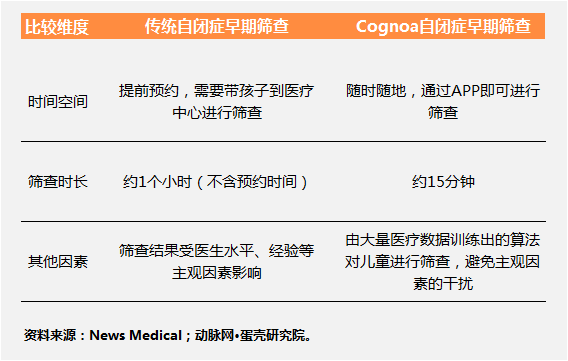
Figure 2: Comparison of Two Early Screening Protocols for Autism
Online Questionnaire + Video Analysis = Autism Screening Solution
After parents download the app from the app store, they first need to complete their child’s basic information, then answer 15 to 20 behavior-related questions based on the child’s specific circumstances, and finally, the system will automatically generate a screening report.
If the system fails to provide a clear screening result after completing the aforementioned steps, parents may upload one or two additional videos of their child’s daily life. These videos will be analyzed by professional pediatricians.
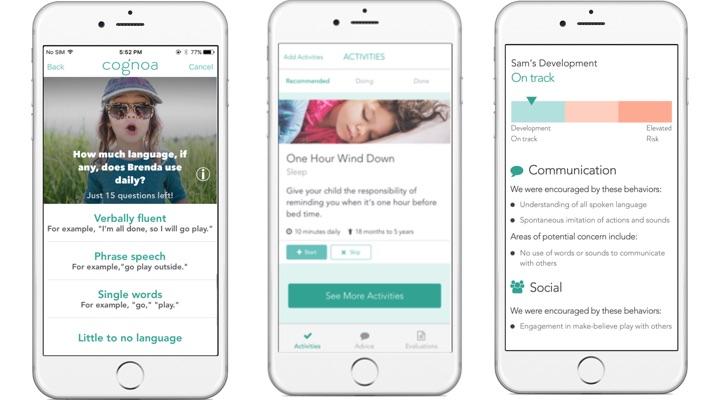
Figure 3: Cognoa Autism Screening Process
Cognoa has also established a community for parents to exchange ideas, enabling them to support one another and thereby alleviate their own anxiety.
Machine Learning–Trained Algorithms Aid in Autism Screening
The screening solution offered by Cognoa may appear simple, but it is the result of integrating the most authoritative medical research with cutting-edge artificial intelligence technology.
The crux of the entire screening protocol lies in the reliability of the online questionnaire design and the accuracy of its results. The theoretical basis for these questions is grounded in Dr. Dennis Wall’s clinical research spanning more than five years. During this period, his team tracked the condition of over 100,000 children with autism at Harvard Medical School and Stanford University School of Medicine.
Information generated in clinical studies is consolidated into massive databases. Cognoa leverages machine learning to analyze vast amounts of medical data, thereby training a proprietary algorithm. When users input children’s behavioral information into the app, the system generates corresponding screening results based on the established algorithm. The screening results are encrypted to ensure user privacy and security.
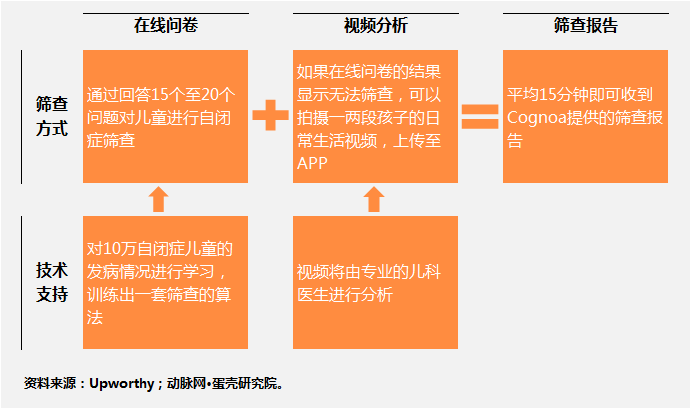
Figure 4: Autism Screening Workflow and Technical Support Provided by Cognoa
Transitioning from a Free Model to a B2B Paid Model
Cognoa’s early free-access strategy generated significant user traffic. However, starting in May 2017, users could only access Cognoa through employer-sponsored healthcare benefits. Currently, both Cognoa’s official website and mobile app have suspended registration for individual users.
As autism screening evolves into a mature business model, Cognoa, leveraging founder Dennis Wall’s years of research experience in pediatrics, will expand its offerings to include screening for other pediatric developmental disorders.
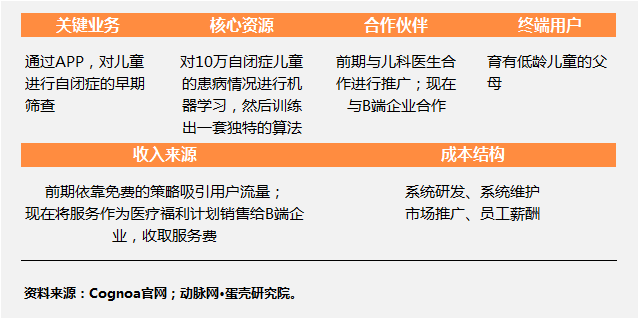
Figure 5: Cognoa’s Business Model
Other Cases of Artificial Intelligence Applied to Autism Screening
In February 2017, according to a report in the renowned scientific journal Nature, psychiatrist Heather Hazlett of the University of North Carolina at Chapel Hill led a team that developed an artificial intelligence system capable of predicting whether children will develop autism spectrum disorder as early as 12 months of age.
These scientists conducted magnetic resonance imaging (MRI) scans on the brains of 106 high-risk children with a family history and 42 low-risk children, and applied machine learning to analyze these medical data, thereby developing an algorithm for autism screening.
However, some argue that imaging studies can only be used to rule out other conditions, and that a definitive diagnosis of autism spectrum disorder (ASD) relies solely on clinical judgment by physicians. Therefore, the extent to which this system can effectively screen for ASD remains to be validated over time.
Overview of Autism-Spectrum Disorder Apps in China
On April 1, 2017, the Wucailu Autism Research Institute, the Department of Special Education at Beijing Normal University, and Xinhua Net jointly released the “Report II on the Development Status of China’s Autism Education and Rehabilitation Industry” in Beijing. The report indicates that, conservatively estimated, there are over 10 million individuals with autism spectrum disorder (ASD) in China, including 2 million children with ASD. The number of newly diagnosed cases is increasing at an annual rate of 200,000.
To date, there is no clearly identified etiology or curative treatment for autism spectrum disorder (ASD). Patients typically undergo ASD screening at major hospitals and, upon confirmation of diagnosis, receive intervention therapy at rehabilitation centers. For children with severe symptoms, parents may choose to enroll them in specialized schools for children with autism.
In recent years, with the rise of mobile internet, several autism-related apps have emerged in China. VCBeat conducted a review of these apps in early 2015. Two years later, the competitive landscape has shifted. However, their approaches to entering the autism sector remain unchanged. We have summarized them as follows:
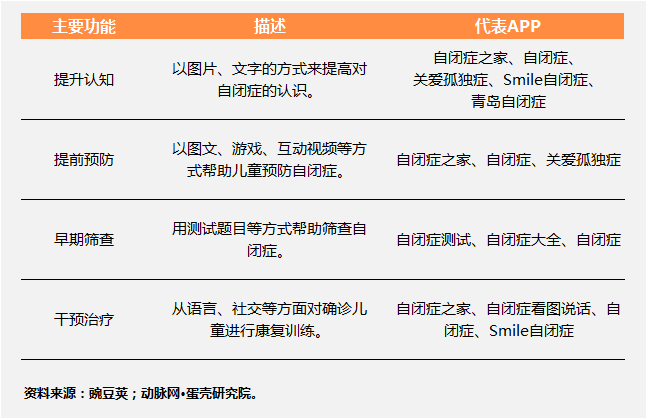
Figure 6: Major Autism-Related Apps in China and Their Features
Reflections for Entrepreneurs in China
Overall, autism-related apps in China suffer from rudimentary design, infrequent updates, and unclear monetization models. Drawing on Cognoa’s experience, VCBeat•VBInsight believes that entrepreneurs need to carefully consider the following two points:
1) What are the core resources of the enterprise?
The greatest challenge in autism lies in accurate screening and proper intervention. Cognoa’s success stems from its foundation in authoritative scientific theories, which has earned market recognition for the reliability of its screening results.
However, many domestic autism-related apps merely serve as content aggregators, compiling information on autism from various channels. They lack their own "moat," making their business models too easy to replicate.
Therefore, entrepreneurs need to clearly identify the resources their company possesses that differentiate it from competitors and that can address key pain points.
2) What is the company's profit model?
Currently, all autism-related apps in China are offered to users free of charge. Although Cognoa also operated under a free model for three years, given the immaturity of commercial health insurance in China, it is difficult for these apps to replicate Cognoa’s B2B monetization model.
However, companies need not be pessimistic. Healthcare remains an inelastic demand for humanity. If the challenges in traditional autism screening and treatment processes can be addressed, there will be opportunities to explore monetization models in both the consumer (C-end) and business (B-end) sectors.