

New Gateway to the Silver Economy: Competitive Analysis of Square Dancing Platforms
Whether on pedestrian streets in first-tier cities or in central squares of fourth-tier cities, square dancing attracts over 100 million seniors to engage in offline exercise and social interaction nearly every day. Square dancing has gradually become one of the most important activities in mass fitness programs.
Square dance participants are characterized by a concentrated age demographic, strong purchasing power, and pronounced health-related needs. A report released by Alibaba Big Data and Yicai indicates that the average expenditure on standard dance attire and equipment by senior square dancers is 437 yuan, excluding costs for audio systems and props. This suggests that the market for dance equipment directly serving square dancing exceeds 50 billion yuan.
More importantly, square dancing represents the most concentrated and efficient entry point for directly reaching the middle-aged and elderly population within the silver economy.Square dancing is also one of the earlier segments within the silver economy to achieve industrialization and scale, playing a significant role in driving the development of industries such as health management, medical services, household finance, leisure and entertainment, and e-commerce. It is not an exaggeration to call it the gateway to the trillion-yuan market of the silver economy.
Since 2015, a large number of startups have rushed into this field almost simultaneously. The second half of 2016 also saw a small surge in financing, with intense competition and fierce market rivalry. By scanning square dance-related projects currently on the market, VCBeat presents an analysis of competitors to examine the current status and development history of this “silver economy gateway” industry.
Phase I: The Budding Stage
On Chinese New Year’s Eve in 1979, ballroom dancing made its debut on the CCTV Spring Festival Gala. Once again becoming a symbol of fashion, as it had been during the Republic of China era when it swept through cities across the country, this trend persisted until the year 2000.
Phase II: Community-Driven Development
The “Civilized City and Hygienic City” campaign launched in 2005, along with the National Fitness Program implemented during the 2008 Beijing Olympic Games, represented state-led administrative efforts that fostered an enabling environment for the development of square dancing. With the promotion of the Jiamusi Happy Step Aerobics as a starting point, this initiative pioneered a model characterized by “local organizational guidance, endorsement by national-level authorities, and nationwide dissemination through instructional classes.”
Phase III: The Video Wave Drives Rapid Market Expansion
Around 2010, with the development of square dancing across various regions and the growth of the internet and major video platforms, many outstanding local square dance enthusiasts began uploading their videos to these platforms. They choreographed routines to popular songs, becoming the first generation of celebrity square dance choreography instructors.
Since then, the number of participants in square dancing has surged rapidly; from 2012 to 2013, this population experienced explosive growth at an annual rate of 70%.
In 2013, the district governments of Qingdao conducted a statistical survey during their promotion of square dancing. At that time, the number of square dancing enthusiasts in Qingdao was approximately 350,000, with projections indicating it would reach 600,000 by 2014, accounting for 7% of the total population. Based on an estimated proportion of 4% to 7%, the number of square dancers nationwide in China was projected to be between 80 million and 100 million by the end of 2016.
We can obtain corroborating evidence through the following forms:
Searching for "square dancing" as a keyword on QQ yields over 200,000 QQ groups, which primarily include fan groups for various celebrity instructors, square dancing discussion groups, and enthusiast communities organized by websites.
The Mobile QQ subscription account “Let’s Dance Square Dance Together” has 640,000 followers and 40,000 topics. Premium posts can reach up to 100,000 views, while ordinary posts typically receive around 5,000 views.
Tangdou.com ranks first among square dancing websites. According to Alexa statistics, as of May 30, 2017, Tangdou.com ranked 25th among online video websites, with an average daily visitor count of 47,000.
The "China Consumer Trends Report," released by Alibaba Big Data and Yicai, shows that the average expenditure on standard dance gear by elderly square-dance participants is 437 yuan. This figure excludes spending on audio equipment, props, and other items. Consequently, the market for dance equipment directly serving square dancing exceeds RMB 50 billion.
Currently, market participants are primarily focused on square dance video tutorials and video sharing, while hardware projects have largely exited the market:
Figure 1 Overview of Square Dance-Related Programs
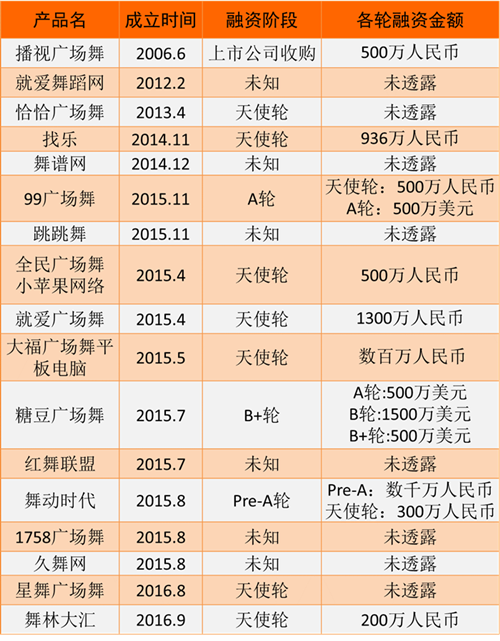
Data Source: VCBeat Database Cut-off Date: May 30, 2017
I. Selection of Competitors
We selected the top three square dance apps by most recent funding amount—Tangdou Square Dance, 99 Square Dance, and Jiu'ai Square Dance—as well as Boshi Square Dance, which was acquired by a publicly listed company, as the sample set for this competitive analysis.
Figure 2. Basic Information on Competing Products
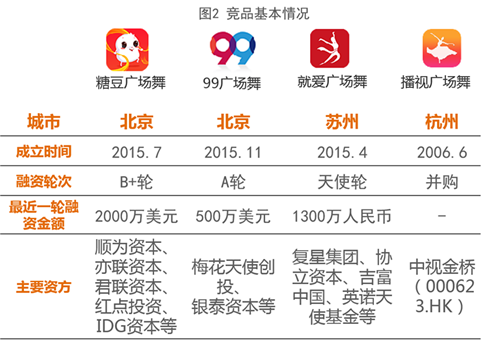
Data Source: VCBeat Database
II. Flow Comparison
Figure 3 Comparison of Flow Conditions
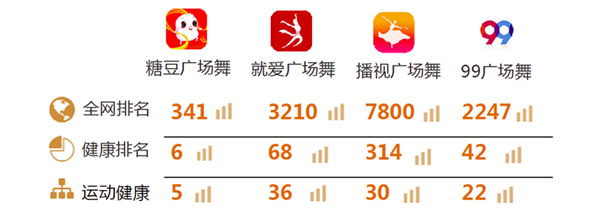
Data Source: Analysys Qianfan Statistical Period: May 1, 2017
Number of Users
Figure 4 Comparison of User Numbers
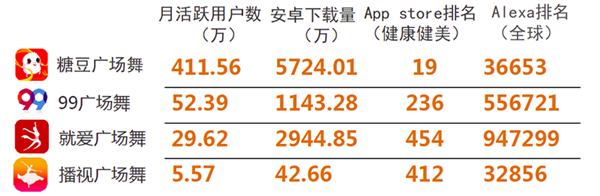
Data sources: Analysys Qianfan, App Annie, KuChuan, Alexa Statistical period: May 1, 2017
Usage
Figure 5. Comparison of Usage
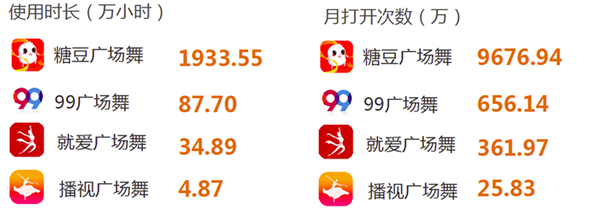
Data Source: Analysys Qianfan Statistical Period: May 1, 2017
Based on the data comparison above, it is evident that Tangdou Square Dance holds a significant advantage in terms of traffic. The second- and third-ranked platforms, 99 Square Dance and Jiuai Square Dance, are in a tight competition regarding installation base and user engagement time. Relying on the promotion from its PC-based Boshi Network, Boshi Square Dance demonstrates prominent website traffic and maintains a high Alexa ranking.
Next, we will conduct a comprehensive comparative analysis of the aforementioned four products by addressing the following four questions:
Why Is Tangdou Square Dance at the Forefront?
What Are the Respective Advantages and Disadvantages of “Jiu Ai Guangchang Wu” and “99 Guangchang Wu”?
Why Does Boshiguangchangwu Have Low Traffic?
Where is the intersection between square dancing and the silver economy?
The above is an excerpt from this report,The report also includes the following:
1. Product positioning and comparative advantages of the four products;
2. Analysis of Unique Features of Each Product;
3. Comparison of identical features across products from different manufacturers;
4. Product portfolio structure of each company;
5. Interaction formats of each product;
6. Profit models of various companies;
7. The Development History of Square Dancing Programs;
8. Comprehensive Evaluation of the Four Projects;
9. Industrial Opportunities in the Silver Economy Presented by Square Dancing
This is a research report on square dancing as a new entry point for China’s silver economy—《New Entry Point for the Silver Economy: Competitive Analysis of Square Dancing Projects》, through competitive analysis, to examine the current status and development history of this entry point into the silver economy, and explore opportunities in the extended scope of the square dancing industry.
Scan the QR code below to becomeVCBeat Official Member, to access the full version“A New Entry Point for the Silver Economy: Competitive Analysis of Square Dance Projects”》. Moreover, over the coming year, you will have unrestricted access to the completeIndustry Trend Report, promptly grasp the latest globalInvestment and Financing Information, boasting a comprehensiveMedical Enterprise Database, and alsoMassive Resource Integration。

Scan the QR code to become a VCBeat member,
Beta Version Trial Price: 365 yuan/year.