

BenevolentAI Files for IPO After Securing $800M Deal for Two AI-Discovered Drug Candidates
In the field of medical artificial intelligence, AI-driven drug discovery remains relatively unfamiliar to most people. Although this niche sector has not developed as rapidly as medical imaging, it has produced a unicorn company—BenevolentAI. Headquartered in London’s King’s Cross district, known as the “Knowledge Quarter,” BenevolentAI primarily leverages artificial intelligence to extract knowledge and generate novel, testable hypotheses from vast amounts of unstructured data, thereby accelerating the drug development process.
From the fourth quarter of 2013 to the third quarter of 2015, BenevolentAI completed four rounds of financing, totaling £87.72 million (approximately $100 million), with a valuation reaching $1.781 billion. In terms of funding raised, BenevolentAI has become the most valuable artificial intelligence startup in Europe and ranks among the top five globally. In January 2017, it was named to CB Insights’ “Top 100 Artificial Intelligence Companies” list.
Why BenevolentAI Has Won the Favor of Investors and Pharmaceutical Companies: An Analysis by VCBeat (WeChat ID: vcbeat)
Excellent entrepreneurs will receive long-term support from capital.
The company was founded by Ken Mulvany in 2013, initially named Stratified Medical, and was renamed BenevolentAI in October 2016.
Ken Mulvany is a serial entrepreneur. In 2003, Ken Mulvany founded a pharmaceutical company—Proximagen.Proximagen is dedicated to providing novel drugs and innovative therapies for central nervous system (CNS) disorders. The company secured two rounds of financing in June 2009 and September 2011, respectively, raising a total of $96.5 million, with Lundbeck as one of the investors. In September 2012, Ken Mulvany sold Proximagen to the U.S. pharmaceutical company Upsher-Smith for $555 million.
The sale of Proximagen generated solid returns for investors and helped Ken build a strong reputation. Consequently, when Ken Mulvany founded BenevolentAI, two investment firms and two pharmaceutical companies that had previously collaborated with him provided £8 million in angel funding. These backers were Lundbeck, Upsher-Smith, Woodford Investment Management, and Lansdowne Partners.
Drug development is inherently capital-intensive, and combining it with artificial intelligence makes the vision and boldness of these investment firms truly admirable. Given BenevolentAI’s current valuation of $1.781 billion, these investors and pharmaceutical companies have once again reaped substantial profits.
There was also a minor incident: Ulf Wiinberg, the former CEO of Lundbeck, once received shares in BenevolentAI as a gift from Ken. He omitted this holding during his asset declaration process, which ultimately cost him his job.
On August 31, 2016, BenevolentAI spun off its business operations and established two wholly owned subsidiaries: BenevolentBio and BenevolentTech.
BenevolentBio has inherited the core business of BenevolentAI, continuing to focus on applying the company’s technologies to healthcare and drug discovery, with a commitment to addressing inflammation, neurodegenerative diseases (such as Parkinson’s and Alzheimer’s), and other rare diseases.
BenevolentTech will continue to refine and develop its AI engine that drives biological science discoveries, and will apply this technology to other fields.
Founder Ken Mulvany stated: “The purpose of this is to integrate AI with technologies in biology, chemistry, and pharmaceuticals to accelerate the research and development of innovative drugs, and then rapidly scale up this technology.”

The Founder Is Not the Company’s CEO
On November 30, 2015, BenevolentBio welcomed a new female CEO—Jackie Hunter. Hunter was the Chief Executive of the UK Biotechnology and Biological Sciences Research Council (BBSRC). The BBSRC is a globally leading funding agency responsible for academic research and training at universities and research institutions across the United Kingdom.
Shortly after she joined BenevolentAI, founder Ken Mulvany stepped down as CEO to assume a board director role, handing the position over to her. In 2016, the company underwent a business spin-off, with BenevolentBio inheriting the core operations of BenevolentAI. Hunter then became CEO of the subsidiary—a highly unusual move in the startup world. Why did Ken Mulvany place such immense trust in her?
Driven by curiosity, I looked into the background of this accomplished female CEO and discovered that she served as a Non-Executive Director at Proximagen, Ken Mulvany’s previous startup, from January 2010 to October 2012. As a member of the company’s Remuneration Committee and Nomination Committee, she gained extensive insight into the company’s workforce.
Prior to this, she spent 27 years in the pharmaceutical industry, serving as Senior Vice President of Neurology, Gastroenterology Drug Discovery, and Early Clinical Development at GlaxoSmithKline. It can be inferred that Ken’s decision to step aside was driven by his full trust in Jackie Hunter and her extensive experience.
Jérôme Pesenti, CEO of another subsidiary, BenevolentTech, is a world-class AI technology pioneer. Over the past 16 years, he has focused on research in big data, cloud services, and machine learning, and led and participated in the development of the IBM Watson platform as Chief Scientist. He joined IBM after Vivisimo, the company he co-founded, was acquired by IBM in 2012.
Later, impressed by BenevolentAI’s advantages and innovations in the field of AI-driven drug discovery, he decided to join BenevolentAI.
Drug Discovery Faces Numerous Challenges
The Three Gorges Dam is a major water conservancy project in China. It took 12 years from construction to completion, at a cost of RMB 50 billion (approximately USD 6 billion), covering only the main structure expenses and excluding resettlement costs and power transmission and transformation engineering fees. It has been hailed as a “mega-project of a major nation.” In the same period, specifically in 2006, Pfizer’s R&D expenditure amounted to USD 8.34 billion, with 11 drug candidates in Phase III clinical trials. Bringing a new drug to market also takes 10–12 years, nearly identical to the timeframe for constructing the Three Gorges Dam. Why, then, are the cost and development cycle for new drugs so high and lengthy?
The challenges in new drug development can be divided into two phases: the early-stage discovery of small-molecule compounds, and Phase I, II, and III clinical trials. Generally, Phase I and II clinical trials take three to five years, while Phase III clinical trials take two to three years. The smooth progression of this stage largely depends on whether the candidate compound was appropriately selected during the early drug discovery phase. The process of identifying candidate compounds plays a critical role in subsequent clinical development. Here, we first provide an overview of the workflow.
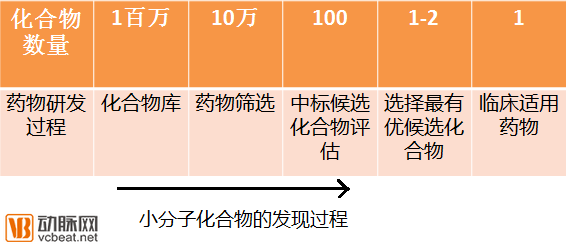
Drug discovery is an arduous quest, often reliant on serendipity. The process is fraught with numerous challenges, such as the need to screen an excessive number of compounds, assess the toxicity of lead candidates, and address issues like drug failure and biased study designs. Inadequate preclinical work significantly increases the likelihood of mid-stage clinical trial failures, which can result in losses amounting to hundreds of millions of dollars.
Rapidly Discover New Drugs from Massive Amounts of Information
Given the immense challenges in new drug discovery, how does BenevolentAI’s artificial intelligence technology improve the odds of successful drug discovery?
In an era of rapid advancement in scientific research, a life sciences paper is published every 30 seconds. Furthermore, vast amounts of information, including numerous patents and clinical trial results, are disseminated worldwide. Only a small fraction of this scientific data can be transformed into useful new knowledge.
For drug R&D professionals, there is neither the time nor the energy to keep track of all emerging information. Yet this information encompasses the research findings of most scientists worldwide and a vast amount of data on new drugs. Identifying subtle clues for novel therapeutics from such information represents a shortcut in drug discovery.
BenevolentAI’s technology platform leverages artificial intelligence to extract knowledge capable of advancing drug discovery from vast amounts of unstructured data, generating novel, testable hypotheses that accelerate the drug development process. This platform is called JACS (Judgment Augmented Cognition System).
JACS processes massive amounts of data during computation. To enhance computational efficiency and capability, the company purchased the DGX-1, a supercomputer specifically designed for deep learning, from NVIDIA. This system can simulate recognition and learning patterns occurring in the cerebral cortex, accelerating the establishment of new relationships across diverse information sources, thereby enabling faster and more prolific innovation in novel drug development.
The first transaction amounted to $800 million.
BenevolentAI did not secure funding by spinning narratives; to date, the company has been leveraging AI technology to develop more than 10 drug candidates targeting diseases across four distinct therapeutic areas, including Alzheimer’s disease and rare cancers.
In June 2014, BenevolentAI announced a collaboration with a U.S. pharmaceutical company, selling two novel Alzheimer’s disease drug candidates currently in development to this American firm. These two drugs were at the stage of evaluating hit-to-lead compounds. The deal was valued at up to $800 million, with BenevolentAI receiving an upfront payment of $400 million. If the subsequent development of these new drugs proceeds successfully, the company will receive the remaining $400 million. Both drugs involved in this transaction were developed using the JACS system.
In addition to the small-molecule compounds identified through its sales efforts (innovative drugs that have not yet entered clinical trials), BenevolentAI can also analyze small-molecule compounds, thereby participating in the entire drug discovery and development process. In November 2016, BenevolentAI entered into a collaboration with Johnson & Johnson, under which Johnson & Johnson transferred certain experimental small-molecule compounds to BenevolentAI for new drug development.
On May 25, 2017, a drug discovered for the treatment of amyotrophic lateral sclerosis (ALS) was confirmed by research conducted at an institution in Sheffield, UK, to be effective in treating motor neuron degeneration.
Additionally, VCBeat learned from BenevolentAI’s official website that BenevolentAI will leverage its artificial intelligence system to guide the conduct of clinical trials and data collection, with plans to initiate Phase 2b clinical trials for a certain drug as early as mid-2017.
Does China have opportunities in this area?
BenevolentAI is so profitable that it is poised to become a world-class enterprise in the future. Does China, therefore, have significant opportunities to make its mark in the field of AI-driven new drug development?
In China, we have currently identified only one company, XtalPi, engaged in the business of AI-driven new drug R&D. This company primarilyLeveraging technologies such as artificial intelligence, quantum physics and chemistry algorithms, big data, and cloud computing to drive innovation in drug research and development,Providing global pharmaceutical companies with highly precise, intelligent drug design and R&D technologies to enhance research efficiency and success rates.
Unlike BenevolentAI, XtalPi applies its developed technologies to early-stage design and optimization in the drug discovery process, drug solubility prediction, toxicity prediction and screening, drug design, and drug repurposing. The company has also achieved significant progress in the AI-driven pharmaceutical sector.。
However, from a macro perspective,For Chinese entrepreneurs looking to develop in this field, the barriers to entry remain relatively high.
We conducted a brief analysis primarily from the following dimensions:
Market:The market for innovative drugs is as vast as you can imagine; as long as you have the capability, you can secure your share of the pie. No further elaboration will be provided here.
Data:High-quality data is a critical foundation for artificial intelligence enterprises; without it, everything is meaningless. China’s new drug development environment lags significantly behind that of other countries, with notable gaps compared to Europe and the United States in both compound libraries and experimental data on small-molecule compounds. Chinese entrepreneurs must first establish collaborations with universities, research institutions, or hospitals, as access to high-quality data is a prerequisite for any viable venture.
Talent:China indeed has a considerable number of artificial intelligence experts, but there is still a scarcity of talent who combine AI with pharmaceuticals and biochemistry. Recruiting such professionals remains quite challenging, unless experts are hired from overseas.
Business Model:Europe and the United States have mature exit mechanisms for drug development. Once new drug discovery and R&D projects collaborate with pharmaceutical companies, there is a high probability of acquisition by these firms, allowing investment institutions to successfully exit. However, there are few such successful cases in China.