

Dashenlin Pharmaceutical Group Successfully Passes IPO Review, Poised to Become China's Top-Valued Pharmacy Retailer with Market Cap Exceeding RMB 10 Billion
VCBeat (WeChat ID:vcbeat)6Month7[News] Documents disclosed on the China Securities Regulatory Commission’s (CSRC) official website yesterday showed that Dashenlin Pharmaceutical Group Co., Ltd.’s application for an initial public offering (IPO) and listing on the main board has been approved by the CSRC’s Main Board Issuance Review Committee.
Dashenlin previously submitted its initial public offering (IPO) application on April 13 this year and disclosed its prospectus. It took less than two months from the prospectus disclosure to obtaining regulatory approval, making Dashenlin’s listing process remarkably swift. According to Wealth Investment’s statistics on IPO timelines for companies listed in 2016, the shortest period from submission to approval for main board listings exceeded six months.
However, this is not the first time Dashenlin has pursued an initial public offering (IPO). According to data from the China Securities Regulatory Commission (CSRC), Dashenlin previously filed for an IPO on November 30, 2015. Less than two years after its prior filing, the revamped Dashenlin has finally received the CSRC’s “green light.”
"The No. 1" Private Chain Pharmacy
DaShenLin Pharmaceutical Chain was established in 1999, evolving from DaShenLin Pharmaceutical Retail, which originated in Maoming, Guangdong Province in 1993. The company is owned by the three brothers Ke Yunfeng, Ke Kangbao, and Ke Jinlong.
When the chain company was established in 1999, Dashenlin had fewer than 20 stores, with its headquarters located in Maoming. Since the inception of the chain operation, Dashenlin has implemented the Corporate Identity System (CIS) strategic framework, registered the “Dashenlin” trademark nationwide, and embarked on an aggressive expansion strategy.
In 2004, Dashenlin relocated its headquarters to Guangzhou. The following year, its 100th store opened across China. Subsequently, Dashenlin expanded into the neighboring Guangxi region, initiating its regional layout.
In 2011, Dashenlin operated 1,000 stores, establishing itself as the leading pharmaceutical retail chain in Guangdong and surrounding regions. That same year, Dashenlin recruited senior executives from Watsons to spearhead a diversification reform; however, the initiative yielded unsatisfactory results, adversely impacting the company’s performance.
“2011 was a year of chaos for us, but great order follows great chaos, which aligns with the laws of history.” Two years later, Ke Yunfeng described that period in this way during an interview with the media.
Nevertheless, this did not halt Dashenlin’s forward momentum. The company has been actively engaged in capital operations, forming listing alliances, launching beauty stores, and extending its reach upstream. At the time, Ke Yunfeng outlined a plan for Dashenlin to surpass 10,000 stores by its third decade (2023).
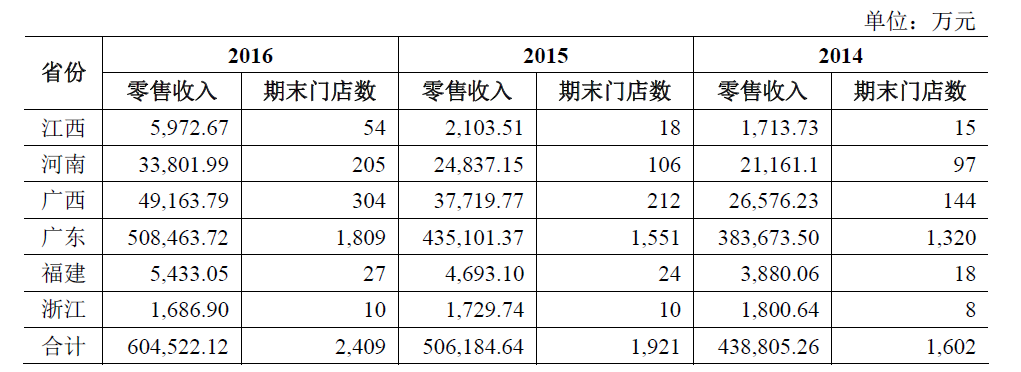
The prospectus disclosed that Dashenlin opened an average of approximately 400 new stores annually across China, bringing its total store count to 2,409 by the end of 2016. Guangdong Province served as its core market, with 1,809 stores, followed by Guangxi and Henan. The company also had a presence in Jiangxi, Fujian, and Zhejiang provinces.
Table 1: Changes in the Number of Dashenlin Stores
It is also worth noting that Dashenlin’s revenue growth is commendable. Data show that its annual revenue growth rates in 2015 and 2016 were 15.84% and 19.14%, respectively, more than double the overall growth rates of 8.6% and 9.5% recorded by the pharmaceutical retail market during the same periods.
Table 2: Historical Revenue Data of Dashenlin
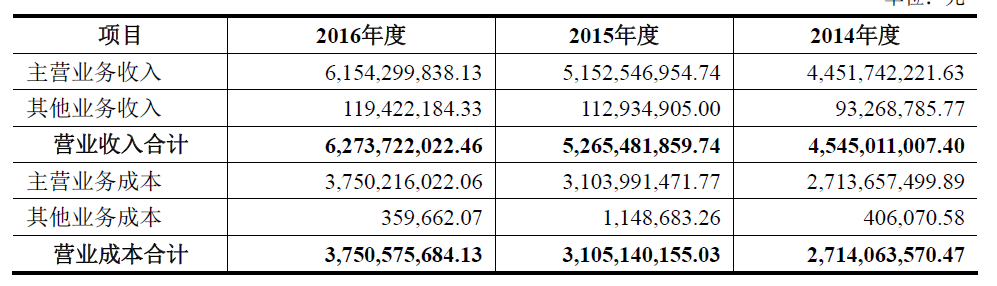
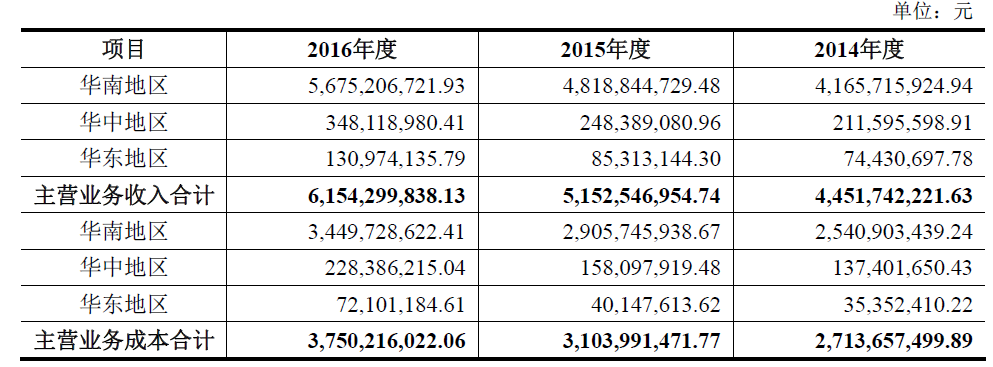
Table 3: Dashenlin's Main Business Revenue by Region
Stronger revenue figures also indicate that Dashenlin“Not short of cash.” The announcement shows,2014Year-end,2015End of Year,2016Year-end,DashenlinCash and cash equivalents balances were, respectively,60,333.2210,000 yuan,52,668.6410,000 yuan,66,844.78ten thousand yuan, accounting for the proportion of current assets respectively35.73%、29.01%、27.80%。Meaning that while continuously expanding, Dashenlin has long heldCash exceeding 500 million yuan.
Ample liquidity stems from robust internal cash-generation capabilities, with gross profit margin being the key metric of focus. In 2014, 2015, and 2016, the company’s gross profit margin from its core operations was 39.04%, 39.76%, and 39.06%, respectively. Among these, pharmaceutical retail constitutes the company’s core business, with gross profit margins of 39.18%, 39.93%, and 39.36% in 2014, 2015, and 2016, respectively, demonstrating relative stability.
Table 4: Gross Profit Margin of Dashenlin's Core Business
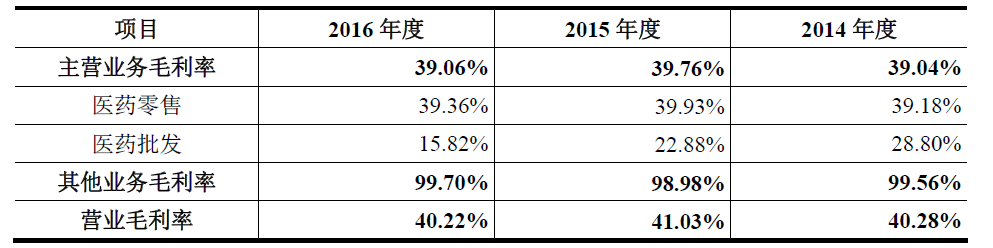
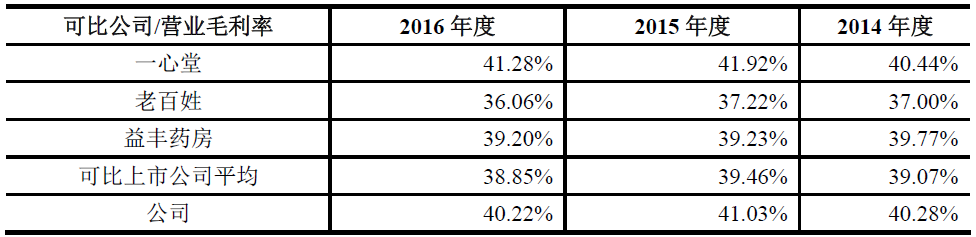
A comparison of Dashenlin’s gross profit margin with industry benchmarks reveals that its margin level is among the leading in the sector.
Table 5: Comparison of Industry Gross Profit Margins
Raising RMB 1.8 Billion, Setting a New High for Pharmaceutical Retail IPOs
According to Dashenlin’s prospectus, the company plans to publicly issue no fewer than 40 million new shares. After deducting issuance expenses from the funds raised, the net proceeds will be invested in four projects in order of priority, namely:
Table 6: Use of Proceeds from Dashenlin's Fundraising
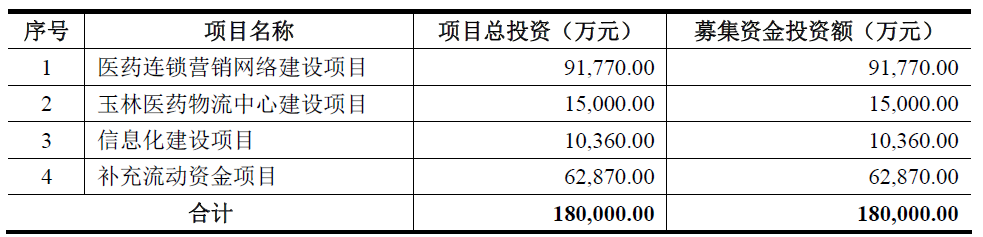
Most notably, under the “Pharmaceutical Chain Marketing Network Construction Project,” Dashenlin will add 1,311 new stores over the next three years. Dashenlin stated that “the annual number of new stores is consistent with its current expansion pace, and the investment scale is relatively reasonable.”
The Yulin Pharmaceutical Logistics Center project, with an investment of 150 million yuan, is also a key focus, as in-house distribution has been Dashenlin’s primary approach to cost control and meeting its own operational needs.
In this regard, Dashenlin stated, “The proportion of self-managed deliveries accounts for 80% of total delivery volume. Our robust in-house distribution capability effectively ensures high fulfillment and on-time delivery rates, while strictly controlling error rates and costs.”
The prospectus notes that the company operates logistics warehouses in Guangzhou, Maoming, Shunde, Jiangmen, Yulin, Wuzhou, Zhengzhou, Dongguan, Fuzhou, and other regions. These facilities handle daily deliveries to stores within their respective areas, with reasonably planned distribution radii that enable rapid response to store delivery needs. Overall, Dashenlin currently has 17 warehouses in operation, with an additional five scheduled to become operational in 2017 and 2018, including the Yulin project.
From Yixintang, the first to go public in the industry, to Jianzhijia, which recently disclosed its prospectus, a comparison reveals that Dashenlin raised the largest amount of capital, setting a record for IPO fundraising in the pharmaceutical retail sector.
Table 7: Overview of IPO Information for Pharmaceutical Retail Enterprises

In terms of revenue generation and store count, Dashenlin is quite comparable to Laobaixing Pharmacy. With Laobaixing Pharmacy’s IPO priced at RMB 16.4 per share and a price-to-earnings (P/E) ratio of 22.52, this serves as a benchmark. Based on this reference, Dashenlin’s IPO price is likely to fall within the range of RMB 33–45 per share, pushing its total market capitalization above RMB 13 billion and solidifying its status as the undisputed “leading listed company in pharmaceutical retail.”
Furthermore, regarding the equity structure, the three Ke Yunfeng brothers, as founders, hold approximately 70% of the shares. This means that after Dashenlin’s successful initial public offering (IPO), the three brothers will share wealth exceeding RMB 9 billion, bringing the Ke family’s total wealth to over RMB 10 billion.
At the current approval pace of China’s A-share market, Dashenlin will still need to respond to relevant inquiries from the China Securities Regulatory Commission (CSRC) after passing the listing committee review. Barring any unforeseen circumstances, Dashenlin is expected to successfully complete its IPO within the next two to three months.