

Elder Care Market Trends: Scale to Exceed RMB 500 Billion, Shifting Toward Mid-to-High-End with Capital Preference for In-Home Care
In St. Gallen, Switzerland, elderly care can be “banked”: Retirees in good health provide voluntary assistance to seniors with limited mobility, and the hours spent on caregiving are credited to a “time bank” within their personal social security accounts. When they themselves grow old, they can redeem these credits for equivalent free nursing care. This represents a pioneering exploration in elderly care models.
In China, the wave of innovation and entrepreneurship has reached the elderly care industry, where technologies such as the Internet and smart products have given rise to a variety of new concepts in elderly care, making this traditional sector more “trendy.” However, when it comes to addressing fundamental needs, challenges remain in providing care and rehabilitation for seniors with limited mobility, and the industry has yet to identify effective solutions. According to the 2016 “Results of the Fourth Sample Survey on the Living Conditions of Urban and Rural Elderly People in China” released by the National Working Commission on Aging, there are approximately 40.63 million disabled or semi-disabled elderly individuals in China, accounting for 18.3% of the total elderly population. Tens of millions of families are overwhelmed by the burden of caring for their elderly relatives. With aging continuing to intensify, this trend is driving the gradual expansion of the elderly care market.
“Essential needs,” as opposed to other elderly care services that merely enhance quality of life, sometimes also imply higher fees. However, with the growing population of disabled older adults and increasing pressures on the younger generation, hiring dedicated caregivers may become a choice for more families. As early as in the “12th Five-Year Plan for the Development of the Social Elderly Care Service System (Draft for Comments)” issued by the Ministry of Civil Affairs in 2011, it was mentioned that by 2020, the potential market size for elderly nursing services and daily living assistance in China would exceed500 billion yuan。
The primary components of elderly care services include geriatric nursing, daily living assistance, disease management, and geriatric rehabilitation. Herein, VCBeat (WeChat ID: vcbeat) has compiled a list of companies that have established robust elderly care service offerings, categorized into institutional care, community-based care, in-home nursing, geriatric rehabilitation facilities, and elderly care training. Additionally, we have gathered insights from industry practitioners. Meanwhile, we welcome elderly care enterprises not included in this review to contact VCBeat for further exchange of industry information.
Five Key Sectors: A Scan of 52 Elderly Care Enterprises
Here, VCBeat has compiled a list of 52 companies that emphasize elderly care services. Among all the included companies, 27 have established care-oriented elderly care institutions, 23 have deployed community-based custodial care services, 27 offer in-home elderly nursing care, 6 are involved in elderly rehabilitation, and 7 have elderly caregiver training programs (with several companies operating in multiple business areas simultaneously).
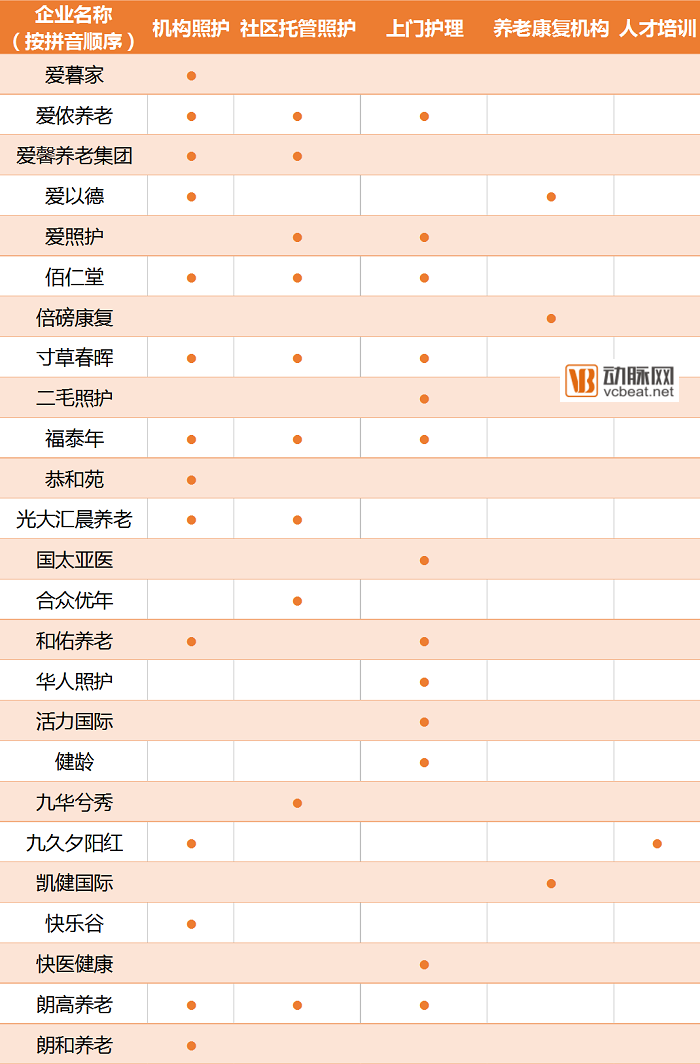
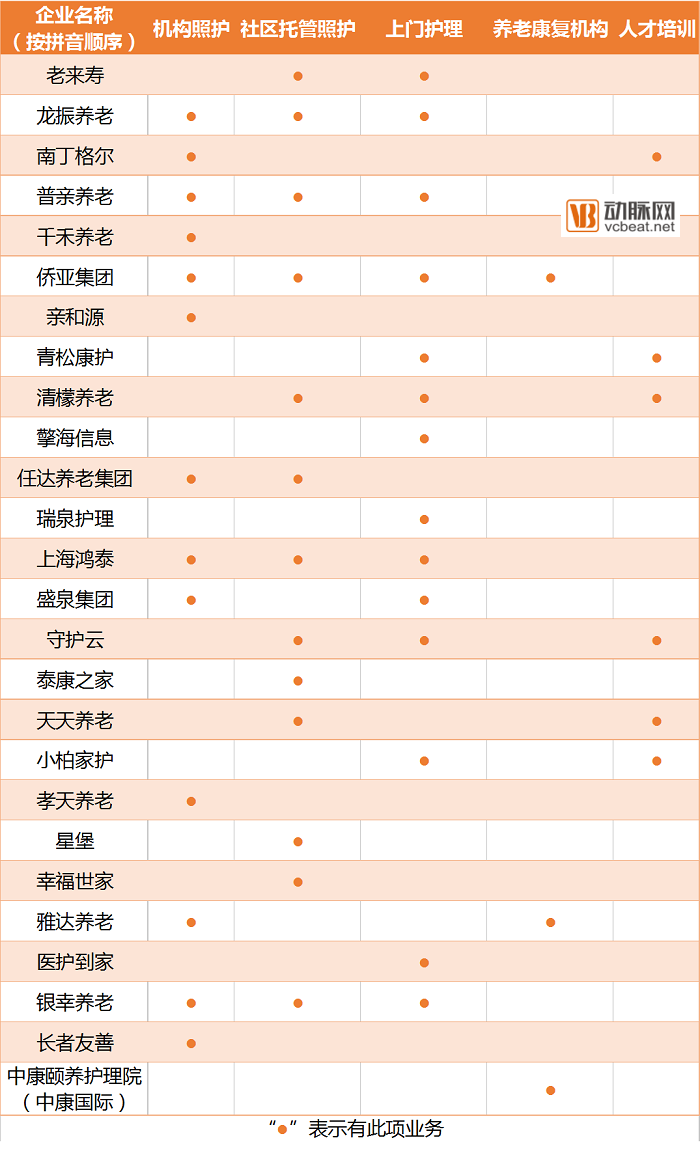
Company information in the charts can be queried through the VCBeat database. Scan the QR code at the end of this article to become a VCBeat member, allowing you to log in to the VCBeat Mini Program or official website to view the full report and use the database to search for relevant company information.
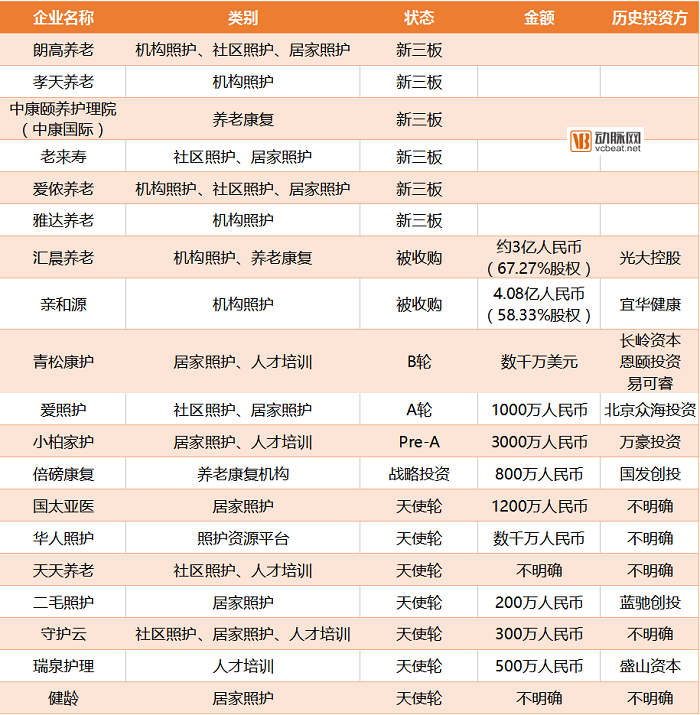
Among them, a total of 19 enterprises have been reported for financing, mergers and acquisitions, and listing on the New Third Board. From the type of enterprises, it can be seen that elderly care companies listed on the New Third Board are mostly comprehensive elderly care and rehabilitation institutions. Examples include Langao Elderly Care, which has established numerous nursing homes and undertaken community nursing outsourcing, and Zhongkang International, whose business scope covers social welfare centers for the elderly, convalescent nursing homes, and various health management services.
In addition, Huichen Elderly Care and Qinhheyuan, both acquired by large enterprises, fall under the category of elderly care institutions. Among the companies that have recently received investment, most adopt business models focused on providing elderly care personnel to households, communities, and even hospitals, as well as establishing offline elderly care facilities within communities. Overall, these models are relatively “asset-light.” Among publicly disclosed financing information for invested elderly care companies, the highest funding round reached only Series B. This indirectly reflects investors’ cautious stance toward this sector. To attract capital and expand operations, elderly care service providers must develop distinctive business models, standards, and operational capabilities. (According to the latest unpublished information obtained by VCBeat, one elderly care company secured RMB 70–80 million in its latest financing round, setting a new record among those listed.)
So, what is the current landscape of the various service sectors centered on elderly care in China, and how are these different sectors interconnected? First, let us illustrate this with the following diagram.
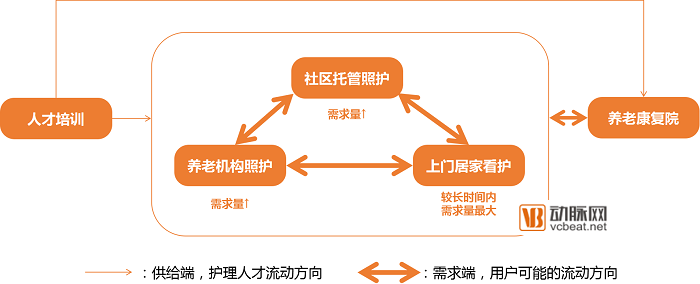
On the supply side, training providers for elderly care personnel are essential, offering critical support regardless of whether services are delivered in institutions, communities, through home visits, or in rehabilitation facilities. On the demand side, care methods and settings vary according to the elderly individual’s condition and the family’s caregiving burden. Over the foreseeable future, home-based care for disabled and semi-disabled seniors will remain the mainstream approach. However, as elderly care institutions and community care centers strengthen their medical and nursing resources, an increasingly open-minded population is becoming more accepting and supportive of these institutional and community-based care models.
Domain 1: Care in Elderly Care Institutions
This is the model that immediately comes to mind when people hear the term “elderly care industry.” However, the reality is that many institutions suffer from suboptimal operational performance and lack sufficient capacity to admit elderly individuals with disabilities.
However, with the gradual implementation of the “integration of medical and elderly care,” all parties have been emphasizing that elderly care institutions need to strengthen their medical care capabilities. Notably, in 2015, the Beijing Municipal Government issued the “Opinions on Deepening the Reform of the Management System of Public Elderly Care Institutions,” stipulating that public nursing homes can only accept elderly individuals who are disabled, advanced in age, or fall into other similar categories. VCBeat has found thatMany branded private elderly care institutions are also refining their elderly care services as a key competitive advantage., among which many distinctive practices have emerged.
For instance, the elderly care institutions under Bairentang specialize primarily in care services for individuals with dementia and disabilities. It is reported that all staff members have received professional dementia care training, and the team comprises interdisciplinary talent. Notably, they provide 24/7 uninterrupted professional care for seniors who are completely dependent on others for daily living activities, representing the highest tier of elderly care services.
Positioned as a high-end medical-elderly care provider, Langhe Elderly Care offers personalized butler services tailored specifically for the elderly. Each resident is assigned a dedicated butler available 24/7 to address their needs, with regular health monitoring conducted. One of its flagship offerings, “Langhe Nursing Home,” provides specialized medical, nursing, and rehabilitation services for seniors with disabilities or dementia, further emphasizing personalized customization.
In 2014, Beijing saw the establishment of its first senior care facility dedicated exclusively to caring for elderly individuals with dementia, namely the Jinsong Dementia Care Home under Longzhen Elderly Care. In 2016, commissioned by the Beijing Municipal Civil Affairs Bureau, Jinsong Dementia Care Home participated in the formulation of care standards for elderly residents with dementia in Beijing’s senior care institutions.
It has been observed that elderly care institutions with comprehensive care and medical resources are generally positioned in the mid-to-high-end market, which aligns with the current reality of essential elderly care needs: only when prices rise can professional supporting elderly care services keep pace. Furthermore, if Beijing’s approach is gradually adopted across China, with most public elderly care facilities accommodating low-income disabled seniors, opportunities for private elderly care institutions will become more concentrated on middle- and high-income seniors who are self-reliant. Therefore, it is logical for these private institutions to focus on the mid-to-high-end segment and provide more diverse elderly care facilities than their public counterparts.
Domain 2: In-Home Elderly Care
There is a large population of disabled elderly people in home settings, yet this group remains the furthest from professional medical and nursing care. This model represents the “lightest” form of elderly care services. VCBeat’s previously published report on the at-home nursing industry also suggests that having medical professionals provide healthcare services to seniors in their homes may evolve into a key component of home-based elderly care in the future.
Similar to home visits by medical personnel, home-based services provided by elderly care assistants have already been adopted by numerous startups in the eldercare sector; such companies are also part of the elderly care service providers.Most Active Financing ActivityAmong the companies listed in the aforementioned financing round, Qingsong Kanghu, which has secured Series B funding, specializes in home-based elderly care. Its services are segmented into rehabilitative care tailored for stroke survivors, post-operative patients, and bedridden seniors, complemented by distinctive offerings such as telemedicine consultations and home delivery of pharmaceuticals. Ai Zhaohu, currently at Series A, employs artificial intelligence techniques during its in-home elderly care services to mine and analyze core data generated throughout the caregiving process. Xiaobai Jiahu, at the Pre-A stage, has established its own proprietary standards for in-home care procedures, with its care quality recognized by numerous industry associations.
Among these in-home elderly care companies, those with self-operated service teams include Qingsong Kanghu (which employs both a direct-employment model and a contracted-provider model), Xiaobai Jiahu (where all home care specialists are company employees), and Ermao Care. Such companies are characterized by services that are more customized and standardized, with a market positioning skewed toward the mid-to-high-end segment.
Domain Three: Community-Based Elderly Care
Here, the community-based care models we outline fall into two categories. The first comprises enterprises that have developed purpose-built senior living communities with integrated care functions, such as Taikang Community and Jiuhua Xixiu, which staff dedicated nursing and medical personnel within the community. The second involves establishing service points within existing communities, delivering care in a manner similar to adult day care centers and elderly care homes, while leveraging smart eldercare technologies to enhance care capabilities. This article focuses primarily on the second type of enterprise.
The Tiantian Elderly Care Project operates by partnering with property management companies across various regions, where the government (or property management companies) provides community elderly care service centers free of charge. Service orders are accepted through three channels: offline community elderly care service centers, telephone call centers, and internet platforms, offering both on-site care services within community facilities and home-based consultation services. Revenue is generated through community site operations and nursing staff training.
Qingmeng Elderly Care has established more than 300 care centers across eight cities in China, and its community-based smart elderly care services have been featured by CCTV. Most notably, Qingmeng Elderly Care has exclusively developed over 1,500 groundbreaking profiling criteria for older adults, enabling the customization of highly precise care plans as well as dietary and health management programs.
Another smart elderly care enterprise, called Shouhu Yun (Guardian Cloud), collaborates with community-based elderly care service centers to provide health management services for seniors and enables precise tracking of elderly individuals within a 500-meter radius in the community. Recently, the company has also begun developing a platform for elderly care workers, recruiting candidates from housekeeping agencies, property management firms, and compassionate community volunteers. Those who pass the assessment become “Shouhu Yun Envoys,” providing nursing and domestic care services to seniors in the community.
Domain 4: Geriatric Rehabilitation Institutions
Elderly rehabilitation facilities are, in fact, a new concept introduced from overseas, somewhat akin to “nursing homes” abroad—where caregivers and skilled nurses provide 24-hour monitoring services, and specialists offer rehabilitation guidance to the elderly. Therefore, such facilities are closely associated with medical institutions, with some being established in affiliation with hospitals. Compared to other care settings, elderly rehabilitation facilities admit a higher proportion of disabled and semi-disabled seniors. Beyond daily living assistance, the most critical objective is providing rehabilitative treatment for frail elderly individuals.
Domestic rehabilitation medical institutions include elderly care and rehabilitation hospitals under comprehensive elderly care enterprises such as Qiaoya Group and Yada International, as well as specialized mid-to-high-end elderly care and rehabilitation chains like Kaijian International. Based on the number of companies we have collected, this business model has not yet fully developed in the Chinese market, with some involvement from foreign investment.
Geriatric rehabilitation, which currently receives limited attention in China, could emerge as a new profit center for the elderly care industry.Not long ago, Yang Jinyu, Director of the Think Tank at Sanguo Zhiku, former Senior Healthcare Consultant in IBM’s Global Business Consulting Services, and Chief Consultant in Neusoft Group’s Strategic Consulting Division, shared insights with VCBeat. During the discussion, he articulated a highly valuable perspective: “Many elderly care providers face a common challenge—strong market demand but unfavorable cash flow. A viable solution is to consistently deliver high-quality care and nursing services procured by the government and covered by medical insurance or long-term care insurance. Building on this foundation, companies can expand into service segments with healthier cash flows and stronger out-of-pocket payment capacity, such as preventive care and rehabilitation during the recovery or maintenance phases for older adults.”
Domain 5: Nursing Talent Training
Talent training is the upstream segment of the elderly care industry. Setting aside all other factors—such as where elders reside and whether age-friendly facilities and equipment are available—as long as the era in which robots completely replace human caregivers has not arrived, skilled elderly care professionals remain an indispensable prerequisite. It is understood that an increasing number of enterprises are engaging in caregiver training services, including independent elderly care training institutions and internet-plus elderly care service companies that train their own caregiving staff.
Nightingale, previously featured by VCBeat, is a typical example of an entity that has evolved from elderly care training into a comprehensive elderly care service complex. Since founding Shandong Liming Vocational College of Science and Technology (Shandong University of Integrated Traditional Chinese and Western Medicine) in 1984, Nightingale has commercialized its elderly care educational resources. It is now capable of supplying diverse elderly care professionals to domestic and international institutions and has even established the “Medical-Care-Education-Tourism Mass Innovation Cloud Platform,” enabling elderly care personnel to seize opportunities for independent entrepreneurship. Wang Liyi, Chairman of Nightingale, stated, “The elderly care professionals we train can be matched with enterprises in need; we can provide targeted training wherever specific types of personnel are required.” Similarly, the Jiujiu Xiyanghong Elderly Care Group has established the Hefei Jiujiu Xiyanghong Vocational Qualification Training School, adopting a comparable model that integrates an elderly care industry cluster with elderly care talent training.
We also found that self-operated home-based elderly care companies are increasingly inclined to build their own nursing teams and provide regular training and advanced studies.
China’s elderly care workforce falls far short of the domestic senior population’s needs in terms of headcount, professional categories, and service granularity. Therefore, at this stage, those who secure access to high-quality elderly care aides hold a competitive advantage on the supply side.
Map of Elderly Care Enterprises in China
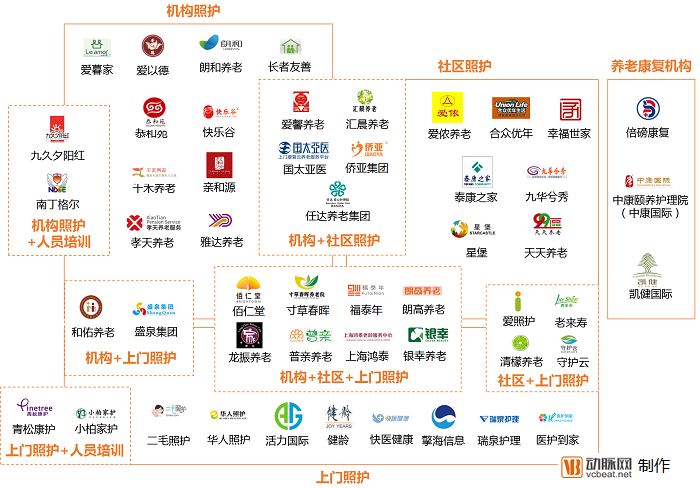
(Categorized by the core businesses of enterprises in the elderly care sector)
Case Studies of U.S. Elderly Care Companies
Zhao Xia, co-founder of Xiao Bai Jia Hu, has conducted an in-depth examination of elderly care services in the United States. She told VCBeat, “The supply side of elderly care in the U.S. differs significantly from that in China. In China, we only have one type of credential—the Occupational Qualification Certificate for Elderly Caregivers—whereas in the U.S., elderly care personnel are affiliated with the American Association for Homecare, and there is a large pool of specialized professionals in areas such as nursing, nutrition, and psychology, each requiring its own distinct certification.”
The United States has cultivated a diverse range of elderly care professionals from the source, providing a workforce foundation for its numerous home-based care, community care, and elderly rehabilitation institutions. Below, we present several case studies of U.S. elderly care enterprises.
1. Community Care: Brookdale Senior Living
Since its founding in 1978, Brookdale Senior Living has been a leader in community-based senior care. Its model centers on senior service communities that serve surrounding towns and neighborhoods, with more than 1,100 such senior service and retirement communities established across the United States. Services include assisted living, 24-hour care, dementia care, rehabilitation training, and specialized medical support. Brookdale has also launched in-home senior care services for older adults who have difficulty leaving their homes.
2. Geriatric Rehabilitation and Convalescent Care: Genesis HealthCare
Founded in 1985, Genesis HealthCare operated more than 500 skilled nursing facilities and senior living communities across the United States as of January 2017, making it the largest operator of skilled nursing facilities in the country. The company provides both short-term and long-term elderly care services, along with specialized offerings such as orthopedic rehabilitation, professional cardiopulmonary health management, and dialysis care.
3. In-Home Care: Home Instead
Founded in 1994, Home Instead has grown into the world’s largest non-medical senior care company, with over 1,000 independently operated offices worldwide. It provides in-home elderly care services, including companionship and daily living assistance, personal care, medical appointment accompaniment, and specialized disease care. The company officially entered the Chinese market in 2013, establishing its headquarters in Shenzhen to serve the elderly populations in Shenzhen and Wuhan.
For more information on the elderly care industry, please refer to“2016 Global Report on Asset-Light Venture Capital Trends in Elderly Care”For an in-depth analysis, scan the QR code below to become an official VCBeat member and gain access.Full Version of the "2016 Global Asset-Light Venture Capital and Investment Trends in Elderly Care Report", featuring more industry updates, investment and financing news, and case studies on asset-light elderly care services. Moreover, you will have full access to complete articles throughout the coming year.Industry Trends Report, timely grasp the latest globalInvestment and Financing Information, boasting a comprehensiveMedical Enterprise Database, and alsoMassive Resource Matching。

Scan the QR code to become a VCBeat member,
Beta Version Trial Price: RMB 365/year.