

How the 'Shao Yi Model' Integrates with Xinjiang's Remote Medical Collaboration Platform: Insights from Dr. Cai Xiujun, President of Sir Run Run Shaw Hospital
As healthcare reform enters its critical phase, comprehensive reforms of public hospitals in China have been fully rolled out. The practice of marking up drug prices has been completely phased out, pilot programs for the establishment of medical consortia have been launched across the board, and the development of modern hospital management systems has accelerated. Policy measures such as the gradual piloting and implementation of diversified, composite health insurance payment methods—primarily based on diagnosis-related group (DRG) payments—are also advancing. As a result, 2017 is destined to leave a significant mark in the history of the reform and development of public hospitals in China.
On June 10, the “4th High-Level Forum on the Development of Large Public Hospitals and the Healthy China Hangzhou Summit,” hosted by Health News and organized by Sir Run Run Shaw Hospital, Zhejiang University School of Medicine, was held at the Hangzhou International Expo Center.
Themed “Building a Healthy China: Major Hospitals Making Significant Contributions,” the forum brought together more than 1,500 participants—including government leaders, principal officials from national health administrative departments, academicians of the Chinese Academy of Sciences and the Chinese Academy of Engineering, and hundreds of administrators, scholars, and experts from large hospitals both in China and abroad—to gather by the West Lake. They engaged in in-depth discussions on “Healthy China,” focusing on topics such as the Sir Run Run Shaw Hospital model, comprehensive reform of public hospitals, development of medical consortia, modern hospital management, pharmaceutical supply and assurance systems, tiered diagnosis and treatment, and hospital culture and humanistic care, offering insights and recommendations on the roles and contributions that large public hospitals should make in advancing the Healthy China initiative.
Seizing this opportunity, Professor Cai Xiujun, President of Sir Run Run Shaw Hospital, provided an external interpretation of the “Sir Run Run Shaw Model” and discussed how to integrate with Xinjiang’s telemedicine collaboration platform.
Sir Run Run Shaw Hospital is a comprehensive public hospital funded by the renowned Hong Kong industrialist Mr. Run Run Shaw, supported by the People’s Government of Zhejiang Province, and managed in collaboration with Loma Linda University Medical Center in the United States.
Since its establishment in 1994, Sir Run Run Shaw Hospital, Zhejiang University School of Medicine, has drawn on U.S. hospital management models while adapting to China’s national conditions. With an international perspective and numerous innovations, it has developed the distinctive “Shaw Medical Model,” which has attracted widespread attention in the healthcare industry and serves as a highly practical and directly applicable benchmark for the comprehensive advancement of public hospital reform.
Cai Xiujun told reporters, “The ‘Sir Run Run Shaw Hospital Model’ encompasses multiple dimensions, including an innovative modern hospital management model, a high-quality patient experience, superior medical quality and safety, an advanced smart healthcare platform, and a hospital culture that is patient-centered and staff-oriented.”
Public hospital reform imposes higher requirements on large public hospitals in areas such as hospital management systems, operational mechanisms, informatization, smart healthcare development, personnel and compensation systems, and collaborative development among medical institutions. In the comprehensive advancement of public hospital reform, Sir Run Run Shaw Hospital has taken a leading position in multiple aspects.
Especially in establishing modern hospital management models and innovative medical operational mechanisms, Sir Run Run Shaw Hospital stands out in the industry due to its unique founding background and the seamless integration of Chinese and Western cultures. Over 23 years of development, it has forged a distinctive path shaped by this cultural fusion. Its representative and domestically pioneering management practices—such as “no intravenous infusions in outpatient clinics,” “no additional beds hospital-wide,” “one patient per consultation room,” and “pain-free hospital”—have not only continuously enhanced patients’ healthcare experience but also attracted widespread emulation by peers across China.
According to Cai Xiujun, in 2016, the average length of stay at Sir Run Run Shaw Hospital was 6.77 days, with the proportion of drug costs at 29.5%, consistently maintaining the lowest levels among hospitals in China. The hospital achieved the targets of the “13th Five-Year Plan” five years ahead of schedule, with figures far below the benchmark data for the National Health and Family Planning Commission’s Top 100 Hospitals.
Meanwhile, the hospital promotes a management philosophy centered on patients and driven by employees, advocating that “senior leadership serves middle management, middle management serves frontline staff, and frontline staff serve patients.” Guided by this philosophy, Sir Run Run Shaw Hospital has been consecutively recognized as the Best Employer in Zhejiang Province’s healthcare industry. It has also innovatively introduced management models such as the “President’s Mailbox” and the “Trinity” recruitment and interview system.
Furthermore, Sir Run Run Shaw Hospital has actively and thoroughly implemented the “Double Sinking, Two Improvements” initiative, establishing assistance partnerships with 25 hospitals in Zhejiang, Jiangsu, Xinjiang, and other regions. Through this approach, the “Sir Run Run Shaw Model” has been integrated into many local hospitals.
So, is the Shao Yi Model replicable?
“Certainly. The Xiasha Campus of Sir Run Run Shaw Hospital, which opened in August 2013, was able to achieve rapid and healthy growth and development from the outset by leveraging the advanced management concepts, high-quality medical resources, and comprehensive integrated management strategy of the hospital’s main campus,” Cai Xiujun told reporters.
In fact, at the very inception of the hospital, Cai Xiujun proposed that “the development of the Xiasha Campus has aggregated numerous resources and represents a further advancement built upon the foundation of Sir Run Run Shaw Hospital. It should not only draw on the strengths of the Qingchun Campus but also cultivate its own distinctive features, adapting to local conditions to achieve differentiated development with unique characteristics.”
By the end of 2016, six major clinical centers—the Brain Center, Endoscopy Center, Oncology Center, Rehabilitation Medicine Center, Hemodialysis Center, and Health Promotion Center—had been fully established, completing the construction of a multidisciplinary, center-based diagnosis and treatment platform. By the end of this year, all 1,200 beds will be fully operational. Since its opening, the Xiasha Campus has comprehensively implemented the core standards of Joint Commission International (JCI). In 2016, it passed the JCI accreditation together with the Qingchun Campus, becoming the first public hospital in Hangzhou to achieve JCI accreditation and setting a record for the shortest time from hospital opening to accreditation approval in JCI history.
As can be seen, Xiasha has successfully replicated the “Sir Run Run Shaw Hospital Model” by leveraging seven key strategies: a consistent corporate governance structure inherited from Sir Run Run Shaw Hospital, the extension of management systems, integration of core JCI standards, delivery of homogeneous medical services, adherence to the value proposition of “patient-centered care with employees as the mainstay,” an open and win-win mindset for exchange, and a healthy, positive organizational culture.
According to Cai Xiujun, the achievements generated by replicating the “SAHZU Model” have shortened the development and construction cycle of Xiasha Hospital, enabling it to complete its five-year planned tasks within three years. This has realized multi-party win-win outcomes, demonstrated the fruits of municipal-university collaboration, become a prestigious calling card for investment promotion in the Development Zone, facilitated leapfrog development at Sir Run Run Shaw Hospital (SAHZU), and alleviated the difficulties faced by residents in eastern Hangzhou in accessing medical care.
“The Perfect Replication of the ‘Sir Run Run Shaw Hospital Model’ at the Xiasha Campus”
Not only has the “Sir Run Run Shaw Hospital Model” been widely praised, but Sir Run Run Shaw Hospital has also been committed to building a “Hospital of the Future,” implementing numerous initiatives in smart healthcare. In particular, it established China’s first mobile smart healthcare service platform centered on tiered diagnosis and treatment—the Sir Run Run Shaw (Nali) Health Cloud Platform.
The platform has currently connected with over 1,480 medical and health institutions in China, featuring more than 60,000 active physicians and achieving a monthly service volume exceeding 200,000 consultations. Among these, there are over 8,000 active physicians in Zhejiang Province, covering 182 medical institutions across 72 districts, counties, and county-level cities in all 10 prefecture-level cities of the province.
In the process of decentralizing high-quality medical resources, Sir Run Run Shaw Hospital has fully leveraged the advantages of its SRSH Health Cloud Platform to connect with all supported hospitals. By granting access to premium medical resources such as remote consultation and teaching systems, the hospital provides homogeneous medical services and educational opportunities. It has established a three-tier collaborative mechanism involving provincial hospitals, county hospitals, and township health centers, thereby providing strong support for the orderly development of tiered diagnosis and treatment.
Cai Xiujun pointed out that while the “Sir Run Run Shaw Hospital Model” encompasses rich connotations, its core essence is innovation. Moving forward, Sir Run Run Shaw Hospital will continue to uphold innovation, implement the decisions and deployments of the CPC Central Committee and the State Council, focus on addressing public challenges in accessing medical care, and take equity, accessibility, and public benefit as the starting point and ultimate foundation for the hospital’s development.
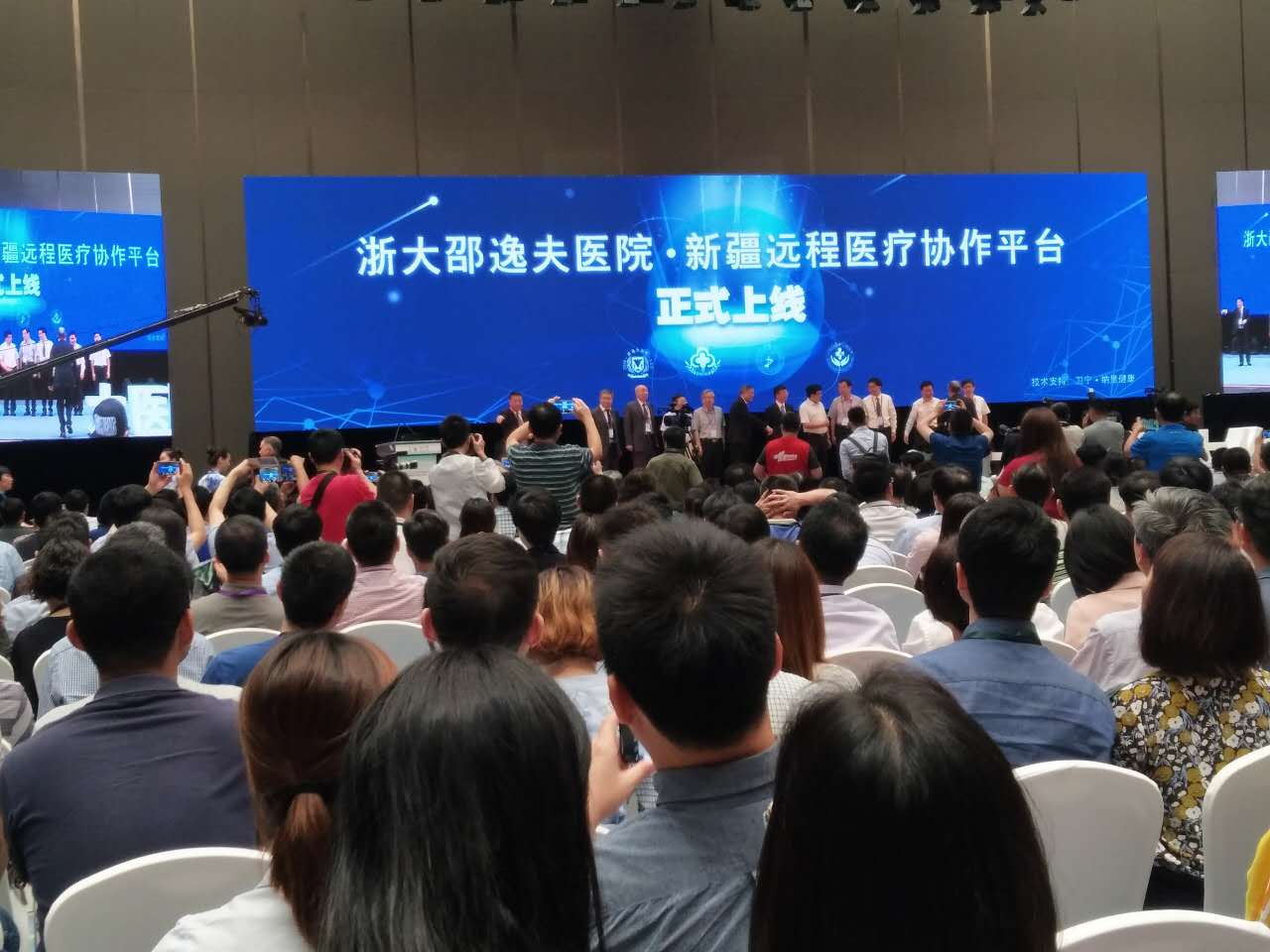
To support the development of medical service centers in core regions, Sir Run Run Shaw Hospital, Zhejiang University School of Medicine, has actively implemented the strategic plans and decisions of the Zhejiang Provincial Party Committee and Provincial Government regarding paired assistance to Xinjiang. In collaboration with multiple regional medical centers—including the First Division Hospital of the Xinjiang Production and Construction Corps, the First People's Hospital of Kashgar Prefecture, and the Second People's Hospital of Aksu Prefecture—the hospital leverages the “Sir Run Run Shaw Health Cloud Platform” to jointly create a new model of Internet-based Belt and Road telemedicine collaboration.
According to Cai Xiujun, the Sir Run Run Shaw Hospital Xinjiang Telemedicine Collaboration Platform is an extension and development of the Sir Run Run Shaw Health Cloud Platform. By deploying the “Sir Run Run Shaw Health Cloud Platform” in southern Xinjiang, this initiative has broken through the traditional telemedicine model constrained by “fixed times and fixed locations,” achieving internet-based and mobile-enabled telemedicine collaboration. This has made the alignment of medical resources between Zhejiang and Xinjiang more convenient and efficient, facilitated the collaborative sharing of medical resources in southern Xinjiang, and promoted the establishment of a regional tiered diagnosis and treatment system.
Currently, the platform supports business functions such as remote joint outpatient clinics, multimodal remote consultations, remote mobile ward rounds, remote imaging diagnosis, internet-based remote teaching, and mobile technical guidance.
In the future, the platform will continuously deepen its service capabilities, innovate mechanisms for international medical service cooperation, and expand its international medical services, with the aim of actively building a comprehensive and open “Silk Road Cross-Border Medical Service Platform” to fully support the Belt and Road Initiative.