

AI-Powered Drug Discovery: 14 Overseas Startups Raise $276M, Only One Chinese Company in the Race
“It’s difficult to develop a story on ‘AI + New Drug Discovery.’ While there are indeed some companies in this space abroad, there seem to be no such enterprises in China. Without conducting interviews, relying solely on overseas information gathering would result in superficial content.” This was part of the debate among colleagues during an editorial planning meeting at VCBeat (WeChat ID: vcbeat) regarding the field of AI-driven new drug discovery.
This is indeed the case. According to VCBeat’s database, there are only 14 overseas startups focused on AI-driven new drug discovery (specifically referring to preclinical candidate drug discovery). Although Watson for Drug Discovery also conducts research in this field, it is not classified as a startup.
We found that all 14 startups secured financing, raising a total of $276.82 million, with UK-based BenevolentAI alone accounting for $100 million. The company has one drug candidate scheduled to enter Phase IIb clinical trials in mid-2017, and it sold two other investigational drug candidates to a U.S. pharmaceutical company for $800 million.。
Overseas companies are thriving in this space, yet few domestic startups have ventured into it. In our quest to identify entrepreneurial teams in this field, we consistently asked experts in other areas of artificial intelligence the same final question during interviews: “Do you know of any Chinese companies working on AI-driven drug discovery?” After extensive searches and thanks to an introduction from Mr. Zhang Hua at Lianxin Medical, we connected with XtalPi. It has become the only company in the VCBeat database that leverages AI for new drug development in China. (If you are also a startup in this field, please feel free to contact VCBeat.)
Industry insiders often note that China ranks first globally in the number of artificial intelligence (AI) research papers published, comparable to Europe and the United States. It is undeniable that in the medical field, China’s research in radiological imaging, pathology, natural language processing, and intelligent voice entry is on par with that of Europe and the United States. However, in the application of AI to new drug development, a significant gap remains, with China lagging far behind its Western counterparts.
Where do we stand in comparison? What are the challenges facing China in leveraging AI for new drug discovery? How are Europe and the United States conducting research in this field and commercializing their findings? VCBeat has reviewed the current state of the industry both domestically and internationally to seek answers to these questions.
A Review of AI-Driven New Drug Discovery Companies in China and Abroad
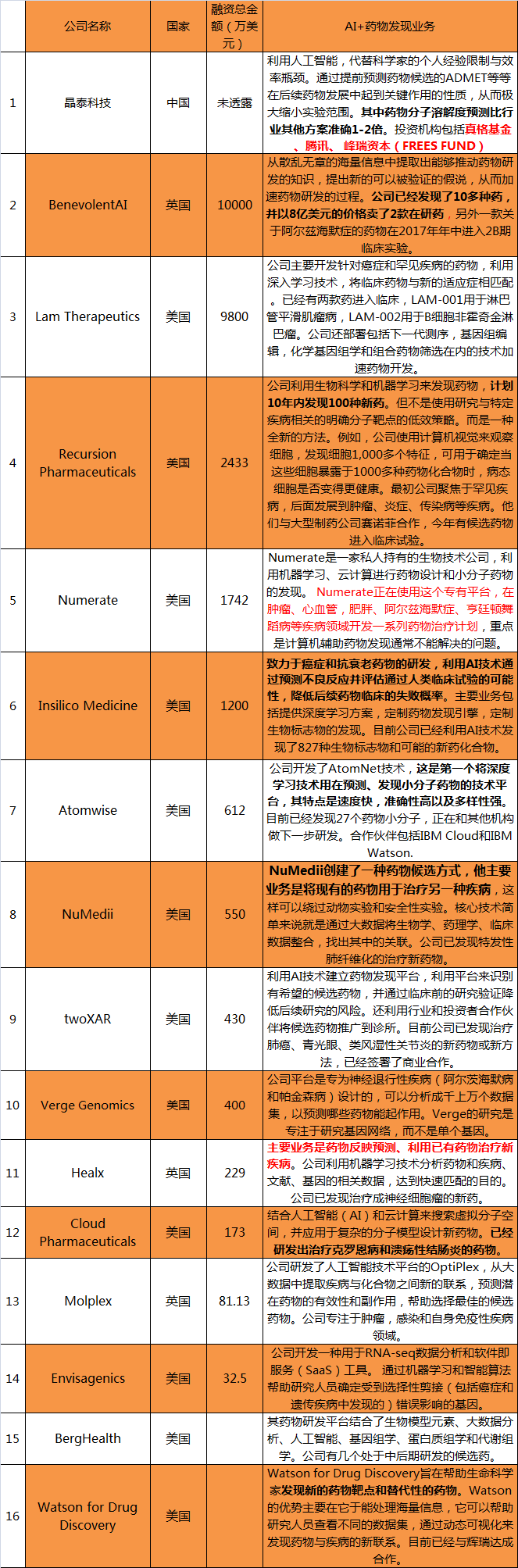
As shown in the table, the United States holds an absolute leading position in this field, with a total of 12 companies. The United Kingdom follows with three companies, including BenevolentAI, which has secured the highest funding. Currently, only one Chinese company, XtalPi, has been identified as operating in this sector.
In this review, VCBeat only compiled a list of preclinical new drug discovery companies and did not include enterprises that leverage AI to serve pharmaceutical companies during the clinical trial phase.
Processes and Challenges in New Drug Discovery
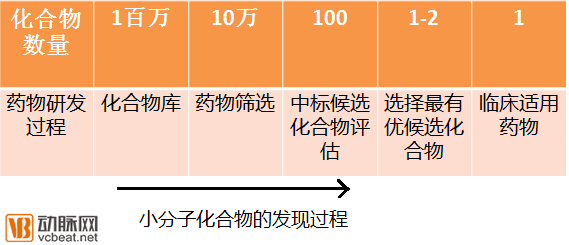
The first step in traditional small-molecule drug development is typically high-throughput screening, a method widely adopted by the pharmaceutical industry. These assays generally evaluate the activity of tens of thousands of compounds against a specific target. Once candidate compounds are identified, they proceed to further evaluation (e.g., cellular bioactivity), followed by optimization of properties such as pharmacokinetics and bioavailability (e.g., through medicinal chemistry experiments).
Given the large number of tests required to evaluate compounds, each stage advancement in drug research and development (R&D) and production costs between $2 million and $4 million. For biologics, due to their greater complexity, the R&D process is even more challenging, with costs per stage reaching $5 million to $10 million.
The scope of potential targets and off-targets typically requires screening from tens of thousands of compounds. Using traditional high-throughput screening methods, accurate assessment is difficult without sufficient funding. Furthermore, high-throughput screening methods inherently suffer from design flaws that can lead to invalid experimental screening results. These issues are even more pronounced for biologics, which have more complex structures and less well-understood design principles.
“The Father of Viagra,” Ferid Murad, recounted the drug’s development process at a symposium, stating, “This medication was originally developed for cardiovascular diseases, but male participants exhibited unexpected physiological responses when exposed to attractive female nurses, leading researchers to pivot toward studying erectile dysfunction.” This anecdote underscores the frustrations faced by new drug developers: despite their considerable efforts, outcomes often fall short of expectations, highlighting the substantial role of serendipity in drug discovery.
Challenges in New Drug Discovery in China
In addition to the aforementioned challenges, new drug R&D companies in China must also contend with difficulties unique to the Chinese market. Dr. Lai Lipeng, Co-founder of XtalPi and Head of the Beijing Big Data and AI R&D Center, told VCBeat that China faces significant hurdles in talent, data, and business models in the field of AI-driven drug discovery.
TalentThe application of AI in drug R&D requires the joint participation of experts from several vertical domains to achieve breakthroughs. This necessitates not only physicists, chemists, pharmacologists, and R&D executives from pharmaceutical companies, but also interdisciplinary talents such as AI scientists and cloud computing engineers. By leveraging accumulated expertise and experience across multiple fields, the entire team must collaborate closely to facilitate breakthrough ideas and deliver high-quality outcomes.
High-Quality DataAI-driven drug discovery requires high-quality data support. As China’s innovative drug R&D started later than that of other countries, there remains a gap in the accumulation of high-quality data compared to international counterparts.
Business Model, there are few benchmark cases of successful biotechnology ventures in China. Meanwhile, the drug development industry is inherently complex and unpredictable compared to sectors such as healthcare and finance. This explains why, despite the widespread enthusiasm for artificial intelligence (AI), AI-driven drug discovery remains a path less traveled.
How to Leverage AI to Address Challenges in New Drug Discovery
Rapidly Discover New Drugs from Massive Amounts of Information
In an era of rapid advancement in scientific research, a life sciences paper is published every 30 seconds. In addition, vast amounts of information, including numerous patents and clinical trial results, are disseminated worldwide. Only a small fraction of this scientific information can be translated into useful new knowledge.
For drug R&D professionals, there is neither the time nor the energy to keep abreast of all emerging information. Yet this information encompasses research findings from the majority of scientists worldwide and a wealth of data on new drugs. Identifying subtle clues for novel therapeutics within these data streams represents a shortcut in drug discovery.
Artificial intelligence technologies can extract knowledge that drives drug discovery from these vast, unstructured datasets and generate novel, testable hypotheses, thereby accelerating the drug development process.
Another scenario involves leveraging proprietary deep learning algorithms to identify novel small-molecule drugs from hundreds of thousands of potential compounds.
Representative company: BenevolentAI
Drug Repurposing
Leveraging deep learning techniques to match clinical drugs with new indications, thereby bypassing animal testing and safety trials.
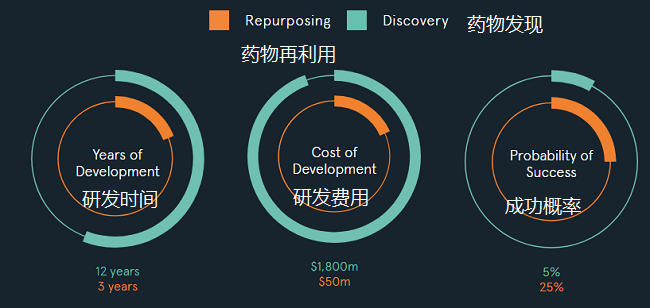
For example, thalidomide was primarily used as a sedative in the 1950s. In 1998, it was approved in the United States for the treatment of leprosy. Researchers subsequently proposed its use for multiple myeloma. Because the drug had already been tested for leprosy treatment, researchers were able to bypass Phase I safety and dosing trials. Based on the experimental results, the FDA approved thalidomide for the treatment of multiple myeloma in 2012. According to Bloomberg’s estimates, this process cost a total of $40 million to $80 million, whereas the average cost of developing a drug from scratch is $2 billion.
Representative companies: Lam Therapeutics, NuMedii, Healx, Insilico Medicine
Beyond accelerating development timelines and reducing costs, the advantages of leveraging artificial intelligence (AI) for new drug development also include lowering the probability of failure in subsequent clinical trials. Supported by cloud computing and specialized supercomputers, AI can overcome the limitations of scientists’ individual experience and efficiency bottlenecks. By predicting in advance the ADMET (absorption, distribution, metabolism, excretion, and toxicity) properties—which play a critical role in later stages of drug development—AI can significantly narrow the scope of experiments, predict adverse reactions to compounds, and assess the likelihood of success in human clinical trials, thereby reducing the risk of failure in subsequent clinical development.
Data source: Healx
Diseases of Primary Focus for Overseas Novel Drug Discovery Companies
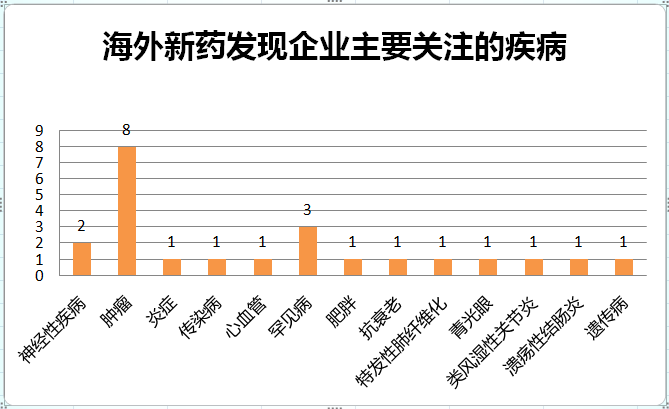
We were quite surprised when compiling this table. We had assumed that, given the large market size and strong demand for oncology drugs, all companies would be involved in their development. However, only eight companies (50%) were engaged in this area. Neurological diseases primarily referred to Alzheimer’s disease and Parkinson’s disease. Rare diseases included Huntington’s disease (an autosomal dominant hereditary disorder characterized clinically by apathy, irritability or depression, speech impairments, stubbornness, involuntary choreiform movements, and declines in judgment, memory, and cognitive function) and lymphangioleiomyomatosis, among others. Overall, these companies were involved in the R&D of drugs for more than 15 diseases. While this number may not seem large, it is nonetheless surprising for an emerging industry.
Business Model Exploration
VCBeat shares three business model explorations here. The first was obtained through an interview with Dr. Lai Lipeng, Co-founder of XtalPi and Head of the Beijing Big Data and Artificial Intelligence R&D Center. The latter two were compiled by VCBeat from research conducted by Nest.vc.
1. Openness and Feedback Approach
XtalPi clearly defined its initial core customer base from the outset, establishing a model with R&D conducted in China and business expansion targeted internationally. While effectively controlling R&D costs, the company actively sought international partners during its early stages. Currently, XtalPi has earned the trust of top-tier global pharmaceutical companies and established long-term collaborations with them.
In addition to expanding its international business, Li Lipeng believes that, given the complexity of the drug development process, the large-scale application of machine learning in drug R&D depends on the joint efforts of the entire industry chain. Therefore, from a commercial perspective, XtalPi will champion an open and feedback-driven approach, leveraging its strength in providing state-of-the-art computational hardware and software tools to traditional R&D personnel, thereby helping them complete scientific research tasks more efficiently and rapidly.
2. Outsourced Validation by the Virtual Screening Team
There are two primary models for outsourcing virtual screening teams: (1) collaboration with stakeholders; and (2) collaboration with non-stakeholders.
Bringing in stakeholders, such as a larger pharmaceutical company, would yield significant benefits for the company, including aligned incentives, integration with existing clinical pipelines, and access to specialized expertise from teams dedicated to specific diseases. Although the company would need to relinquish some degree of control or ownership, this approach would help improve the success rate of project R&D.
Another approach involves collaborating with non-stakeholders, such as Contract Research Organizations (CROs). Under this model, the company retains full intellectual property rights and achieves rapid execution, albeit at a higher cost. However, there is a potential loss of control over experimental design; therefore, special attention must be paid to ensuring high-quality results.
The advantages of this model are its low cost and rapid execution, offering significant opportunities for industrial partners in the late-stage validation of new compounds and clinical development. It is crucial that these partners fully understand the rationale and design behind the validation experiments, as they play a pivotal role in subsequent clinical development.
Company Examples: Nimbus Therapeutics, TwoXAR, Atomwise
3. Effective collaboration between independent drug R&D teams and virtual screening teams
In this model, the company’s team focuses on computer-aided virtual screening, while other teams provide support for experimental drug development. Close collaboration with teams that typically specialize in specific ligand/receptor interactions, biological phenomena, or disease areas endows the project R&D team with unique expertise.
Although the level of coordination is not as strong as that of a fully integrated team, this model offers the advantages of flexibility in operational structure and selectivity in choosing collaborators. Virtual screening teams with broad application platforms may consider adopting this structure to manage numerous R&D projects while minimizing capital costs.
Company Examples: TwoXAR, Atomwise, Cloud Pharmaceuticals