

Large Public Hospitals Navigate Post-Drug-Markup Era Amid China's Healthcare Reform
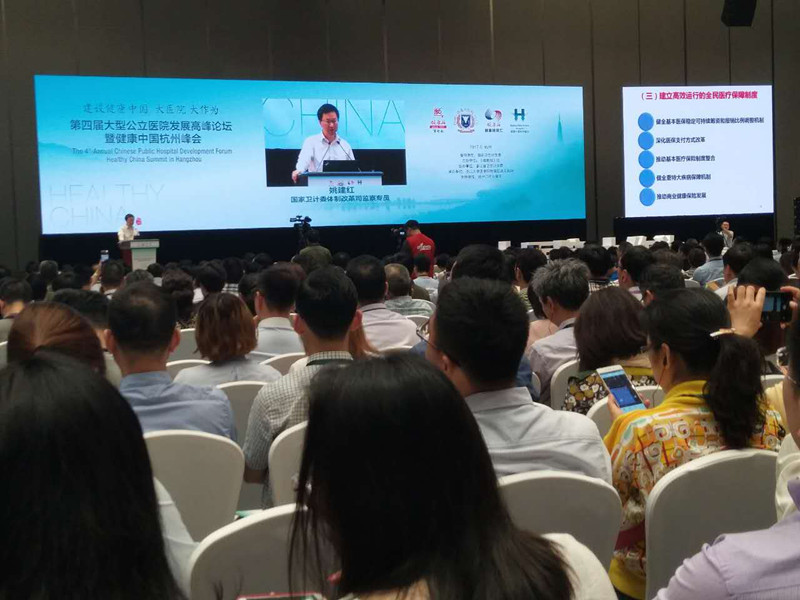
On June 10, the “4th High-Level Forum on the Development of Large Public Hospitals and the Healthy China Hangzhou Summit,” hosted by Health News and organized by Sir Run Run Shaw Hospital, Zhejiang University School of Medicine, was held at the Hangzhou International Expo Center.
Centered on the theme “Building a Healthy China: Major Hospitals Play a Significant Role,” the forum brought together more than 1,500 participants—including government leaders, heads of national health administrative departments, academicians from the Chinese Academy of Sciences and the Chinese Academy of Engineering, as well as hundreds of administrators, experts, and scholars from large hospitals both in China and abroad—to gather by the West Lake.
The opening ceremony was hosted by Zhou Bing, Editor-in-Chief of Health News. Deng Haihua, President of Health News; Ma Weihang, Deputy Director of the Zhejiang Provincial Health and Family Planning Commission; Mao Qunan, Director of the Publicity Department of the National Health and Family Planning Commission; and Zou Xiaodong, Party Secretary of Zhejiang University, delivered opening addresses.
In-depth discussions were held on topics such as the Sir Run Run Shaw Hospital Model, comprehensive reform of public hospitals, development of medical consortia, modern hospital management, drug supply and assurance systems, tiered diagnosis and treatment, and hospital culture and humanistic care. Recommendations were provided on the roles and contributions that large public hospitals should assume in advancing the Healthy China initiative.
Zhang Zongjiu, Director of the Bureau of Medical Administration and Hospital Management under the National Health and Family Planning Commission (NHFPC), along with other NHFPC leaders, delivered insightful speeches on the current progress, key priorities, challenges, and opportunities in the reform of public hospitals.
Zhang Zongjiu emphasized the importance of advancing the construction of a modern hospital management system in deepening the reform of public hospitals. He stated that it is essential to establish a management and governance framework in which decision-making, execution, and supervision are coordinated, provide checks and balances, and mutually reinforce one another. By separating regulation from operation and administration from service delivery, we should promote the modernization of the governance system and governance capacity of public hospitals, and establish internal management and external governance mechanisms characterized by clear rights and responsibilities, scientific management, sound governance, efficient operations, and robust oversight.
Meanwhile, Professor Leung Chi-yin, an Academician of the Chinese Academy of Sciences and Chairman of the Hospital Authority of Hong Kong, shared Hong Kong’s experience in public hospital management.
Academician of the Chinese Academy of Engineering, Ba Denian, believes that building a Healthy China and deepening the reform of public hospitals not only impose higher requirements on large public hospitals but also grant them better development opportunities. Large hospitals should unhesitatingly assume the key responsibilities and missions therein.
According to Cai Xiujun, President of Sir Run Run Shaw Hospital, the “Sir Run Run Shaw Model” encompasses multiple dimensions, including an innovative modern hospital management model, a high-quality patient experience, superior medical quality and safety, an advanced smart healthcare platform, and a hospital culture that is patient-centered and staff-oriented.
Public hospital reform imposes higher requirements on large public hospitals in areas such as hospital management systems, operational mechanisms, informatization, smart healthcare development, personnel and compensation systems, and collaborative development among medical institutions. In fact, Sir Run Run Shaw Hospital has been at the forefront in many of these aspects during the comprehensive advancement of public hospital reform.
To support the development of medical service centers in core regions, Sir Run Run Shaw Hospital, Zhejiang University School of Medicine, has actively implemented the strategic deployments and decisions of the Zhejiang Provincial Committee and Provincial Government regarding paired assistance to Xinjiang. In collaboration with multiple regional medical centers—including the First Division Hospital of the Xinjiang Production and Construction Corps, the First People’s Hospital of Kashgar Prefecture, and the Second People’s Hospital of Aksu Prefecture—the hospital leverages the “Sir Run Run Shaw Health Cloud Platform” to jointly create a new model of Internet-based Belt and Road telemedicine collaboration.
Currently, the platform supports business functions such as remote joint outpatient consultations, multimodal remote case discussions, remote mobile ward rounds, remote imaging diagnosis, internet-based remote teaching, and mobile technical guidance. In the future, the platform will continue to deepen its service capabilities, innovate mechanisms for international medical service cooperation, expand international medical services, and actively build a comprehensive and open “Silk Road Cross-Border Medical Service Platform” to fully support the “Belt and Road” initiative.
Furthermore, in the view of Wu Jinmin, the first Chinese president of Sir Run Run Shaw Hospital, large hospitals also need to embrace the “clash and integration of Chinese and Western hospital cultures.”
As he recalled, during the first five years since its establishment, Sir Run Run Shaw Hospital was comprehensively managed by medical experts and management teams from Loma Linda University in the United States. Advanced Western management concepts were introduced to China for the first time, including corporate governance structures, hospital-wide appointment systems, board of directors and committee systems, the first Attending Physician Responsibility System in China, and a holistic care philosophy aligned with international standards. Through the adaptation and integration between Chinese and American management teams, the hospital sought a unique development path under the fusion of Chinese and Western cultures, paving the way for the initial alignment, localization, and robust growth of a model that bridges “China’s traditional hospital management model” with “the Western modern hospital management model.”
Wu Jinmin, the first Chinese president of Sir Run Run Shaw Hospital, believes that a major difference between Chinese and Western hospital management lies in hospital culture. Benefiting from the unique advantages of the Sino-US joint establishment, Sir Run Run Shaw Hospital has developed its own characteristics and experience in building hospital culture.
Meanwhile, drawing from the hospital’s development since its establishment, he derived two key insights: First, Sir Run Run Shaw Hospital’s success is founded on its approach of integrating the strengths of both Eastern and Western cultures at the nexus of their cultural clashes, seeking balance through mutually beneficial and complementary relationships. In this process, the determination of the hospital’s leadership was crucial.
Second, cultural conflict and integration represent two dialectically unified and contradictory aspects in the process of cultural development. They are both opposed and unified, serving as the source and direct driving force for the continuous development and progress of human culture.