

Langsheng Tech Files IPO Prospectus Following CFDA Approval and $4.3M Series A Funding from Anlong Fund, Achieves Over 1,000 Unit Sales of Pocket-Sized Smart Ultrasound Devices
Smart Handheld Ultrasound—An ultrasound device the size of a mobile phone, capable of performing examinations that typically require large hospital-based B-mode ultrasound systems. Since the 1980s, the United States has pioneered the development of handheld ultrasound devices for battlefield medical care. These rechargeable ultrasound diagnostic instruments, equipped with satellite-enabled remote image transmission, played a significant role in the U.S. military’s Operation Desert Storm. Subsequently, this technology transitioned from military to civilian applications.
GE’s first-generation handheld ultrasound device, the VSCAN 1.0, was launched in the United States in 2008, creating a sensation. It was named one of “The 50 Best Inventions of 2009” by U.S. Time magazine and one of “The 100 Best Technological Achievements of 2010” by the renowned popular science magazine Popular Science.
Since the introduction of handheld ultrasound concepts and products into China, the relevant market has been dominated by large foreign medical device manufacturers such as GE, Siemens, and Philips. This situation persisted until 2016, when the first domestically produced handheld ultrasound device was launched by the Chinese manufacturer Langsheng Technology Co., Ltd.To explore the development journey of domestically produced handheld ultrasound devices and their unique features,VCBeat (WeChat ID: vcbeat) reporters conducted exclusive interviews with Wu Zhe and Gong Ren, founders of Langsheng Technology (Suzhou) Co., Ltd.。
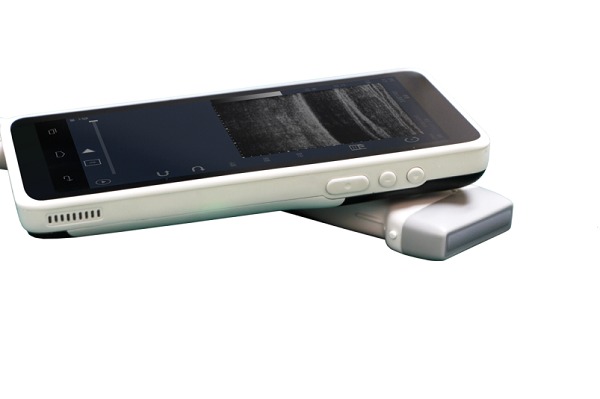
Handheld Ultrasound Devices Are as Small as Mobile Phones
“Our smart handheld ultrasound product obtained medical device registration certification from Sichuan Province in August 2016. In December 2016, the company completed its RMB 30 million Series A financing round invested by Anlong Fund. Since entering the market, we have established partnerships across 25 provinces, municipalities, and autonomous regions in China, with cumulative sales exceeding one thousand units..” Wu Zhe and Gong Ren from Langsheng Technology happily shared their current achievements during an interview with VCBeat.
Dr. Wu Zhe, a world-class expert in ultrasound imaging who earned his Ph.D. while studying in the United States, founded Langsheng Technology with the initial aim of “slimming down” large-scale ultrasound equipment. This initiative seeks to enable primary-care physicians to carry ultrasound devices more conveniently, address the need for ultrasound examinations in remote areas, and meet the daily convenience requirements of doctors at major hospitals when using ultrasound equipment.
Wu Zhe stated during his introduction of the R&D process, “The smaller the device, the greater the technical challenges involved. Many underlying technical logics in areas such as image processing, acoustics, automation principles, and automated software control had to be redesigned from scratch.” After overturning dozens of design iterations and collecting data from thousands of experiments, Wu Zhe and his team underwent more than two years of trial and error, ultimately overcoming these hurdles to develop this ultrasound device.
Handheld ultrasound devices feature numerous innovations. Wu Zhe cited the example of full-touchscreen operation, which simplifies the use of ultrasound equipment. In traditional methods, performing a medical scan requires physicians to press buttons approximately 300 times, whereas with their micro-imaging system, this number is reduced to only about 10.
Additionally, Wu Zhe and his teamTo meet the requirements for simplicity and speed, in addition to considering how to miniaturize the device, we also consider how to increase its response speed. Currently,Handheld ultrasound devices require only 5 seconds from power-on to scanning, whereas traditional hospital ultrasound equipment takes 3–5 minutes.. Moreover, as the ultrasound micro-imaging system is designed to leap directly from “PC-level” to “smartphone-level,” it not only meets physicians’ portability needs but also features mobile connectivity capabilities for real-time data transmission.
Currently, Langsheng Technology has not only developed an ultrasound micro-imaging system but also completed the construction of a cloud-based platform for synchronized image data collaboration. By integrating an intelligent operating system with specialized app development, backend big data will enable AI-driven services for specific medical conditions.
In the field of artificial intelligence, they have achieved initial success in AI-assisted diagnosis of thyroid ultrasound. In the future, they aim to leverage cloud platforms to assist primary care physicians in making diagnoses. Once this AI-assisted diagnostic technology matures, it will significantly boost product sales at the primary care level and enhance the quality of healthcare services in grassroots medical institutions.
Three Factors Attracting Anlong Fund
Wu Yuepeng, Investment Director of Anlong FundVCBeat was told that the initial decision to invest in Langsheng Technology was primarily driven by three considerations.
First and foremost, it is certainlyTeamAmong the key factors, Langsheng Technology’s co-founder Wu Zhe holds a Ph.D. in Ultrasound and Imaging from the University of Rochester in the United States and has dedicated 13 years to research in the field of ultrasound imaging. The other co-founder, Gong Ren, majored in Electrical Engineering at the Georgia Institute of Technology in the United States and brings extensive experience in handheld device computing. Their partnership represents a strong complementarity of expertise.
The second reason isMarket DemandConventional medical ultrasound imaging equipment, weighing hundreds of kilograms, is a “bulky unit” that is difficult to maneuver and inconvenient to carry. For primary healthcare institutions, moving the equipment becomes a major challenge when providing services in rural areas or communities. In addition to the practical demand for handheld ultrasound devices at the primary care level, there is also significant demand across various departments in large hospitals, such as anesthesiology, pain management, urology, general surgery, gynecology, respiratory medicine, hematology, and oncology, where ultrasound equipment is required for most routine diagnostic procedures.
Consequently, hospital ultrasound departments are extremely busy and cannot fully meet the demands of various clinical departments. Moreover, given the high cost of ultrasound equipment, it is prohibitively expensive for each department to make independent purchases, and equipping every department with its own unit is impractical. In addition, large-scale ultrasound systems are complex to operate, and training personnel is a time-consuming process; even individuals with a master’s degree require extensive on-the-job training in hospitals before they can proficiently use the equipment. Therefore, an intelligent, handheld ultrasound device that meets clinical needs, is portable, and is reasonably priced is highly welcomed by hospitals.
Third is Langsheng Technology'sIntelligenceHandheld Ultrasound Device Receives Sichuan Provincial Medical Device Product Registration Certification, can be sold on the market.
In terms of market expansion, Wu Zhe stated that while large-scale ultrasound systems typically cost hundreds of thousands to over a million yuan, handheld ultrasound devices are priced at around 100,000 yuan, which has ultimately earned them market recognition. The company currently has partners across 25 provinces, municipalities, and autonomous regions in China. Since entering the market after obtaining medical device product registration certification from Sichuan Province, the handheld ultrasound devices have achieved sales of over 1,000 units in just over six months.
These devices are currently sold primarily to large hospitals, such as Grade 3A hospitals, while primary healthcare institutions account for only a small share. Wu Zhe stated that this is mainly because many physicians at primary healthcare institutions are unfamiliar with the use of ultrasound equipment, necessitating gradual training and market education. The company plans to focus its efforts in this area in the near future.