

WeDoctor Showcases Internet-Based Medical Consortium Model at 2017 Beijing International Telemedicine Summit
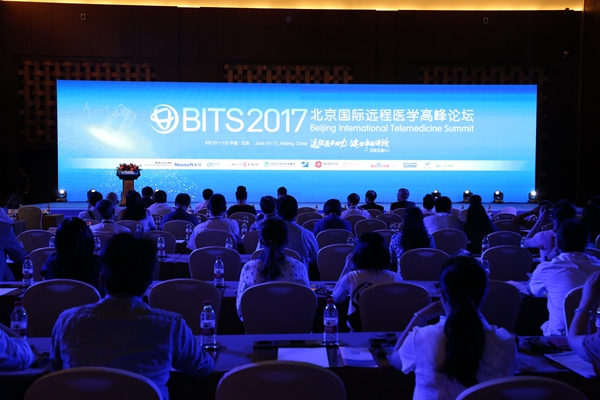
On June 10, the 2017 Beijing International Telemedicine Summit was held at the China National Convention Center in Beijing. Key officials from the National Health and Family Planning Commission, including Liang Wannian, Full-time Deputy Director of the State Council’s Office for Healthcare Reform, attended the main forum. The event drew more than 1,000 participants.
Han Qide, Vice Chairman of the National Committee of the Chinese People's Political Consultative Conference and Academician of the Chinese Academy of Sciences, pointed out in his address to the conference that telemedicine is a typical application of “Internet Plus” in the medical field. Through telemedicine, interconnectivity between higher-level and lower-level medical institutions can be achieved, facilitating the downward distribution of healthcare resources and accelerating the implementation of tiered diagnosis and treatment. At the main forum, the Internet-based Medical Consortium model presented by WeDoctor received affirmation and support from industry experts, becoming a highlight of this Telemedicine Summit Forum.
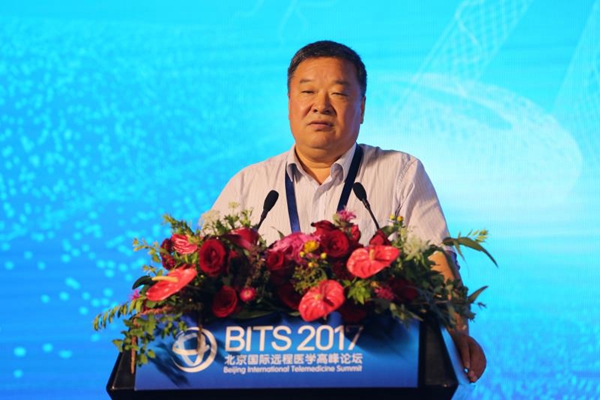
Liang Wannian, Full-time Deputy Director of the State Council’s Office for Healthcare Reform
In recent years, driven by both policy and technology, telemedicine in China has flourished, with continuously improving service capabilities and increasingly diverse application scenarios. It is advancing at full speed toward informatization, personalization, and intelligence, with multiple applications reaching world-leading levels. Telemedicine plays a significant role in promoting the establishment of a tiered diagnosis and treatment system and enhancing the quality of medical services. “When healthcare reform and development reach a certain stage, a major shortcoming becomes evident: the problem of information silos is extremely severe,” pointed out Deputy Director Liang Wannian at the forum. He emphasized that the construction of information platforms at all levels should be advanced, requiring interconnectivity among medical institution systems across various regions.
In 2017, China fully launched pilot programs for Medical Consortiums. As the most widely applied form of Medical Consortiums, how can we leverage the internet and telemedicine to advance their development? Under the traditional Medical Consortium model, how can telemedicine achieve large-scale adoption?
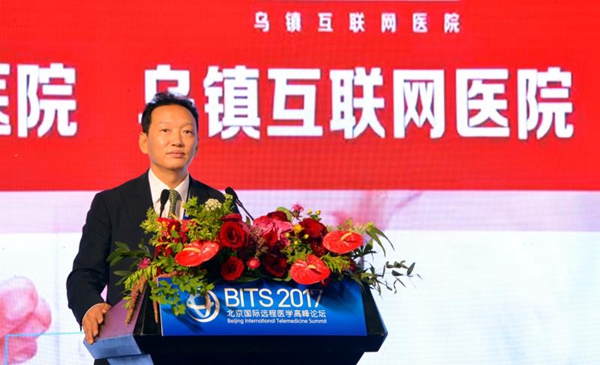
Zhang Qunhua, Dean of Wuzhen Internet Hospital
To this end, Zhang Qunhua, Dean of Wuzhen Internet Hospital, was specially invited to attend the main forum and deliver a keynote speech titled “Internet Medical Consortium: A New Model for the Healthcare Industry.” He introduced WeDoctor’s innovations in telemedicine and medical consortiums, highlighting how WeDoctor’s “Internet + Medical Consortium” model demonstrates robust interoperability capabilities and advanced telehealth technologies.
Since the launch of its Medical Consortium initiative in April 2016, WeDoctor has developed three core capabilities in systems, traffic, and operations. It has invested RMB 300 million to build a comprehensive Medical Consortium System comprising seven subsystems: remote diagnosis and treatment, remote consultation, remote referral, remote training, cloud-based electronic medical records, cloud-based laboratory and imaging services, and payment settlement. This ecosystem includes hardware and software systems refined through large-scale operations, referral channels connecting more than 700 major Grade A tertiary hospitals across China, and consultation resources from over 7,300 expert teams spanning 28 medical specialties.
Leveraging its technological and resource advantages, the Wuzhen Internet Hospital has been in operation for one and a half years, with daily consultation volumes exceeding 12,000, making it the largest telemedicine collaboration network in China.
“Telemedicine and internet technologies facilitate information flow among institutions within medical consortia, fostering tighter integration and supporting their healthy, sustainable development,” stated Zhang Qunhua. Micro Medical Group has established medical and operational teams led by hospital management experts from institutions such as Shanghai Huashan Hospital and Sir Run Run Shaw Hospital across 32 provinces and municipalities. By scaling its capabilities in systems, patient traffic, and operations, the company assists large public hospitals in establishing medical consortia, achieving “five integrations” within these networks: data, capabilities, services, payment, and supply chain.
In early 2017, WeDoctor established a 16,000-kilometer remote connection with the Great Wall Station in Antarctica. In his speech, Zhang Qunhua introduced that WeDoctor’s Medical Consortium telemedicine system has reached an internationally leading level. It not only facilitates data transmission across disparate information systems through flexible access technology but also enables smooth audio-video interaction over narrow bandwidths via self-developed video compression and transmission algorithms, significantly reducing the interconnection costs and operational burden of the medical consortium.
In addition to the telemedicine collaboration network represented by the Wuzhen Internet Hospital, WeDoctor’s Medical Consortium Platform has also assisted local governments in regions such as Bao’an District in Shenzhen and Guangshan County in Henan Province in establishing regional medical communities. To enhance collaboration among major hospitals, it has supported Huashan Hospital and Guangdong Provincial Hospital of Traditional Chinese Medicine in building internet-based medical consortia. Furthermore, leveraging disciplines as links and using the WeDoctor platform for technical and operational support, it has assisted the Huatuo Project of the China Association for Promotion of International Exchange of Medicine (CAPIEM) in establishing discipline-specific alliances, exemplified by the National ENT Specialty Medical Consortium, thereby successfully exploring four models of medical consortia.
Currently, WeDoctor has achieved a comprehensive industrial layout encompassing "medical care, pharmaceuticals, and insurance." Driven by its core AI capabilities, the company is sustainably and effectively facilitating the implementation of medical consortia and telemedicine. This promotes the further decentralization of high-quality medical resources, enhances primary healthcare institutions' capabilities in medical treatment, pharmaceutical services, and diagnostic testing, thereby better implementing tiered diagnosis and treatment and meeting the public's health needs.
It is reported that the conference was jointly organized by the Beijing Hospital Association and the German Telemedicine Association, among other entities. Centered on the theme “Interconnectivity 5+1,” the event featured six sub-forums covering topics such as tiered diagnosis and treatment and modern hospital management. An exhibition was also held to showcase new trends, concepts, technologies, methodologies, and products in telemedicine and the health services industry.