

Jianke Secures Internet Drug Transaction Service License A, Completing ABC Certification Trio Ahead of IPO
VCBeat (WeChat ID: vcbeat) reported on June 13 that Jianke, a pharmaceutical e-commerce company, recently announced that its wholly-owned subsidiary has officially obtained the license for online drug trading services.ASyndrome.
Certificate No.: GuoA20170008, the acquiring entity is GuangzhouXingyu Information Technology Co., Ltd.The scope of services covers a third-party transaction service platform, which means that Jianke has officially obtained the qualification to provide platform services for online drug transactions among pharmaceutical manufacturers, pharmaceutical distributors, and medical institutions.
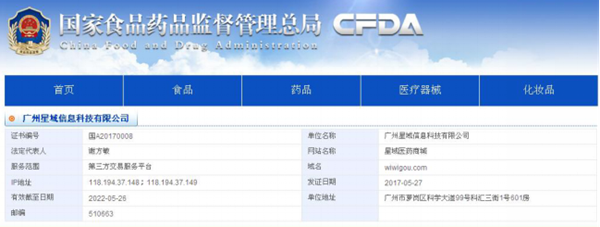
This marks another significant milestone in Jianke’s history, following its $50 million Series A+ financing round last month. With this achievement, Jianke now holds all three licenses—A, B, and C—for online drug transaction services, becoming one of the few pharmaceutical e-commerce companies in China to possess full licensure.
Xie Fangmin, CEO of Jianke, stated, “The acquisition of all three licenses marks a further refinement of Jianke’s strategic layout in the pharmaceutical e-commerce sector. This will provide a solid foundation for Jianke to build a closed-loop ecosystem of pharmaceutical and comprehensive health services, and offer strong support for establishing Jianke as the most trusted smart health service platform.”
Jianke Completes Pharmaceutical E-commerce Service Chain with Full Licensing
Founded in 2006, Jianke is a leader in China’s pharmaceutical e-commerce industry. Its B2C platform, Jianke.com, is currently one of the largest online pharmacies in the country. The recent approval of the Class A qualification for internet drug transaction services marks Jianke’s formal acquisition of all three licenses—Class A, B, and C—for internet drug transaction services.
Currently, among the three categories of licenses (A, B, and C) for online drug transaction services in China, the Category A license holds the highest value. It requires approval from the China Food and Drug Administration (CFDA) and is subject to stringent standards, making it difficult to obtain. To date, fewer than 50 enterprises nationwide have been granted a Category A license. Holders of a Category A license are permitted to operate only as third-party drug trading platforms and are prohibited from providing direct drug sales services to individual consumers.
Licenses B and C were previously approved by local authorities. However, in January of this year, the State Council officially abolished the approval requirements for Licenses B and C for online drug trading, which had been in place for 11 years, further lowering the entry barrier for enterprises. License B is primarily aimed at B2B platforms, allowing licensed enterprises to conduct drug transactions with other enterprises; enterprises holding License C can provide drugs to individual consumers, i.e., B2C enterprises.
Given the stringent approval process for the Class A Internet Drug Information Service Qualification Certificate, many pharmaceutical e-commerce companies committed to operating third-party B2B platforms have opted to acquire existing certified entities to secure this “entry ticket” more quickly. It is reported that Tmall, Ping An Good Doctor, and Weiming Penguin all obtained their Class A certificates through acquisitions.
Xie Fangmin stated, “With the acquisition of the Class A Internet Drug Information Service Qualification Certificate, Jianke will officially enter the third-party transaction platform market, further perfecting its layout across the pharmaceutical e-commerce service chain. Currently, there are only a handful of pharmaceutical e-commerce enterprises in China that hold all three required licenses. This achievement will significantly strengthen Jianke’s leadership position in the pharmaceutical e-commerce industry, further enhancing its brand influence and voice. In the future, it will also provide strong platform support for Jianke to build a closed-loop ecosystem for pharmaceutical and general health services.”
Accelerated Development: Jianke Builds a Closed-Loop Pharmaceutical and Healthcare Service Ecosystem
Obtaining the Class A License and qualifying as a third-party platform is merely the starting point for Jianke to build a complete pharmaceutical e-commerce service chain; its ultimate goal remains the creation of a comprehensive health services platform.
After securing $100 million in Series A financing early last year and an additional $50 million in Series A+ financing last month, Jianke is leveraging strong capital support to fully drive its strategic upgrade.
In the pharmaceutical e-commerce sector, Jianke upgraded its service system and enhanced user experience, while forging strategic partnerships with pharmaceutical giants such as Eli Lilly, Abbott, and Pfizer to further strengthen its supply chain layout.
In the field of internet healthcare, Jianke’s first internet healthcare pilot project has been launched at Guangzhou Baiyun Jingtai Hospital. The company also plans to establish six physical hospitals across China this year, making comprehensive efforts to explore internet healthcare.
In the offline brick-and-mortar pharmacy sector, Jianke plans to expand its chain of pharmacies to 50 stores this year. Currently, it has established a presence in over 20 locations across South China. Additionally, the company intends to set up multiple DTP (Direct-to-Patient) pharmacies in cities such as Guangzhou and Dongguan, with five already operational.
Jianke has fully entered the fast lane of development. The company is diversifying its layout around the big health industry chain and is striving toward its ultimate strategic goal: becoming a smart health service platform.
Xie Fangmin stated, “Jianke is implementing a strategic layout across China. We are committed to advancing the integration of online and offline channels while building our own proprietary service system that spans both realms. By closely aligning with the pharmaceutical service needs of patients and hospitals, we will drive and integrate resources to secure a competitive advantage, thereby establishing an ecosystem encompassing pharmaceutical, medical, and health services.”