

KuaiFang Launches Smart Pharmacy System to Empower Retail Pharmacies with Digital Transformation and Delivery Solutions
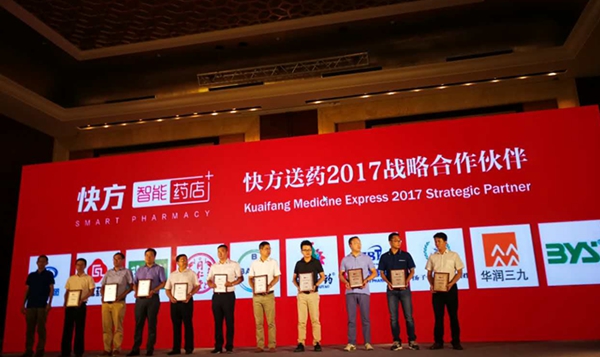
VCBeat (WeChat ID:vcbeat)6Month13VCBeat News. KuaiFang Technology held a strategic press conference today, unveiling its new round of development plans.
According to the plan, KuaiFang will partner with 500 pharmacies across 50 cities in China, providing them with intelligent pharmacy systems and delivery services. This initiative aims to help these pharmacies meet the growing online demand and capitalize on the emerging incremental market driven by the outflow of prescription drugs from hospitals.
Market Opportunities Have Arrived
“The market is changing, and relying solely on KuaiFang is insufficient. Therefore, we are sharing our pharmacy informatization solutions to enable other retail pharmacies to benefit from the dividends of digital transformation.”
At the press conference, Gao Yue, CEO of Kuai Fang, stated that the separation of medical services from pharmaceutical sales, the outflow of prescriptions, and new policies on pharmaceutical e-commerce were the primary drivers behind Kuai Fang’s strategic adjustment. As the market signals a surge in volume, Kuai Fang will share this dividend with its partners.
Specifically, under the backdrop of the new healthcare reform, the out-of-hospital pharmaceutical retail market has been gradually expanding. According to relevant estimates, prescription outflow was projected to bring an incremental market value of RMB 800 billion to retail pharmacies by 2020. Combined with the existing market size, the out-of-hospital pharmaceutical retail market would exceed RMB 1 trillion.
Meanwhile, with the development of mobile networks, pharmaceutical retail has partially shifted online. Retail pharmacies risk losing this segment of business due to a lack of digital capabilities. KuaiFang’s role is to provide digital transformation solutions, helping retail pharmacies better capture market growth.
However, Gao Yue also revealed that this planning is partly driven by its own strategic choices. He pointed out that although Kuaifang has achieved certain results through rapid growth, it is far from sufficient for a single company like Kuaifang to address the vast national market in China; therefore, Kuaifang needs to seek partners.
In fact, Gao Yue has mentioned on multiple occasions that the pharmaceutical O2O sector is a large market capable of sustaining multiple enterprises aspiring to succeed in this space. Openness and collaboration are also the central themes of Kuai Fang’s current strategy.
Kuaifang Medicine has been operating in Beijing for nearly three years, with 18 stores and an average of over 10,000 daily orders. Its high delivery timeliness and customer satisfaction demonstrate the effectiveness of its business model. The next step is to rapidly replicate this model across China, enabling other pharmacies to easily meet the growing online demand.
Three Models Empower Retail Pharmacies
How will this be executed? This is the most closely watched aspect of KuaiFang’s new strategy. KuaiFang will approach it from three angles. The first is self-built and self-operated stores, which currently constitute KuaiFang’s core business. The second is a model combining partner pharmacies with KuaiFang’s delivery services; KuaiFang will establish delivery teams in 50 cities across China to provide logistics support for its partner pharmacies. The third is a model combining partner pharmacies with their own delivery capabilities; KuaiFang will provide IT infrastructure upgrades to help these pharmacies better process online orders and improve operational efficiency.
Certainly, the foundation of all three models lies in the digital transformation of pharmacies. According to Gao Yue, this digital transformation will start from online demand and integrate multiple processes, including supply chain management, drug listing, order processing, and delivery tracking, enabling retail pharmacies to provide O2O pharmaceutical services to users with maximum efficiency.
Another key aspect is the establishment of a delivery workforce. KuaiFang will deploy core marketing personnel from Beijing to various regions across China to rapidly build up its delivery teams. In addition to meeting the needs of its self-operated pharmacies, KuaiFang will also provide delivery services to other retail pharmacies in need. Of course, KuaiFang welcomes capable retail pharmacies to establish their own delivery teams, and will likewise provide them with logistical support for pharmaceutical distribution.
Once the methodology is established, KuaiFang also prioritizes its selection of partners. Rather than deploying outlets without restriction in each city, KuaiFang selects only one pharmacy within every 25-square-kilometer area. After designating a pharmacy as a partner, KuaiFang consolidates all orders—including those placed through KuaiFang, orders from platform partners, remote e-prescription orders, and prescriptions purchased outside hospitals—to establish itself as the dominant player within the region.
“The specific selection will be determined through a comprehensive assessment of each pharmacy’s willingness to handle online orders, its geographic location, and its existing business foundation.”
Kuaifang’s ultimate goal is to achieve a comprehensive transformation of the entire S2B2C process, namely, constructing a new business model that spans from the supply chain to pharmacies, and then from pharmacies to consumers.
“The Disruptor” KuaiFang
In fact, in addition to KuaiFang, numerous other companies have explored the pharmaceutical O2O model. These include Alibaba Health, which established the earliest “O2O Pioneer Alliance”; JD Health Daojia, with its crowdsourced delivery service; and various other O2O enterprises active in the market.
This strategy encompasses both KuaiFang’s established self-operated delivery model and the service provision model that KuaiFang will prioritize moving forward. The differentiator of KuaiFang’s new strategy lies in its more targeted selection of partners, which, combined with KuaiFang’s existing experience, enables faster and more precise market deployment.
Gao Yue used the term “Davis double play” to describe the potential impact of the new model. He stated that when pharmacies possess both the incentive and the capability, these factors translate into strong competitive advantages, triggering a Davis double play effect.
The original meaning of this phrase is that when investors recognize the investment value of a stock, they will increase their purchases. In this context, it means that pharmaceutical retail is itself a high-growth market. Within such a rapidly expanding market, KuaiFang’s positive influence creates a synergistic effect with market expectations, thereby accelerating the market’s progression toward its “inflection point.”
The primary impact of this turning point is that a cohort of poorly managed standalone or chain pharmacies lacking innovation awareness may face elimination. As these entities exit the market, the reduction in offline stores will lead to customer diversion toward pharmacies that have undergone informatization transformation, thereby benefiting the latter.
From this perspective, it is indeed appropriate to label Kuai Fang as a “disruptor.”