

When Genetic Testing Meets E-commerce: An Analysis of Four Internet-Based DTC Genetic Testing Sales Models
Consumer-grade genetic testing typically uses buccal swabs or saliva as samples. Unlike blood samples, which require collection by healthcare professionals, buccal swab and saliva samples can be easily collected by individuals themselves. This provides the foundational conditions for consumer-grade genetic testing to directly serve end consumers.
Abroad, 23andMe, Helix, and Ancestry are leading the trend; in China, DTC (Direct-to-Consumer) genetic testing companies such as WeGene, 23Mofang, and Starship Gene have also emerged.
In addition to establishing sales channels through their official websites, some companies have recently expanded their business presence via third-party e-commerce platforms such as JD.com and Tmall. According to data from the VCBeat knowledge base, there are currently 24 consumer genetics companies in China that utilize e-commerce channels (including official website channels). VCBeat has compiled an overview of these companies’ sales channels, product offerings, and pricing structures.
Data shows that testing items sold through e-commerce channels can be divided into five major categories: nutritional health, maternal and child health, ancestry, oncology, and disease risk.
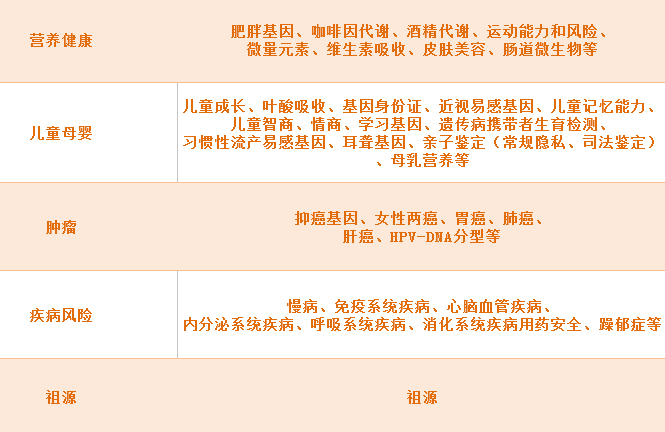
Most companies have established a presence in the fields of nutritional health, disease risk assessment, maternal and child health, and oncology. In contrast, ancestry testing is less prevalent, with only WeGene and 23Mofang offering this service among the 25 companies.
Next, let’s examine the four types of sales channels established by companies in the internet era.
If you want to learn about a new term or a company, what is your usual approach? Chances are, many people would choose to “Baidu it.”
Perhaps driven by such user habits, or perhaps drawing on lessons learned from overseas DTC companies, many enterprises have established sales channels on their own website platforms.
Generally, individuals who search for information on web pages are those with a certain demand for genetic testing products, some level of understanding, or sustained curiosity. This group represents ideal users for companies.
In the internet environment, consumers can not only access extensive information related to genetic testing but also form a preliminary assessment of corporate products. After visiting a company’s official website, consumers can gain a deeper understanding of its offerings; meanwhile, online customer service and payment channels help create an online shopping environment.

Among the 24 companies, 16 have established sales channels through their own platforms. In addition to product sales, official websites serve not only as a showcase for corporate image but also as an authoritative purchasing channel in the minds of consumers.
Currently, sales from the company’s proprietary platform dominate total sales volume, and its sales data reflect the enterprise’s influence in the consumer market.
However, Boao Yihe, Daan Gene, and Subo Medical have not established sales channels on their own platforms. Compared to online channels, these companies have placed greater emphasis on offline operations, building a nationwide sales network through regional distributors.
The number of enterprises that have entered the Tmall platform is very small. Coincidentally, these few companies on Tmall are precisely those mentioned earlier that have not established sales channels on their own platforms.

Data from the Tmall platform indicates that Daan Gene and Boao Yihe hold a dominant position. Sales figures for various products offered by these two companies reveal that alcohol metabolism testing, obesity gene testing, and children’s talent assessment are the most popular. Notably, Daan Gene recorded sales of 77 units for its Children’s Multiple Intelligence Test in just ten days (June 1–10). Of course, these figures are negligible compared to the sales volumes generated through their offline channels.
The prices of genetic testing products for alcohol metabolism, obesity genes, and children’s innate talents are relatively low. In particular, the alcohol metabolism test offered by Boao Yihe is priced at only RMB 199. Moreover, its functional features align with the needs of most consumers. Consequently, this category has become a bestseller among direct-to-consumer genetic testing products.
In addition, Luoyi, Kangai Gene, and Xinhua Health have entered the Tmall channel through collaborations with health checkup institutions. This model allows their products to be listed on the platform, but the companies themselves have not established official storefronts.
Therefore, strictly speaking, only three enterprises are currently listed on the Tmall platform: BioCapital Yihua, Da An Gene, and Subo Medical.
In addition to larger-scale enterprises such as Boao Yihe, Daan Gene, and Subo Medical, JD.com alsoAcceptedStartups such as 23Mofang, WeGene, and Xingjian Gene. Compared with the Tmall platform, the JD.com platform appears to be slightly more open toward consumer genetic testing products.

With more companies joining the platform, JD.com offers a richer product selection than Tmall. Among these, ancestry testing products from WeGene and 23Mofang are bestsellers on JD.com.
Taking WeGene as an example, since its entry onto the JD.com platform in April 2017, cumulative product sales have exceeded 1,000 units. Of course, sales on JD.com represent only a small fraction of the company’s total sales.

The WeChat platform is a product of new media. On this platform, enterprises can not only establish a new channel to showcase their corporate image but also build their own media endpoint to interact with consumers and conduct science popularization education.
However, in the sales process, the platform’s role appears rather marginal.
Typically, after consumers click on the online store, the platform automatically redirects them to the company’s official website, Weidian, or Youzan store. The advantage of the WeChat platform lies in its ability to provide consumers with a unique consumer ID and a seamless payment environment, enabling purchases without the need for prior registration.
Companies are not required to undergo the platform’s approval process, as is necessary for onboarding onto JD.com or Tmall. However, the WeChat platform cannot provide after-sales support or platform endorsement to users in the same manner as JD.com or Tmall.
Pros and Cons of Third-Party Platforms
Third-party platforms impose specific review requirements when vetting enterprises for onboarding. This means that products listed on these platforms have already undergone a preliminary screening, allowing the platform to provide a form of endorsement. Furthermore, user reviews on these third-party platforms offer consumers an objective reference point, which is highly valued by consumers.
Additionally, after-sales services, installment payment options, and discount promotions (e.g., price reductions for meeting spending thresholds) offered by third-party platforms can also attract more consumers.
However, enterprises currently prefer their own proprietary platforms. The greatest advantage of proprietary platforms is flexibility, as enterprises have development rights to their own websites and can make adjustments according to their needs.
Meanwhile, proprietary platforms are more stable than third-party platforms. After all, third-party channels rely entirely on third-party platforms, which may entail significant uncertainties in the future.
Furthermore, for some small businesses, it is more difficult to pass the audit of third-party platforms, and the operability of their own platforms will be stronger.
How to Break Through on Third-Party Platforms
VCBeat interviewed multiple companies that sell products on third-party platforms, and the response was consistent: these companies are currently only testing the waters on third-party platforms, while their own proprietary platforms remain dominant across all sales channels. Of course, non-DTC enterprises such as Da An Gene and Boao Yihe continue to focus primarily on offline operations.
Compared with proprietary channels, sales on third-party platforms remain relatively weak. This may be attributed to the inherent attributes of the products themselves, as many were not designed to align with the characteristics of internet-based business models.
Chen Gang, CTO of WeGene, told VCBeat, “In the internet era, when consumers learn about a new product or offering, their first instinct is not to purchase it, but to look up information through online channels. Only after they have developed a certain level of understanding of the product will they feel an impulse to buy.”
For consumer-grade genetic testing products to break through on third-party platforms, the most critical factor remains the product itself. Chen Gang believes that companies should put themselves in the consumers’ shoes when designing their products and consider what needs consumers have.
In terms of operational channels, it is also essential to think from the consumer’s perspective about the various factors they consider when shopping on third-party platforms—each of these touchpoints should feature our own information. Of course, more importantly, transparency of information and objective, fact-based promotion may be the most effective way to engage consumers.