

XtalPi: China's Pioneer in AI and Quantum Physics-Driven Drug Discovery, Files IPO Prospectus
Amid the current AI boom, “AI + drug discovery” is gradually emerging as a new blue ocean for entrepreneurship. Many R&D teams are starting from niche segments of new drug development, injecting fresh momentum into drug innovation—a process that is costly, time-consuming, and fraught with high failure rates. According to VCBeat’s database, there are 15 overseas startups focused on AI-driven new drug discovery, all of which have secured funding totaling $276 million. Among them, UK-based BenevolentAI raised $100 million, with one of its drug candidates scheduled to enter Phase IIb clinical trials in mid-2017.
However, while China can boldly claim to be “catching up with the UK and surpassing the US” in other AI sectors, it remains a blank slate in the vertical field of drug development.VCBeat (WeChat ID: vcbeat) has currently identified XtalPi as the only company in China leveraging AI for the discovery and development of small-molecule drugs. (If you are an entrepreneur in this field, please feel free to contact VCBeat.)。
As a pioneer in this research field that remains largely unexplored in China, XtalPi has developed technologies primarily applied to early-stage drug screening and drug design within the drug discovery process, as well as drug repurposing and drug repositioning.
By leveraging applications such as computer-aided early-stage compound design and optimization, solid-state drug screening and design, drug solubility assessment, and toxicity prediction and screening, this approach enhances the accuracy and efficiency of drug development while reducing R&D risks for pharmaceutical companies.
What is the current state of artificial intelligence in drug development? What challenges are hindering Chinese entrepreneurs from entering the field of new drug discovery? And how has XtalPi overcome these obstacles to achieve the R&D and industrial application of “intelligent pharmaceutical” technologies? VCBeat addressed these questions in an interview and report on XtalPi.
The Entrepreneurial Journey of an MIT Postdoc
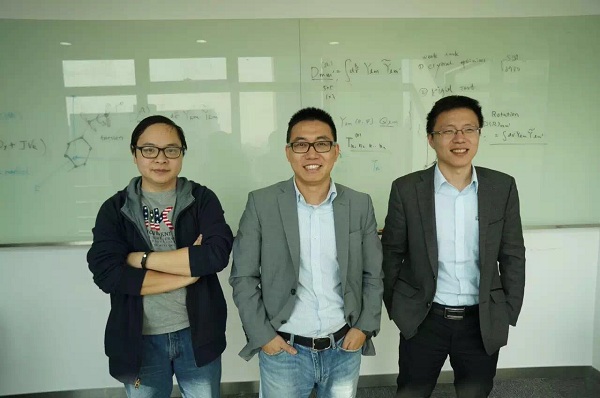
From left to right: Lai Lipeng, Wen Shuhao, Ma Jian
XtalPi was founded in 2014 on the campus of the Massachusetts Institute of Technology, with quantum physicists and senior pharmaceutical industry experts at its core.Postdocs Ma Jian, Wen Shuhao, and Li Lipeng, who have been deeply engaged in academia for many years, quickly hit it off., with the aspiration of leveraging its self-developed advanced technologies to drive an innovation that would catalyze industry transformation, it founded XtalPi.
The technologies mastered by these founders can be applied to many fields related to compound and new material design. After repeated deliberation and market research, they ultimately focused on the pharmaceutical industry, which offers both high economic returns and significant social value. From defining their goals to launching the startup, their mentor, Dr. Jiang Yide, was involved throughout the entire process, even resigning from his position as Asia R&D Strategy Director at Genzyme-Sanofi to join the venture full-time.
Dr. Jiang Yide currently serves as the Chief Strategy Officer at XtalPi. He brings over a decade of experience in regulatory affairs and R&D, having worked with both the China Food and Drug Administration (CFDA) and innovative pharmaceutical companies abroad. Discussing his decision to join XtalPi, Dr. Jiang stated, “The potential for applying computational science in pharmaceutical R&D is immense, and many of the necessary conditions are already in place. XtalPi’s technology can fundamentally address the inefficiencies, inaccuracies, and trial-and-error nature inherent in traditional R&D approaches, while its integration with industry is straightforward. Therefore, I have been highly optimistic about this team from the outset.”
Preliminary Results Achieved
Drug development costs escalate in later stages, yet critical properties determining a drug’s success or failure—such as toxicity and solubility—can only be experimentally evaluated at relatively late phases. Consequently, traditional approaches often reveal that a drug candidate is unsuitable for commercialization only after substantial investments of time, labor, and financial resources have been committed to advancing its development, resulting in significant waste of resources and missed opportunities.
By leveraging quantum computing and artificial intelligence, XtalPi is overcoming the limitations of scientists’ personal experience and efficiency. By predicting critical information in advance—such as solid-state properties, ADMET profiles, and target binding—it replaces the former “broad screening” strategy with a small number of more targeted experiments, thereby identifying the most promising candidate compounds with accurate and comprehensive data.
Drug Solid-State Design and Screening Platform Based on Quantum Chemistry Algorithms: XtalPi enables precise, comprehensive, and rapid computation for complex small-molecule drugs. Meanwhile, its R&D team is extending applications to other key stages across the upstream and downstream of drug development, allowing computational technology to deliver greater value in a broader range of drug discovery scenarios.
Lai Lipeng, Co-founder of XtalPi and Head of the Beijing Big Data and AI R&D Center, told VCBeat: “Our current algorithms achieve high accuracy, generating millions to tens of millions of crystal structure data points for each drug polymorph screening. By applying deep learning via AI to these high-quality datasets, we can predict the lattice energies of different crystal structures at the initial stage of massive computations, thereby significantly reducing computational resource consumption and further enhancing algorithmic efficiency. Meanwhile, this approach substantially advances our ability to more accurately predict the physical and chemical properties of drug molecules.”
In addition, XtalPi places significant emphasis on maintaining close exchanges with academic leaders both domestically and internationally, and has established R&D collaborations with the National Industrial Crystallization Engineering Laboratory at Tianjin University, the only state-level experimental center of its kind in China.
Professor Gong Junbo, Deputy Director of the Research Center, stated, “Computational prediction has significantly improved work efficiency and reduced experimental workload, enabling us to rapidly identify the target crystal forms. In recent years, the national implementation of the ‘Generic Drug Consistency Evaluation’ has imposed higher requirements on drug polymorph research. We believe that XtalPi’s technology will facilitate advances in domestic drug polymorph screening and become a standardized, scalable R&D model.”
Challenges in Talent, Data, and Business Models
Faced with such a promising market, Dr. Lai Lipeng also candidly admitted to VCBeat that China lacks the necessary “right timing, right place, and right people” for AI-driven drug development—namely, facing challenges in industry trends, data accumulation, and talent availability.
Establish an Interdisciplinary Talent Team
Human capital refers to the reserve of interdisciplinary talent. The application of AI in the pharmaceutical field requires close collaboration among AI scientists, engineers, pharmacists, and chemists. “As China’s scientific research capabilities continue to improve, the gap in talent reserves compared with foreign countries will gradually narrow, and the challenges in this area will diminish,” said Lai Lipeng.
From its inception, the XtalPi team has placed significant emphasis on the accumulation and cultivation of interdisciplinary talent. Its R&D workforce comprises physicists, chemists, pharmacologists, and pharmaceutical R&D executives, alongside top-tier experts in artificial intelligence and cloud computing. The advisory team includes renowned professors from prestigious institutions such as MIT and CMU, as well as pharmaceutical industry experts with extensive experience in R&D and business operations.
Acquiring High-Quality Data
Location Advantage: AI-driven drug discovery requires high-quality data support. As China’s innovative drug R&D started later than that of other countries, there is still a gap in the accumulation of premium data. XtalPi’s data sources areCombination of Public and Private Data, which includes the accumulation of XtalPi’s partners in industry and academia both domestically and internationally. Meanwhile, XtalPi can independently generate large volumes of high-quality data through quantitative computational algorithms, representing another significant advantage of the company.
Currently, XtalPi utilizes a wide variety of data types,For instance, the recently launched solubility prediction tool leverages drug molecule solubility data under various environmental conditions, such as different solvents and temperatures. Its predictive accuracy is 1–2 times higher than that of similar industry solutions.。
Domestic R&D + International Business Expansion Growth Model
Timing: This refers to entrepreneurial trends and business models. There are few benchmark cases of successful biotech ventures in China. Moreover, compared to sectors such as healthcare and finance, the drug development industry is inherently characterized by significant complexity and unpredictability. This explains why, despite the widespread enthusiasm for artificial intelligence, AI-driven drug discovery remains a path less traveled.
In recent years, frequent reports of domestically developed drugs or acquisitions of Chinese pharmaceutical companies have emerged, signaling a promising future for drug research in China.
The reason why XtalPi dares to be the “first to eat crabs”On one hand, leveraging existing technological advantages, the company assembled top-tier talent in the field at an early stage, thereby minimizing the impact of geography on R&D. On the other hand, the team clearly defined its initial target customer base from the outset, establishing a model of domestic R&D coupled with international business expansion. This approach effectively controlled R&D costs while seeking collaborators on a global scale.。
Currently, XtalPi’s core algorithms have been applied to drug development at top-tier international pharmaceutical companies, and its AI-driven R&D platform is gradually being made accessible to researchers both in China and abroad.
Open R&D Platform
Lai Lipeng believes that,The Large-Scale Application of Artificial Intelligence in Drug Discovery and Development Relies on the Joint Efforts of the Computational and Experimental Science Communities。Thus, commercially, XtalPi leads with an open and feedback-driven approach.XtalPi aims to leverage its technological expertise to empower traditional R&D professionals without a computational background to utilize state-of-the-art computational hardware and software tools, thereby enabling them to accomplish their research tasks more effectively and efficiently.
To this end, XtalPi has developed the AtomPai platform, which provides general-purpose, customizable computational services specifically for basic researchers in fields such as pharmacy, chemistry, materials science, physics, and biology. Addressing specific scientific challenges—such as ADMET (absorption, distribution, metabolism, excretion, and toxicity) property prediction and phase transition studies in many-body systems—the platform offers tools for data analysis and simulation, while facilitating data and model sharing and collaboration among users.
The platform is characterized by its customization capabilities and ease of use. By simply logging into the relevant web portal, users can perform various basic data analyses and numerical simulations in real time with just a few clicks, as well as customize models online. XtalPi also has a dedicated algorithm team to address specific user needs and provide tailored solutions.
The purpose of the open platform is to better integrate XtalPi’s advantages in computational hardware and software development with traditional R&D, thereby continuously optimizing its technology; meanwhile, it aims to enhance the awareness and adoption of new technologies within the community and related fields.
Regarding the company’s technological development direction, Wen Shuhao, founder of XtalPi, stated:
“XtalPi has been committed to integrating more physical principles into existing algorithmic models to enhance their accuracy, and has accumulated extensive experience in cloud-based high-performance computing architectures and performance optimization. The introduction of AI will further upgrade the efficiency advantages of these models while ensuring precision.”
XtalPi has secured tens of millions of yuan in Series A financing, led by Tencent, with participation from ZhenFund and FreeS Fund.. The team has grown rapidly, returning to China in mid-2015 to establish its presence in Shenzhen, and by the end of that same year, it opened a Big Data and Artificial Intelligence R&D Center in Beijing. Currently spanning three cities—Shenzhen, Beijing, and Boston—the team continues to recruit interdisciplinary talent with expertise in machine learning and related fields.